AI in Sports: From Cameras to Coaching
Quality reviewed September 2026
Facts verified September 20, 2026
- Subject
- Career & Life Skills
- Grades
- Grades 9-12
- Length
- 10-page student worksheet
- Time
- About one 50-minute class period
- Great for
- Sub plans and independent work
- Includes
- Reading passage, comprehension questions + full answer key
- Format
- Print-and-go PDF
What students do
- Five terms, from spatiotemporal data to paralysis by analysis, get matched to their definitions
- Three blanks name the year Second Spectrum went leaguewide, the data type behind injury prediction, and the film tool Hudl
- Answer three multiple choice questions on spatiotemporal data, the equity concern around AI sports tech, and the Moneyball comparison
- Explain what Devonte's hamstring flag reveals about what AI can detect that he could not feel himself
What it covers
- Eight passages on player tracking, injury prediction, tactical analysis, and AI directed broadcasting
- A key info table on Second Spectrum, Hawk-Eye, Hudl, and the two biggest concerns raised about sports AI
- Devonte's pre scout hamstring risk flag, plus a PDF answer key
Start reading this worksheet
The Data Revolution in the Locker Room
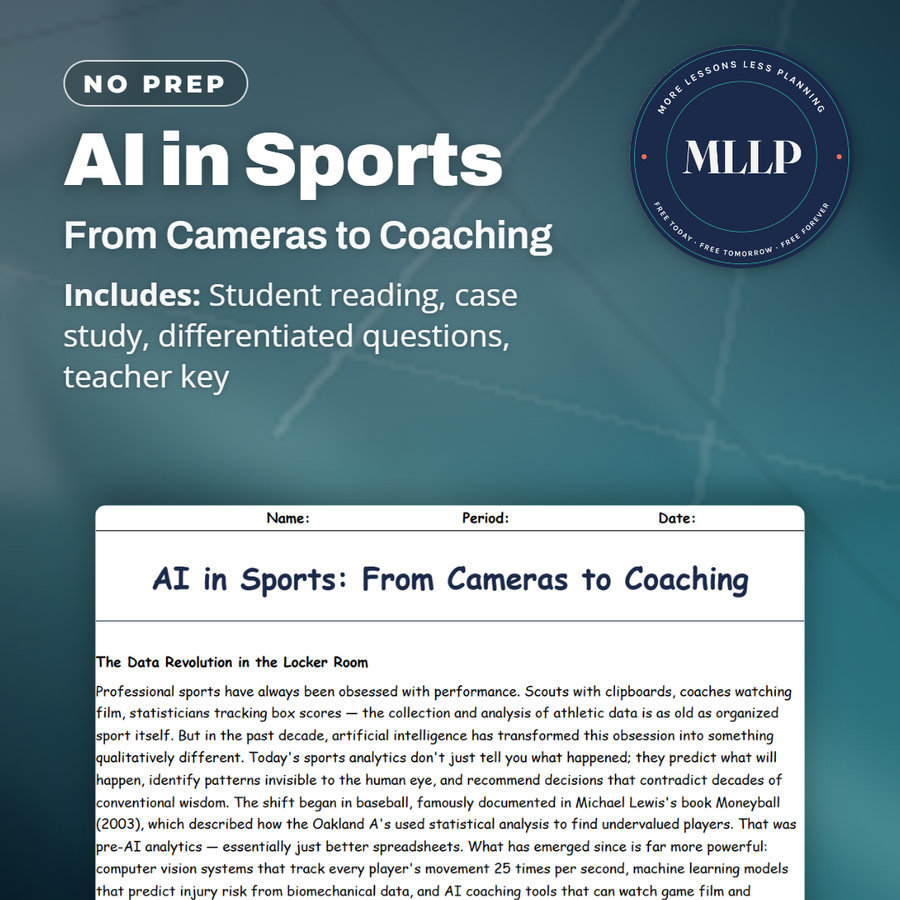
Professional sports have always been obsessed with performance. The collection and analysis of athletic data is as old as organized sport itself: scouts with clipboards, coaches watching film, statisticians tracking box scores. But in the past decade, artificial intelligence has transformed this obsession into something qualitatively different. Today's sports analytics don't just tell you what happened; they predict what will happen, identify patterns invisible to the human eye, and recommend decisions that contradict decades of conventional wisdom. The shift began in baseball, famously documented in Michael Lewis's book Moneyball (2003), which described how the Oakland A's used statistical analysis to find undervalued players. That was pre-AI analytics: essentially just better spreadsheets. What has emerged since is far more powerful: computer vision systems that track every player's movement 25 times per second, machine learning models that predict injury risk from biomechanical data, and AI coaching tools that can watch game film and generate tactical reports in minutes.
Computer Vision on the Court and Field
In the NBA, every arena has a camera system called Second Spectrum (adopted leaguewide in 2017) that uses computer vision to track the position of every player and the ball 25 times per second throughout every game. This generates what analysts call spatiotemporal data, a complete record of where everyone was, how fast they were moving, and what they were doing at every moment of the game. Second Spectrum's AI then processes this data to produce metrics that didn't exist a decade ago: defensive gravity (how much space a player creates by drawing defenders), shot quality scores, and pass network efficiency. Similar systems exist in soccer (StatsBomb, Opta), the NFL (Next Gen Stats), and tennis (Hawk-Eye, which tracks ball trajectory and bounce location with millimeter precision). In cricket and baseball, ball-tracking AI can now measure spin rate, seam position, and release point in enough detail to identify a pitcher's mechanical flaws before they result in injury. These systems have moved from being optional add-ons for rich franchises to league-wide infrastructure standards in major professional sports.
Injury Prediction and Prevention
One of the most consequential applications of sports AI is injury prediction. Traditional sports medicine relied on subjective assessments (how an athlete feels, what a trainer observes during warmup, historical injury data). AI changes this by processing continuous streams of objective data: GPS trackers in training vests measure total distance, acceleration load, and deceleration patterns. Force plates in training facilities measure landing mechanics. Wearable sensors track heart rate variability, sleep quality, and recovery metrics. Machine learning models trained on years of player data can now identify patterns that precede soft-tissue injuries, specifically the kinds of muscle and tendon injuries that sideline players for weeks or months. A model might detect that a player's deceleration mechanics have subtly shifted over the past three training sessions in a way that historically correlates with hamstring strain. The team's medical staff then has the option to rest that player proactively. Several NBA and NFL teams have reported significant reductions in soft-tissue injuries since implementing these systems, though the causality is difficult to prove definitively.
Like what you read? The full reading, the case study, and every question set are in the free download below, along with the answer key.
Why this matters
Students who play sports, or who watch them closely, are already living inside systems that quietly track and predict their bodies, whether that is a school's wearable fitness tracker or a college recruiter's AI generated scouting report. Devonte's dilemma, trusting an algorithm's warning over how he actually feels with scouts watching, is a version of a conflict between data and instinct that shows up in far more places than professional sports, from medical diagnoses to standardized testing.
From one teacher to another
Second Spectrum cameras track every player in an NBA arena 25 times a second, building a record of speed, position, and movement that did not exist a decade ago. This reading follows that data from the court into the training room, where wearable sensors and machine learning models now flag injury risk before a player feels any pain, and into the front office, where AI assisted scouting has scaled up what the Oakland A's started doing with spreadsheets in Moneyball. Devonte's case study puts a face on the tension: an AI flags his deceleration mechanics three days before NBA scouts are set to watch him play, and he has to decide how much to trust a warning his own body is not giving him.
What you get
Download
Where should I send the next one?
Everything here is free and it stays that way. Leave your email and I'll send you the new lessons as they go up. You can unsubscribe from any one of them.
Related resources
AI Customer Service Chatbots: When to Push for a Human
AI in Banking: Fraud Detection and Auto-Approvals
AI in Self-Driving Cars: Tesla, Waymo, and the Rest
AI in Video Games: NPCs and Procedural Worlds
Smart Home AI: Thermostats, Doorbells, Security
Spotify's Discover Weekly: How AI Picks Your Music
Every lesson on this site is free to download and use. If one of them saved you a prep period, you can chip in a few bucks toward my three kids' daycare fund. That's genuinely where tips go.