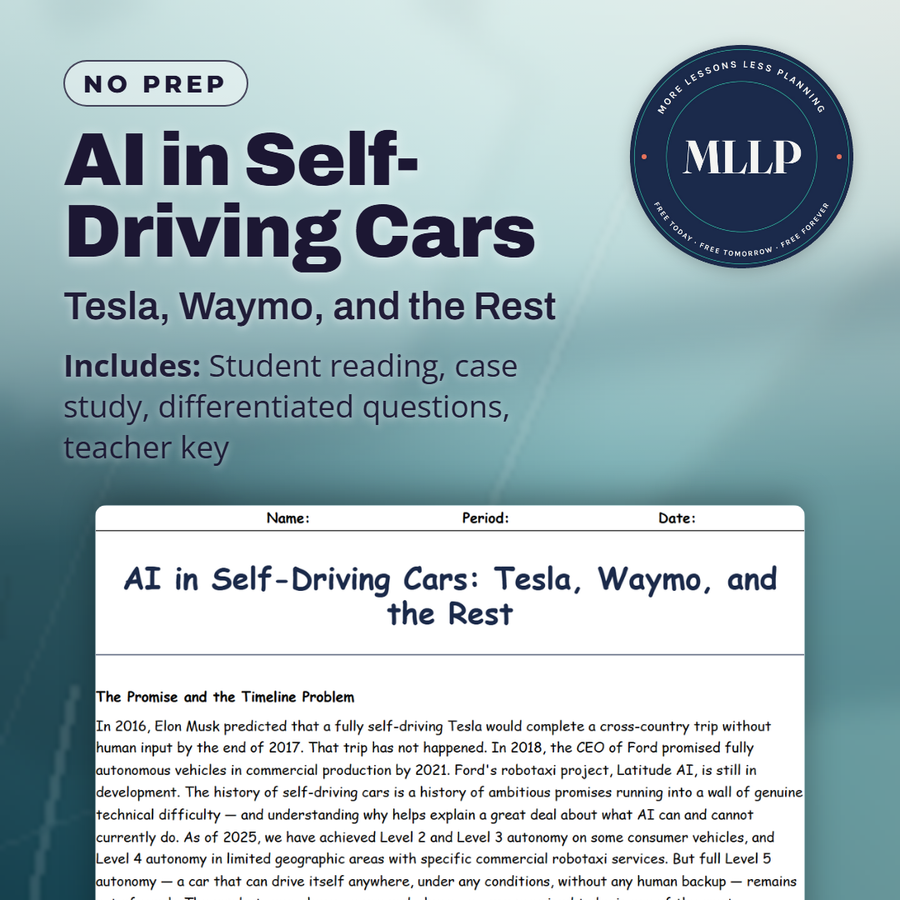
AI in Self-Driving Cars: Tesla, Waymo, and the Rest
Quality reviewed September 2026
Facts verified September 20, 2026
- Subject
- Career & Life Skills
- Grades
- Grades 9-12
- Length
- 10-page student worksheet
- Time
- About one 50-minute class period
- Great for
- Sub plans and independent work
- Includes
- Reading passage, comprehension questions + full answer key
- Format
- Print-and-go PDF
What students do
- Match five terms, from LiDAR to edge case, to their definitions
- Three blanks pull Tesla's autonomy level, Waymo's defined zones, and the crash investigating agency straight from the text
- Three multiple choice questions cover the SAE levels, LiDAR, and what self driving history teaches about AI predictions
- Explain why the mattress in Sofia's case study was such a hard problem for the car's AI to solve
What it covers
- Eight passages on autonomy levels, sensor systems, edge cases, and real world safety data
- A key info table on SAE Level 2 through Level 5 and the Tesla versus Waymo approach
- Sofia's highway mattress incident as a safety monitor, plus a PDF answer key
Start reading this worksheet
The Promise and the Timeline Problem
In 2016, Elon Musk predicted that a fully self-driving Tesla would complete a cross-country trip without human input by the end of 2017. That trip has not happened. In 2018, the CEO of Ford promised fully autonomous vehicles in commercial production by 2021. Ford's robotaxi project, Latitude AI, is still in development. The history of self-driving cars is a history of ambitious promises running into a wall of genuine technical difficulty. Understanding why helps explain a great deal about what AI can and cannot currently do. As of 2025, we have achieved Level 2 and Level 3 autonomy on some consumer vehicles, and Level 4 autonomy in limited geographic areas with specific commercial robotaxi services. But full Level 5 autonomy (a car that can drive itself anywhere, under any conditions, without any human backup) remains out of reach. The gap between where we are and where we were promised to be is one of the most instructive case studies in the real limitations of modern artificial intelligence.
The Five Levels of Autonomous Driving
The Society of Automotive Engineers (SAE) developed a six-level framework for describing driving automation. Level 0 is no automation: a human controls everything. Level 1 includes basic driver assistance features like adaptive cruise control or automatic emergency braking. Level 2 is partial automation: the car can control both steering and speed simultaneously, but a human must stay alert and ready to take over. Tesla's Autopilot and Full Self-Driving systems operate at Level 2. Level 3 is conditional automation: the car handles all driving in specific conditions, and the human can disengage, but must be ready to take control within seconds when the system requests it. Level 4 is high automation: the car drives itself completely within a defined geographic area, with no human needed at all. Waymo's robotaxis in San Francisco and Phoenix operate at Level 4 within their defined service zones. Level 5 is full automation: the car can drive anywhere, in any condition, with no human involvement ever. No commercial vehicle has achieved Level 5.
How AI Makes Driving Decisions
Self-driving systems process the world through a combination of sensors: cameras, radar, and LiDAR (Light Detection and Ranging, which uses laser pulses to build a precise 3D map of the car's surroundings). The AI system takes in this sensor data, classifies everything it sees (is that a pedestrian? a cyclist? a plastic bag blowing in the wind?), predicts how everything will move in the next few seconds, and then decides on a steering, braking, and acceleration response, all in milliseconds. The decision-making AI is trained on enormous datasets of real driving scenarios. Tesla's approach is camera-based and relies on learning from billions of miles driven by Tesla vehicles worldwide. Waymo's approach uses LiDAR as a primary sensor and relies on extremely detailed 3D maps of the specific areas where its cars operate. These are philosophically different bets: Tesla bets that cameras plus machine learning can generalize to any road; Waymo bets that detailed maps plus richer sensor data produces safer, more reliable performance in a controlled zone.
Like what you read? The full reading, the case study, and every question set are in the free download below, along with the answer key.
Why this matters
Several of these students will own a car with some level of automation within the next decade, and understanding the real difference between Level 2 driver assistance and true self driving could matter for their safety, not their curiosity alone. The reading also gives them language for a pattern that shows up across every AI field they will encounter: confident predictions running years ahead of what the technology can actually deliver, and the gap between the two is where the real risk lives.
From one teacher to another
In 2016, Elon Musk predicted a Tesla would drive itself across the country by the end of the following year. That trip still has not happened, and the reading uses that gap between promise and reality to explain what self driving AI can and cannot do almost a decade later. Students learn the six SAE autonomy levels, why Tesla bets on cameras and Waymo bets on LiDAR and detailed maps, and why a stray mattress on the highway can stump a system trained on billions of miles of ordinary driving. Sofia's case study, a safety monitor watching her car flag an unknown object it cannot confidently steer around, makes the edge case problem concrete.
What you get
Download
Where should I send the next one?
Everything here is free and it stays that way. Leave your email and I'll send you the new lessons as they go up. You can unsubscribe from any one of them.
Related resources
AI Customer Service Chatbots: When to Push for a Human
AI in Banking: Fraud Detection and Auto-Approvals
AI in Sports: From Cameras to Coaching
AI in Video Games: NPCs and Procedural Worlds
Smart Home AI: Thermostats, Doorbells, Security
Spotify's Discover Weekly: How AI Picks Your Music
Every lesson on this site is free to download and use. If one of them saved you a prep period, you can chip in a few bucks toward my three kids' daycare fund. That's genuinely where tips go.