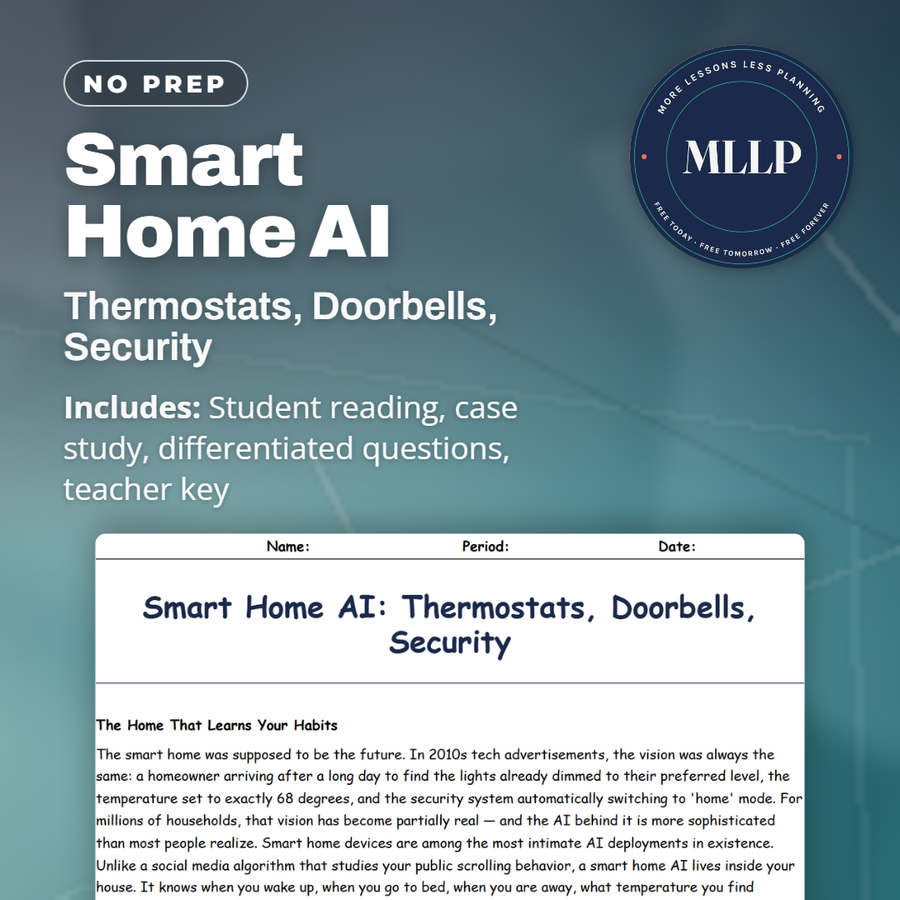
Smart Home AI: Thermostats, Doorbells, Security
Quality reviewed September 2026
Facts verified September 20, 2026
- Subject
- Career & Life Skills
- Grades
- Grades 9-12
- Length
- 9-page student worksheet
- Time
- About one 50-minute class period
- Great for
- Sub plans and independent work
- Includes
- Reading passage, comprehension questions + full answer key
- Format
- Print-and-go PDF
What students do
- Five terms, from wake word to default settings, get matched to their definitions
- Fill in three blanks naming the Amazon lawsuit settlement, the Ring detection technology, and the year Google acquired Nest
- Three multiple choice questions cover how Nest builds its schedule, the Ring Neighbors controversy, and what a wake word actually does
- Trace what privacy gap the Okonkwo family discovered in their Alexa app settings and why the defaults caused it
What it covers
- Eight passages on Nest, Ring, voice assistants, energy management, and device interoperability
- A key info table on Nest's acquisition, Ring's controversies, and the 2023 Amazon lawsuit settlement
- The Okonkwo family discovering years of their daughter's saved Alexa recordings, plus a PDF answer key
Start reading this worksheet
The Home That Learns Your Habits
The smart home was supposed to be the future. In 2010s tech advertisements, the vision was always the same: a homeowner arriving after a long day to find the lights already dimmed to their preferred level, the temperature set to exactly 68 degrees, and the security system automatically switching to 'home' mode. For millions of households, that vision has become partially real, and the AI behind it is more sophisticated than most people realize. Smart home devices are among the most intimate AI deployments in existence. Unlike a social media algorithm that studies your public scrolling behavior, a smart home AI lives inside your house. It knows when you wake up, when you go to bed, when you are away, what temperature you find comfortable, who comes and goes, what you say out loud, and, with newer systems, what you look like. Understanding what these devices actually do with that information is not optional for anyone who uses them.
The Nest Thermostat: A Classic Case Study
The Nest Learning Thermostat, launched in 2011 and later acquired by Google in 2014, was the device that popularized the idea of the smart home. Its pitch was simple: stop manually adjusting your thermostat. Instead, let the device observe your patterns for about a week, learn your schedule, and automatically create a temperature program that matches your actual life rather than a generic preset. To do this, Nest uses a combination of behavioral learning and sensor data. It tracks every manual temperature adjustment you make and notes the time of day. It uses a built-in motion sensor to detect whether anyone is home, and it learns what temperatures correlate with your presence. After enough data collection, it builds a predictive model: at 6:45am on weekdays, someone wakes up; heat to 70. At 8:00am, everyone leaves; drop to 60. At 5:30pm, expect someone home; begin heating. The model gets refined continuously as your schedule changes.
Ring Doorbells and the Video AI Layer
Ring, acquired by Amazon in 2018, operates at a different level of AI complexity. Ring cameras don't just record video: they use computer vision to analyze what they see in real time. Motion detection AI distinguishes between a moving branch, a car passing in the street, and a person approaching your door. Person detection specifically flags human movement and can send different alerts depending on whether it detects a person, a package, or a vehicle. Amazon has pushed Ring further into facial recognition territory. Ring's Neighbors app, a community sharing platform built into the Ring ecosystem, allows users to share footage of people the system flags as suspicious. This has generated significant controversy. Civil rights organizations have documented cases where Ring's Neighbors app was used to share footage of Black residents doing normal activities (walking, jogging, checking mail) with neighbors who found their presence suspicious. The AI flags the presence; the human bias determines what happens with that flag. Ring also has a documented history of sharing footage with law enforcement. Between 2020 and 2022, Amazon admitted in a Senate hearing that it had provided Ring footage to police departments without user consent on multiple occasions. Amazon has since tightened its policies, but the incident revealed how smart home surveillance data can flow outside the home without the resident's knowledge.
Like what you read? The full reading, the case study, and every question set are in the free download below, along with the answer key.
Why this matters
Most of these students already live with a smart speaker, a doorbell camera, or a thermostat that tracks when they come and go, and almost none of them have read the privacy policy the Okonkwo family skipped for two years. The reading gives them a specific, checkable fact, a 25 million dollar settlement over children's recordings, to anchor a conversation about default settings that favor data collection, and concrete steps, muting a microphone, covering a camera, deleting stored history, that they can actually act on rather than just worry about.
From one teacher to another
Chidi, one of the Okonkwo parents, reads a news article about a lawsuit against Amazon and, for the first time in two years, opens his Alexa app's settings. He finds hundreds of saved recordings, many of them his 8-year-old daughter talking to the Echo about homework and jokes he never heard about. This reading uses that discovery to explain what smart home AI actually does with the data it collects, from a Nest thermostat learning a family's schedule to a Ring doorbell using computer vision to flag a stranger at the door, and where that convenience quietly becomes surveillance. It covers real controversies, including Ring's footage sharing with police and the documented racial bias in its Neighbors app.
What you get
Download
Where should I send the next one?
Everything here is free and it stays that way. Leave your email and I'll send you the new lessons as they go up. You can unsubscribe from any one of them.
Related resources
AI Customer Service Chatbots: When to Push for a Human
AI in Banking: Fraud Detection and Auto-Approvals
AI in Self-Driving Cars: Tesla, Waymo, and the Rest
AI in Sports: From Cameras to Coaching
AI in Video Games: NPCs and Procedural Worlds
Spotify's Discover Weekly: How AI Picks Your Music
Every lesson on this site is free to download and use. If one of them saved you a prep period, you can chip in a few bucks toward my three kids' daycare fund. That's genuinely where tips go.