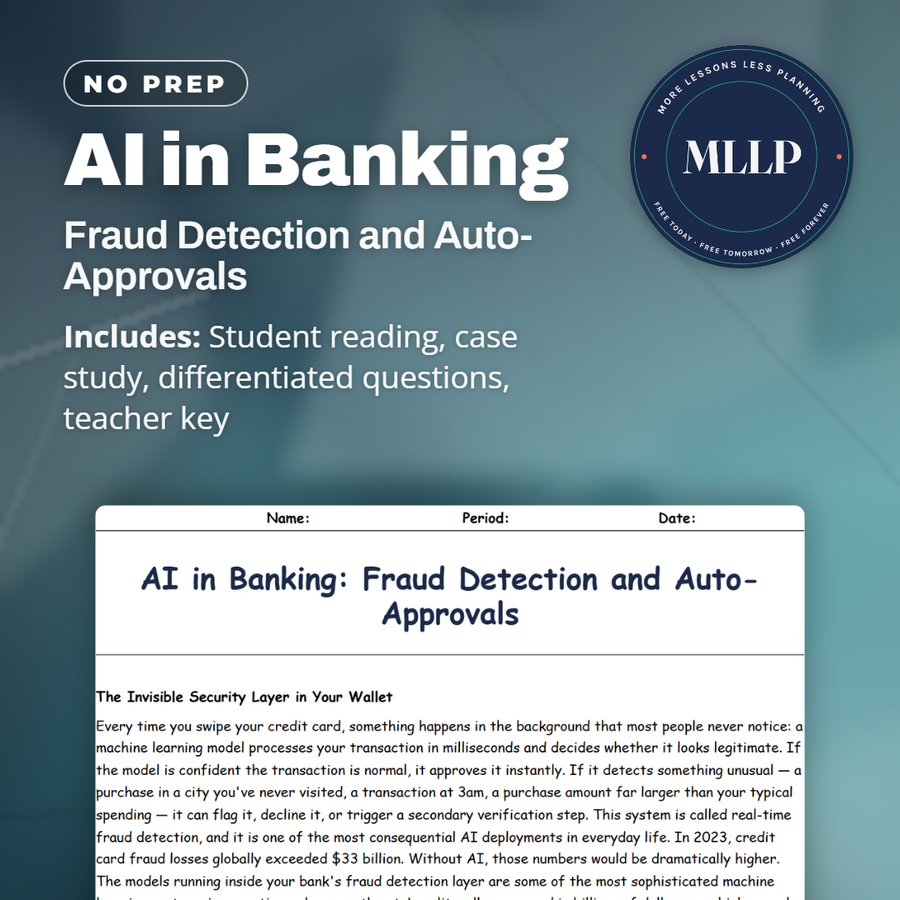
AI in Banking: Fraud Detection and Auto-Approvals
Quality reviewed September 2026
Facts verified September 20, 2026
- Subject
- Career & Life Skills
- Grades
- Grades 9-12
- Length
- 10-page student worksheet
- Time
- About one 50-minute class period
- Great for
- Sub plans and independent work
- Includes
- Reading passage, comprehension questions + full answer key
- Format
- Print-and-go PDF
What students do
- Five terms, from anomaly detection to proxy discrimination, get matched to their definitions
- Three blanks pull the 33 billion dollar fraud figure, the false positive error, and the ECOA's protected characteristics from the text
- Three multiple choice questions cover false positives, proxy discrimination, and what the Apple Card investigation revealed
- Trace exactly which signals in Kezia's Chicago purchase triggered the fraud flag on her card
What it covers
- Seven passages on fraud detection, false positives, AI credit scoring, and the Apple Card discrimination case
- A key info table on global fraud losses, FICO scoring, and proxy discrimination
- Kezia's declined credit card in Chicago, plus a PDF answer key
Start reading this worksheet
The Invisible Security Layer in Your Wallet
Every time you swipe your credit card, something happens in the background that most people never notice: a machine learning model processes your transaction in milliseconds and decides whether it looks legitimate. If the model is confident the transaction is normal, it approves it instantly. If it detects something unusual (a purchase in a city you've never visited, a transaction at 3am, a purchase amount far larger than your typical spending), it can flag it, decline it, or trigger a secondary verification step. This system is called real-time fraud detection, and it is one of the most consequential AI deployments in everyday life. In 2023, credit card fraud losses globally exceeded $33 billion. Without AI, those numbers would be dramatically higher. The models running inside your bank's fraud detection layer are some of the most sophisticated machine learning systems in operation, because the stakes, literally measured in billions of dollars, are high enough to justify enormous investment.
How Fraud Detection AI Works
Fraud detection AI is built on anomaly detection: the model learns what 'normal' looks like for you specifically, and then flags anything that deviates significantly from that pattern. Your normal includes things like: the geographic range where you typically spend money, the time of day you usually make purchases, the types of merchants you frequent, your typical transaction amounts, and the pace at which you normally make purchases (one or two transactions per day vs. a sudden burst of 15 transactions in 30 minutes). The model is trained on enormous datasets of historical transactions, both legitimate and fraudulent. It learns the patterns that distinguish fraud from legitimate spending at a population level, then calibrates those patterns to your individual profile. The more transaction history the model has on you, the better it gets at distinguishing your unusual-but-legitimate spending (you bought an expensive gift for a birthday) from genuinely suspicious activity (someone stole your card number and is buying gift cards in bulk).
The Cost of False Positives
A fraud detection model can make two types of mistakes. A false negative is when the model approves a fraudulent transaction it should have flagged. This costs the bank and cardholders money. A false positive is when the model declines a legitimate transaction it incorrectly flagged as suspicious. This doesn't cost money directly. But it has real costs in customer frustration, missed purchases, and eroded trust. Banks have to balance these two error types, and the balance matters. A model set extremely conservatively (flag anything unusual) will catch more fraud but will also block legitimate purchases constantly, making the card useless for travel or unusual spending. A model set too permissively will let fraud slip through. Most banks try to optimize for something like: 'catch the vast majority of fraud while keeping the false positive rate low enough that normal customers rarely notice.' The false positive problem disproportionately affects certain customers. Research has found that transactions associated with certain types of merchants, certain geographic areas, and certain spending patterns more common among lower-income consumers tend to trigger higher false positive rates. In other words, the 'normal' that the model was trained on is based on the majority of the dataset, which may not reflect minority spending patterns accurately.
Like what you read? The full reading, the case study, and every question set are in the free download below, along with the answer key.
Why this matters
Every student with a debit card has already had a transaction blocked by an algorithm they never see, and most walk away annoyed without understanding why it happened or what it reveals about how AI treats unfamiliar patterns as risk. The reading's harder question, whether a credit model can discriminate without anyone writing race or gender into the code, connects directly to the kind of algorithmic fairness debates these students will vote on and work inside for the rest of their careers.
From one teacher to another
Kezia's credit card gets declined twice at a Chicago restaurant, not because anything is wrong with her account, but because she has never spent money outside Mississippi and Boston before. Her bank's fraud model saw a new city, a new merchant category, and an evening timestamp all at once and flagged it as suspicious. This reading walks through how that anomaly detection actually works, why false positives fall unevenly on certain customers, and how the same kind of AI scoring shows up in loan and credit decisions, including the 2019 investigation into Apple Card's lower credit limits for women. It is a clear window into AI systems most students interact with weekly and never see.
What you get
Download
Where should I send the next one?
Everything here is free and it stays that way. Leave your email and I'll send you the new lessons as they go up. You can unsubscribe from any one of them.
Related resources
AI Customer Service Chatbots: When to Push for a Human
AI in Self-Driving Cars: Tesla, Waymo, and the Rest
AI in Sports: From Cameras to Coaching
AI in Video Games: NPCs and Procedural Worlds
Smart Home AI: Thermostats, Doorbells, Security
Spotify's Discover Weekly: How AI Picks Your Music
Every lesson on this site is free to download and use. If one of them saved you a prep period, you can chip in a few bucks toward my three kids' daycare fund. That's genuinely where tips go.