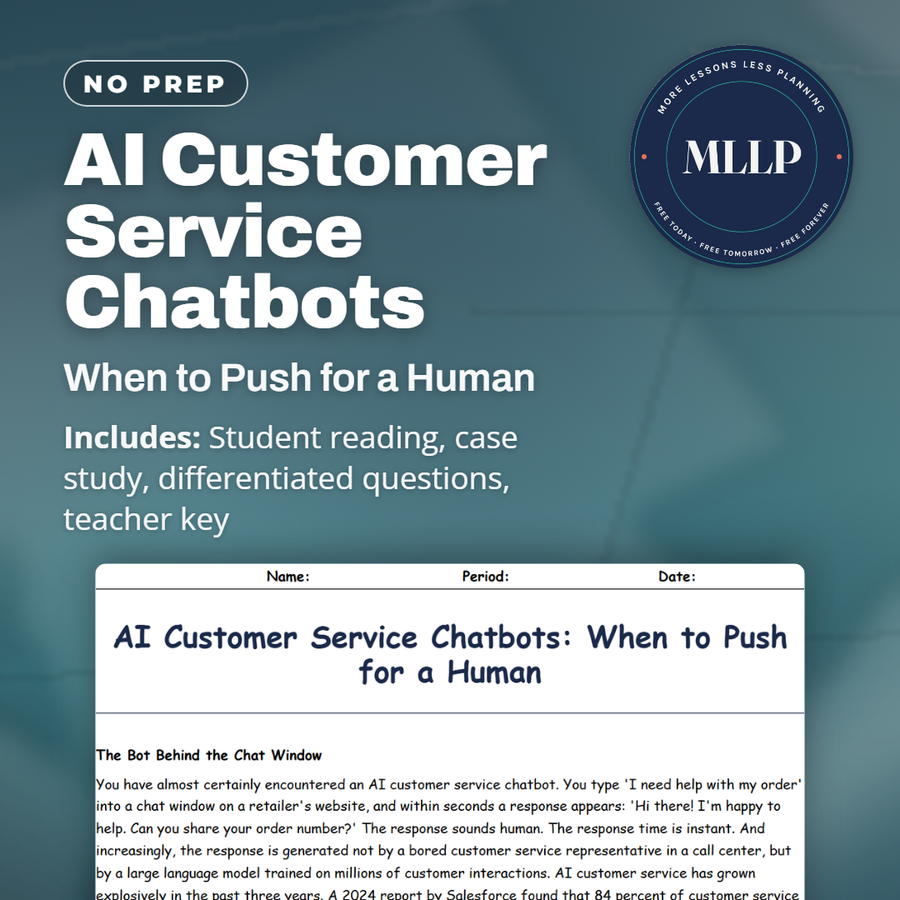
AI Customer Service Chatbots: When to Push for a Human
Quality reviewed September 2026
Facts verified September 20, 2026
- Subject
- Career & Life Skills
- Grades
- Grades 9-12
- Length
- 9-page student worksheet
- Time
- About one 50-minute class period
- Great for
- Sub plans and independent work
- Includes
- Reading passage, comprehension questions + full answer key
- Format
- Print-and-go PDF
What students do
- Five terms, from doom loop to false confidence, get matched to their definitions
- Fill in three blanks on the 84 percent adoption figure, the hallucination term, and the word that triggers escalation
- Three multiple choice questions cover doom loops, chatbot consistency, and why confident answers cannot be trusted blindly
- Sort out the exact moments where the chatbot failed Priya's billing dispute and what a human agent would have done instead
What it covers
- Seven passages on chatbot economics, hallucination risk, doom loops, and how the systems are built
- A key info table on market adoption, cost drivers, and regulatory responses in California and New York
- Priya's twelve minute billing dispute with a hospital chatbot, plus a PDF answer key
Start reading this worksheet
The Bot Behind the Chat Window
You have almost certainly encountered an AI customer service chatbot. You type 'I need help with my order' into a chat window on a retailer's website, and within seconds a response appears: 'Hi there! I'm happy to help. Can you share your order number?' The response sounds human. The response time is instant. And increasingly, the response is generated not by a bored customer service representative in a call center, but by a large language model trained on millions of customer interactions. AI customer service has grown explosively in the past three years. A 2024 report by Salesforce found that 84 percent of customer service and support professionals at large companies were already using or piloting AI tools. Costs are the primary driver: a human customer service agent in the United States costs between $35,000 and $55,000 per year in salary and benefits. An AI system handling the same volume of interactions costs a fraction of that, works 24 hours a day, never gets frustrated, and never quits. From a pure cost perspective, the pressure to replace human agents with AI is enormous.
What AI Chatbots Do Well
Modern AI chatbots, especially those powered by large language models, are remarkably capable at certain types of customer service tasks. They handle high-volume, low-complexity inquiries efficiently and accurately: tracking an order status, resetting a password, answering frequently asked questions about a product's return policy, confirming an appointment, or explaining standard billing terms. For these tasks, an AI system can often provide a faster and more accurate answer than a human agent looking up the same information in a knowledge base. AI chatbots are also consistent. A human agent having a bad day might give a customer shorter, less helpful answers. A human agent who misremembers a policy might give a customer incorrect information. The AI delivers the same quality response to the 10,000th customer at 3am as it does to the first customer on Monday morning. For businesses that struggle with inconsistent service quality across a large frontline workforce, that consistency is genuinely valuable.
Where AI Chatbots Fail
The failure modes of AI customer service are significant and predictable. The first is called 'hallucination' — the same phenomenon that affects large language models in all contexts. When a customer asks a specific, unusual question that the AI doesn't have good training data for, it may generate a plausible-sounding but incorrect answer rather than admitting uncertainty. A customer asks: 'If I return this item three months after purchase but I have the receipt, will you still honor the return?' The AI, uncertain, might confidently state the wrong policy — because confident wrong answers are statistically more common in its training data than honest 'I don't know' responses. The second major failure mode is an inability to handle genuine complexity or emotional distress. A customer calling to dispute a fraudulent charge, or a patient trying to understand a complicated insurance denial, or a grieving family member dealing with a deceased relative's account — these are scenarios that require human judgment, empathy, flexibility, and the authority to make exceptions. AI chatbots in these scenarios frequently loop the customer through scripted responses, fail to escalate appropriately, and leave the person feeling unheard and more frustrated than when they started.
Like what you read? The full reading, the case study, and every question set are in the free download below, along with the answer key.
Why this matters
Every student in this room will eventually argue with a chatbot over something that actually matters, a wrong charge, a canceled order, a denied claim, and the reading gives them two concrete tools for that fight: the specific words that trigger a human handoff, and the habit of verifying any consequential chatbot answer through a second channel before trusting it. Priya's twelve minutes stuck in Hemi's loop is the kind of story every reader has lived through in some form already.
From one teacher to another
A human customer service agent costs a company somewhere between $35,000 and $55,000 a year. An AI system handling the same calls costs a fraction of that and never clocks out, which explains why chatbots are everywhere now. This reading does not stop at the sales pitch. It walks through where chatbots genuinely help, tracking an order, resetting a password, and where they fail badly, especially when a customer needs judgment instead of a script. Priya's case study follows a real billing dispute that goes in circles for twelve minutes with a hospital chatbot named Hemi, never once reaching anyone who can actually fix the problem.
What you get
Download
Where should I send the next one?
Everything here is free and it stays that way. Leave your email and I'll send you the new lessons as they go up. You can unsubscribe from any one of them.
Related resources
AI in Banking: Fraud Detection and Auto-Approvals
AI in Self-Driving Cars: Tesla, Waymo, and the Rest
AI in Sports: From Cameras to Coaching
AI in Video Games: NPCs and Procedural Worlds
Smart Home AI: Thermostats, Doorbells, Security
Spotify's Discover Weekly: How AI Picks Your Music
Every lesson on this site is free to download and use. If one of them saved you a prep period, you can chip in a few bucks toward my three kids' daycare fund. That's genuinely where tips go.