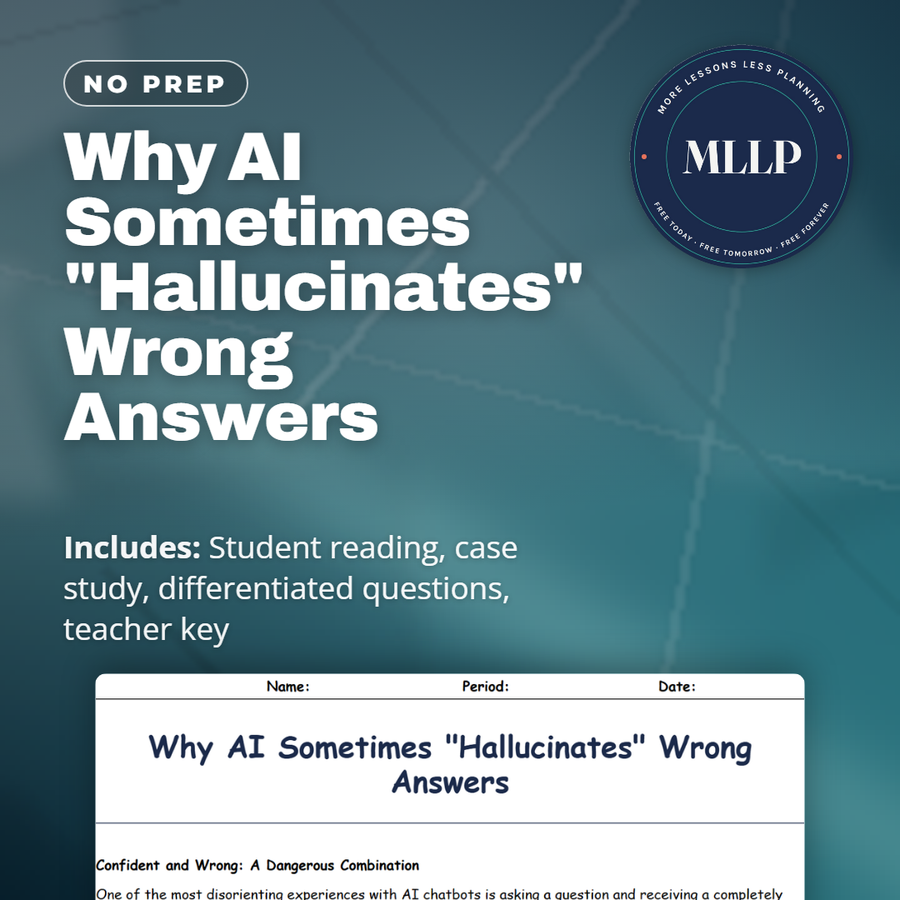
Why AI Sometimes "Hallucinates" Wrong Answers
Quality reviewed September 2026
Facts verified September 20, 2026
- Subject
- Career & Life Skills
- Grades
- Grades 9-12
- Length
- 9-page student worksheet
- Time
- About one 50-minute class period
- Great for
- Sub plans and independent work
- Includes
- Reading passage, comprehension questions + full answer key
- Format
- Print-and-go PDF
What students do
- RAG and citation hallucination round out a five-term matching set on how AI gets things wrong
- Jordan's grandmother and a fabricated clinical trial anchor two case study questions
- Obscure, court case, and verify complete three blanks pulled from the passage on hallucinations
- Explain why RAG and RLHF reduce hallucinations without ever eliminating them
What it covers
- Six passages on why AI hallucinates, the four types, and how companies try to reduce it
- A case study on Jordan's grandmother, a fabricated clinical trial, and a doctor's correction
- A key info table naming RAG, RLHF, and the 2023 lawyer sanctioned for fake citations
Start reading this worksheet
Confident and Wrong: A Dangerous Combination
One of the most disorienting experiences with AI chatbots is asking a question and receiving a completely confident, well-written answer that turns out to be entirely false. The AI does not say 'I am not sure about this.' It does not add a disclaimer. It simply gives you wrong information in the same tone and format it uses for correct information. This phenomenon is called hallucination, and it is one of the most important AI behaviors to understand. AI researchers use the word hallucination to describe when a language model generates information that is factually incorrect, invented, or unsupported by any actual evidence, while presenting it as if it were true. The term is borrowed from psychology, where hallucination means perceiving something that is not really there. When an AI hallucinates, it is generating text that feels real but is not grounded in reality.
Why LLMs Hallucinate: The Prediction Problem
To understand why LLMs hallucinate, you have to remember what they are actually doing. They are not retrieving facts from a database. They are predicting what word is most likely to come next in a sequence, based on patterns learned from training data. The model has no internal fact-checking mechanism. It has no way to distinguish between 'I learned this from a reliable source' and 'this pattern just seems likely based on statistical associations.' Imagine asking an LLM who wrote a particular academic paper. The model knows that academic papers have authors. It knows a lot of names associated with that research field. It knows the general format of a citation. It may have even seen a reference to a paper by that title. But if the model does not have the exact information in its training data, it will generate a plausible-sounding name and citation rather than say it does not know. The result looks completely real but is completely fabricated.
Types of Hallucinations
Hallucinations come in several flavors. Factual hallucinations are the most common: the model states an incorrect fact, such as a wrong date, a misattributed quote, or an event that never happened. Citation hallucinations are particularly problematic in academic contexts: the model generates references to books, papers, or articles that do not exist, complete with realistic-looking author names, titles, journal names, and page numbers. There are also entity hallucinations, where the model invents details about real people, places, or organizations that are not true. A lawyer in New York famously submitted a legal brief in 2023 that cited six court cases provided by ChatGPT, all of which turned out to be entirely fabricated. The judge was not amused, and the lawyer faced sanctions. This case became a widely cited example of the real-world consequences of trusting AI hallucinations. Instruction-following hallucinations occur when the model seems to follow your request but subtly fails. You ask it to summarize a document in three bullet points; it gives you four. You ask it to list only peer-reviewed sources; it includes non-peer-reviewed sources without telling you. The model was optimizing for producing a response that looks correct, not for actually being correct.
Like what you read? The full reading, the case study, and every question set are in the free download below, along with the answer key.
Why this matters
Hallucination sounds like a strange, technical term until a student sees Jordan's grandmother sitting in a doctor's office while a specialist corrects fabricated clinical trial names. This worksheet makes clear that the danger is not that AI is sometimes wrong, every source can be wrong, but that it delivers wrong information with the exact same calm confidence as correct information, with no built-in warning sign. Students who internalize this will treat an AI-generated statistic, court case, or medication name as a lead to verify rather than a fact to repeat, which matters the first time they use AI for a research paper, a job application, or their own health questions.
From one teacher to another
Confident and wrong is the pairing this worksheet is built around, since that is exactly how AI hallucinations show up. Students read that a hallucination happens because a model is predicting statistically likely text, not retrieving a checked fact, and that it has no way to flag when it is guessing. The reading walks through four types, factual, citation, entity, and instruction-following hallucinations, and names the 2023 case of a New York lawyer sanctioned for submitting six fabricated court cases from ChatGPT. Students also see how retrieval-augmented generation and RLHF reduce, but never eliminate, the problem. The case study follows Jordan, who brought AI-generated medical information to a grandmother's specialist appointment, only to learn two of the listed medications and one of the clinical trials were invented.
What you get
Download
Where should I send the next one?
Everything here is free and it stays that way. Leave your email and I'll send you the new lessons as they go up. You can unsubscribe from any one of them.
Related resources
How AI Generates Images: From Words to Pictures
How AI Generates Voice and Video
How AI Learns: Training Data Explained
The Black Box Problem: When AI Can't Explain Itself
The Cost of AI: Energy, Water, and Data Centers
The Internet as a Textbook: Where AI Gets Its Information
Every lesson on this site is free to download and use. If one of them saved you a prep period, you can chip in a few bucks toward my three kids' daycare fund. That's genuinely where tips go.