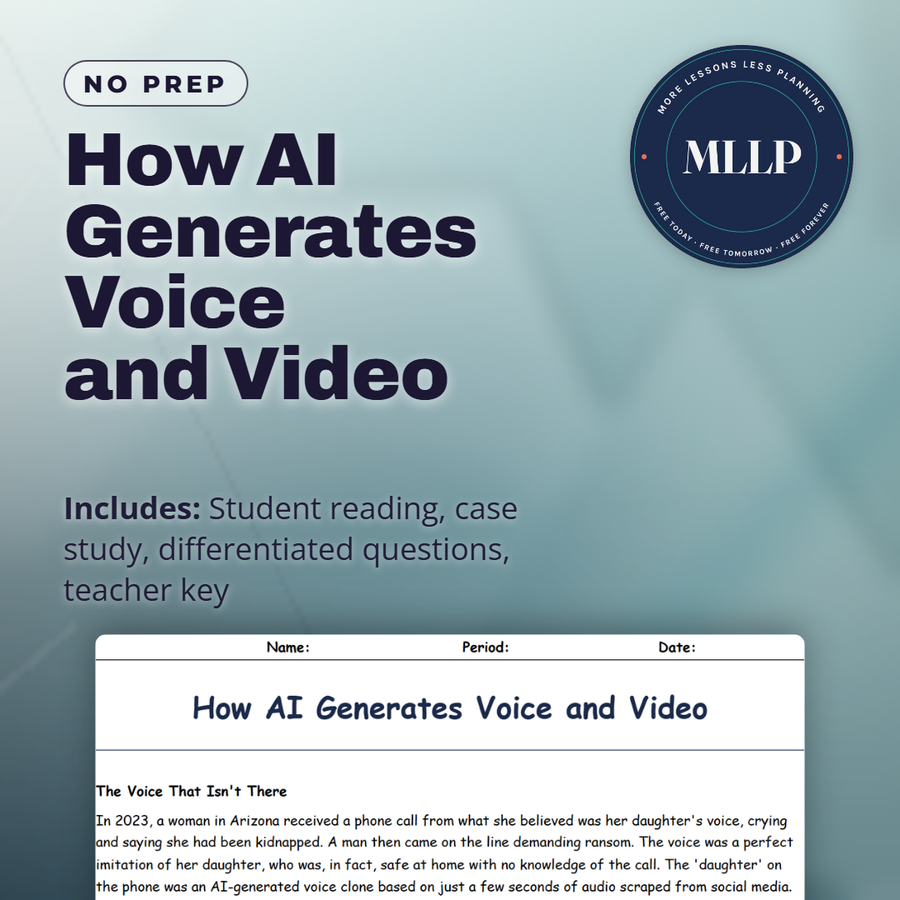
How AI Generates Voice and Video
Quality reviewed September 2026
Facts verified September 20, 2026
- Subject
- Career & Life Skills
- Grades
- Grades 9-12
- Length
- 9-page student worksheet
- Time
- About one 50-minute class period
- Great for
- Sub plans and independent work
- Includes
- Reading passage, comprehension questions + full answer key
- Format
- Print-and-go PDF
What students do
- Tyrese's call from a cloned CEO voice demanding a $47,000 wire transfer gets checked against the reading's verification habits
- Explain how a voice can be cloned from as little as one minute of audio scraped from social media
- Sort the stages of video fakery: face-swap deepfakes, audio-driven avatars, and full video synthesis tools like Sora
- The arms race between generation tools and detection tools gets tested through short answer questions
What it covers
- How voice cloning works, from a documented FBI-warned kidnapping hoax to a one-minute audio sample
- The difference between face-swap deepfakes, audio-driven avatars, and full video synthesis tools like Sora
- Why detection is currently losing the arms race, and what verification habits actually protect people
Start reading this worksheet
The Voice That Isn't There
In 2023, a woman in Arizona received a phone call from what she believed was her daughter's voice, crying and saying she had been kidnapped. A man then came on the line demanding ransom. The voice was a perfect imitation of her daughter, who was, in fact, safe at home with no knowledge of the call. The 'daughter' on the phone was an AI-generated voice clone based on just a few seconds of audio scraped from social media. This is not science fiction. It is a documented FBI-warned scam that is becoming increasingly common. AI voice and video generation has moved faster than almost any other area of AI development. The same technology that makes voice assistants sound natural, that lets actors record audiobooks more efficiently, and that helps people with speech disabilities communicate also enables an entirely new category of fraud and manipulation. Understanding how voice and video generation works is essential for navigating a world where you can no longer trust your ears or your eyes.
Voice Cloning: Teaching AI to Sound Like You
AI voice cloning works by training a model on a sample of someone's speech. Modern voice cloning systems require surprisingly little audio: ElevenLabs, one of the leading voice AI companies, can clone a voice from as little as one minute of audio. The model learns the distinctive characteristics of a voice, including pitch, rhythm, cadence, pronunciation patterns, and acoustic qualities, and encodes them as a style that can be applied to any text input. The underlying technology combines text-to-speech (TTS) synthesis with voice style transfer. A TTS model converts written text into spoken audio using a general voice model. The voice style component then applies the characteristics of the target voice to the generated speech. The result is audio that sounds like the target person saying whatever text you provide, even words and sentences they have never actually spoken. High-end voice cloning, like what is used in film and audiobook production, requires more audio and more processing. Entire films have been dubbed into different languages using actors' voice clones. Voice actors have had their voices cloned for use in productions without their knowledge or compensation, leading to major disputes in the entertainment industry.
Video Synthesis: Beyond Deepfakes
AI video generation has progressed through several stages. Early deepfake technology, which emerged around 2017-2018, could swap one person's face onto another in existing video. This required significant computing power and expertise but became increasingly accessible through free tools. By 2022-2023, face-swap deepfakes were being produced by ordinary users with consumer hardware. The next generation of video AI moved beyond face-swapping to full video synthesis: generating entirely new video from scratch based on text prompts. Tools like Sora (from OpenAI), Runway, and Kling can generate photorealistic video clips of scenes, people, and actions that never occurred. Sora, demonstrated in early 2024, could produce sixty-second videos with consistent characters, realistic physics, and cinematic quality from a text description. Full video synthesis makes face-swapping deepfakes look primitive. Instead of taking an existing video and modifying it, these systems create entirely fabricated videos from nothing. A video of a political figure saying something they never said, or of an event that never happened, can now be generated by anyone with access to the tool.
Like what you read? The full reading, the case study, and every question set are in the free download below, along with the answer key.
Why this matters
A convincing phone call from a familiar voice used to be reliable proof of who was on the other end of the line. This reading takes that assumption away, using Tyrese's near-miss with a cloned CEO and the real Arizona kidnapping hoax to show students that the technology behind convincing scams is the same technology behind dubbed films and accessibility tools for people who have lost their voice. I want students to leave with a specific habit, verify through a second channel before acting on an urgent request, rather than a vague sense that AI fakes exist somewhere out there. The stakes here are financial fraud, political manipulation, and family scams that are already happening, not a hypothetical future.
From one teacher to another
A financial analyst named Tyrese gets a call from what sounds exactly like his CEO's voice, demanding an urgent wire transfer, and his case study drives the reading's central warning. The passages walk through how the fraud is even possible: voice cloning that needs as little as one minute of audio, the jump from face-swap deepfakes to full video synthesis tools like Sora that generate a scene from nothing, and audio-driven avatars that animate a single photograph. Students also read about the 2023 Arizona kidnapping hoax that used a cloned daughter's voice, so the stakes stay concrete rather than theoretical. The reading ends on the arms race between generation and detection tools, and why a hung-up phone call and a second verification channel saved Tyrese's company $47,000 when the technology itself could not be trusted.
What you get
Download
Where should I send the next one?
Everything here is free and it stays that way. Leave your email and I'll send you the new lessons as they go up. You can unsubscribe from any one of them.
Related resources
How AI Generates Images: From Words to Pictures
How AI Learns: Training Data Explained
The Black Box Problem: When AI Can't Explain Itself
The Cost of AI: Energy, Water, and Data Centers
The Internet as a Textbook: Where AI Gets Its Information
Tokens, Parameters, and Why Bigger Isn't Always Better
Every lesson on this site is free to download and use. If one of them saved you a prep period, you can chip in a few bucks toward my three kids' daycare fund. That's genuinely where tips go.