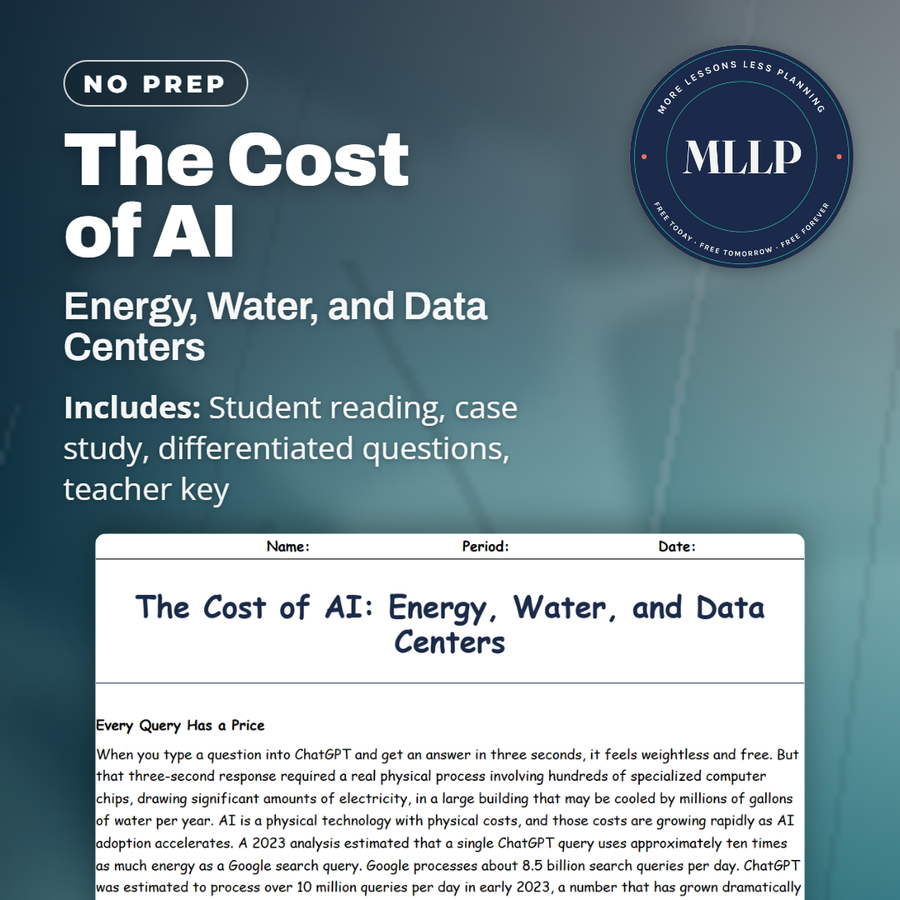
The Cost of AI: Energy, Water, and Data Centers
Quality reviewed September 2026
Facts verified September 20, 2026
- Subject
- Career & Life Skills
- Grades
- Grades 9-12
- Length
- 9-page student worksheet
- Time
- About one 50-minute class period
- Great for
- Sub plans and independent work
- Includes
- Reading passage, comprehension questions + full answer key
- Format
- Print-and-go PDF
What students do
- The desert town of Mesa View weighs 300 jobs against 3.5 million gallons of daily water use for a new data center
- Explain why training GPT-3 used roughly 700,000 liters of water and 1,287 megawatt-hours of electricity
- Fill in blanks on Microsoft's Three Mile Island deal and Goldman Sachs's 2030 electricity projection
- Data center water and energy use gets compared across Arizona, Northern Virginia, and other regions named in the reading
What it covers
- Why a three-second AI answer requires real electricity, water cooling, and a building the size of a small city
- The specific numbers: GPT-3's training energy and water use, and Goldman Sachs's 2030 electricity forecast
- Why Microsoft, Google, and Amazon have turned to nuclear power, including the Three Mile Island restart
Start reading this worksheet
Every Query Has a Price
When you type a question into ChatGPT and get an answer in three seconds, it feels weightless and free. But that three-second response required a real physical process involving hundreds of specialized computer chips, drawing significant amounts of electricity, in a large building that may be cooled by millions of gallons of water per year. AI is a physical technology with physical costs, and those costs are growing rapidly as AI adoption accelerates. A 2023 analysis estimated that a single ChatGPT query uses approximately ten times as much energy as a Google search query. Google processes about 8.5 billion search queries per day. ChatGPT was estimated to process over 10 million queries per day in early 2023, a number that has grown dramatically since. When you multiply these numbers across millions of users making thousands of queries each, the energy and infrastructure costs become enormous.
Data Centers: The Physical Reality of AI
AI computation happens in data centers, massive buildings filled with rows of servers and specialized chips called GPUs (graphics processing units) or TPUs (tensor processing units). A single modern data center can span 100,000 to 200,000 square feet, consume as much electricity as a small city, and cost hundreds of millions of dollars to build. The largest hyperscale data centers operated by companies like Microsoft, Google, and Amazon are even larger. AI has driven a major acceleration in data center construction. Microsoft alone announced plans to invest $80 billion in data center infrastructure in 2025. Google announced over $75 billion in capital expenditure for the same year, much of it directed toward AI infrastructure. Amazon Web Services, the world's largest cloud provider, announced similarly massive investments. This buildout is happening globally, with new data centers under construction across the United States, Europe, and Asia.
The Energy Demand Problem
The energy demand from AI training and inference is significant and growing. Training a large language model uses enormous amounts of electricity: researchers estimated that training GPT-3 used approximately 1,287 megawatt-hours of electricity, equivalent to the annual electricity consumption of roughly 120 average American homes. Training more recent, larger models likely requires several times more energy. Beyond training, every query processed by an AI chatbot requires energy for inference, which is the process of running a trained model to generate a response. At scale, inference energy demand adds up. Goldman Sachs estimated in 2024 that data centers would account for 8% of US electricity consumption by 2030, up from 3% in 2022, with AI being a major driver of that increase. Multiple power grid operators have warned that AI data center growth could strain electrical infrastructure in ways not seen since the industrial revolution.
Like what you read? The full reading, the case study, and every question set are in the free download below, along with the answer key.
Why this matters
Every AI answer a student gets in three seconds is quietly backed by a real building, real electricity, and real water, and this reading is built to make that physical cost visible instead of abstract. Mesa View's dilemma, jobs and tax revenue against a shrinking aquifer, is the kind of tradeoff towns across the water-stressed American Southwest are actually facing right now as data centers get built. I want students to be able to name specific numbers, the water GPT-3's training used, the share of the electricity grid data centers are projected to consume, rather than a vague sense that AI has some environmental cost somewhere. Understanding this is part of understanding what the technology actually is, and not only what it produces on a screen.
From one teacher to another
Mesa View is a desert town weighing 300 promised jobs against a data center that would use 3.5 million gallons of water a day, more than the whole town currently uses, and that case study is where this reading lands. Before students reach the town council's dilemma, the passages lay out the physical reality behind a three-second chatbot answer: the electricity and water GPT-3's training alone required, Goldman Sachs's projection that data centers could reach eight percent of US electricity use by 2030, and the deals Microsoft, Google, and Amazon have signed for nuclear power, including the restarted Three Mile Island plant. The reading also names the tension in corporate carbon pledges, since AI growth is pushing some companies' emissions up even as they promise net-zero. By the case study, students have real numbers to weigh against a rancher's plain question about his grandchildren's water.
What you get
Download
Where should I send the next one?
Everything here is free and it stays that way. Leave your email and I'll send you the new lessons as they go up. You can unsubscribe from any one of them.
Related resources
How AI Generates Images: From Words to Pictures
How AI Generates Voice and Video
How AI Learns: Training Data Explained
The Black Box Problem: When AI Can't Explain Itself
The Internet as a Textbook: Where AI Gets Its Information
Tokens, Parameters, and Why Bigger Isn't Always Better
Every lesson on this site is free to download and use. If one of them saved you a prep period, you can chip in a few bucks toward my three kids' daycare fund. That's genuinely where tips go.