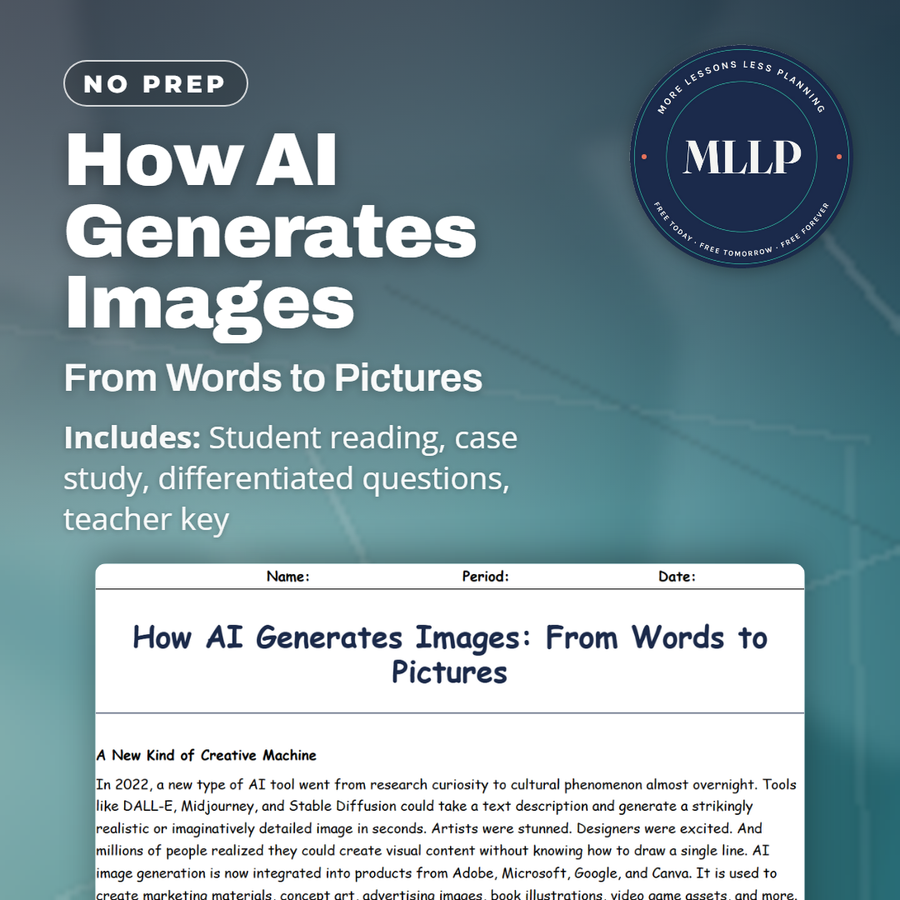
How AI Generates Images: From Words to Pictures
Quality reviewed September 2026
Facts verified September 20, 2026
- Subject
- Career & Life Skills
- Grades
- Grades 9-12
- Length
- 9-page student worksheet
- Time
- About one 50-minute class period
- Great for
- Sub plans and independent work
- Includes
- Reading passage, comprehension questions + full answer key
- Format
- Print-and-go PDF
What students do
- Trace how a diffusion model turns random noise into a finished image guided by a text prompt
- Reina's case study, an illustrator whose style gets copied by Midjourney prompts overnight, grounds the copyright questions
- Fill in blanks on LAION-5B's five billion training pairs and CLIP's role linking text to images
- The shift from GANs to diffusion models gets explained through the generator-and-discriminator contest that came before
What it covers
- How AI image generators like DALL-E, Midjourney, and Stable Diffusion learn from billions of image-text pairs
- What a diffusion model actually does: adding noise to real images, then learning to reverse the process
- The copyright fight over training data, plus the deepfake and non-consensual imagery risks the same technology enables
Start reading this worksheet
A New Kind of Creative Machine
In 2022, a new type of AI tool went from research curiosity to cultural phenomenon almost overnight. Tools like DALL-E, Midjourney, and Stable Diffusion could take a text description and generate a strikingly realistic or imaginatively detailed image in seconds. Artists were stunned. Designers were excited. And millions of people realized they could create visual content without knowing how to draw a single line. AI image generation is now integrated into products from Adobe, Microsoft, Google, and Canva. It is used to create marketing materials, concept art, advertising images, book illustrations, video game assets, and more. Understanding how these systems work is essential for anyone navigating a world where an image cannot be assumed to be real, and where visual creativity is being reshaped by machines.
The Training Process: Learning From Billions of Images
AI image generators are trained on enormous datasets of images paired with text descriptions. The largest datasets, like LAION-5B, contain 5 billion image-text pairs scraped from across the internet. The model learns associations between visual content and language by processing these pairs: an image of a golden retriever beside a lake paired with the caption 'golden retriever dog by lake at sunset' teaches the model to associate those visual elements with those words. During training, the model does not memorize the images. It learns the statistical relationships between visual features and textual concepts. After seeing millions of examples of what 'sunset' looks like in images, it builds a rich internal representation of that concept. After seeing millions of examples of 'dog,' 'fluffy,' 'outdoors,' and 'reflection,' it learns how those visual elements interact. When you later ask it to generate 'a fluffy dog sitting by a lake at sunset,' it draws on all of those learned associations to produce a new image.
Diffusion Models: Noise and Refinement
The dominant architecture behind modern image generators is called a diffusion model. Diffusion models learn to generate images through a two-phase process. During training, they learn to add noise to real images progressively until the image becomes pure random noise. Then they learn to reverse that process: starting from random noise, they learn to progressively remove noise until a coherent image emerges. When you give a text prompt to a diffusion model, it starts with a field of random noise. It uses the text prompt as a guide to steer the denoising process toward images that match your description. Step by step, the noise is removed and replaced with visual structure that reflects the prompt. After many denoising steps, a complete image appears. This is why AI image generation takes a few seconds: the model is running dozens or hundreds of processing steps to refine the noise into a coherent image.
Like what you read? The full reading, the case study, and every question set are in the free download below, along with the answer key.
Why this matters
Any student with a phone can now generate a passable illustration in someone else's exact style in under a minute, for free. This reading asks what that means for the people who spent years building that style, using Reina's situation, forty thousand followers and a signature look copied and resold, as a concrete example instead of an abstract debate. It also matters because these same students are the customers and future employees of the design, marketing, and publishing industries this technology is already reshaping. I want them to leave understanding both why the tool is genuinely useful and why an artist watching her work get scraped without consent or payment has a real grievance, and not merely a reading assignment.
From one teacher to another
Reina spent seven years developing an illustration style before someone generated near-perfect copies of it in seconds with a Midjourney prompt, and her case study is where this reading lands its argument. Before that, students work through how the technology actually functions: training on datasets like LAION-5B's five billion image-text pairs, then generating new images through a diffusion model that starts with random noise and removes it step by step, guided by a text encoder called CLIP. The reading also covers GANs, the generator-versus-discriminator systems that diffusion models mostly replaced. By the time students reach Reina's situation, they have the vocabulary to explain exactly how an AI system could learn her color palette and texture from her own public posts, and why that raises real legal questions.
What you get
Download
Where should I send the next one?
Everything here is free and it stays that way. Leave your email and I'll send you the new lessons as they go up. You can unsubscribe from any one of them.
Related resources
How AI Generates Voice and Video
How AI Learns: Training Data Explained
The Black Box Problem: When AI Can't Explain Itself
The Cost of AI: Energy, Water, and Data Centers
The Internet as a Textbook: Where AI Gets Its Information
Tokens, Parameters, and Why Bigger Isn't Always Better
Every lesson on this site is free to download and use. If one of them saved you a prep period, you can chip in a few bucks toward my three kids' daycare fund. That's genuinely where tips go.