How AI Learns: Training Data Explained
Quality reviewed September 2026
Facts verified September 20, 2026
- Subject
- Career & Life Skills
- Grades
- Grades 9-12
- Length
- 9-page student worksheet
- Time
- About one 50-minute class period
- Great for
- Sub plans and independent work
- Includes
- Reading passage, comprehension questions + full answer key
- Format
- Print-and-go PDF
What students do
- Trace the cycle of prediction, loss function, and backpropagation that trains a model
- Priya's case study, a facial recognition system that fails to recognize her every single day, tests the bias sections directly
- The garbage-in, garbage-out problem gets connected to real datasets like ImageNet and Common Crawl
- Answer short questions on supervised learning, unsupervised learning, and what RLHF adds on top
What it covers
- How training data like Common Crawl and ImageNet actually teaches a model to recognize patterns
- The training cycle itself: loss functions, backpropagation, and gradient descent, run billions of times
- Why biased training data produces biased outcomes, using a real school facial recognition failure
Start reading this worksheet
Learning Without a Teacher (Sort Of)
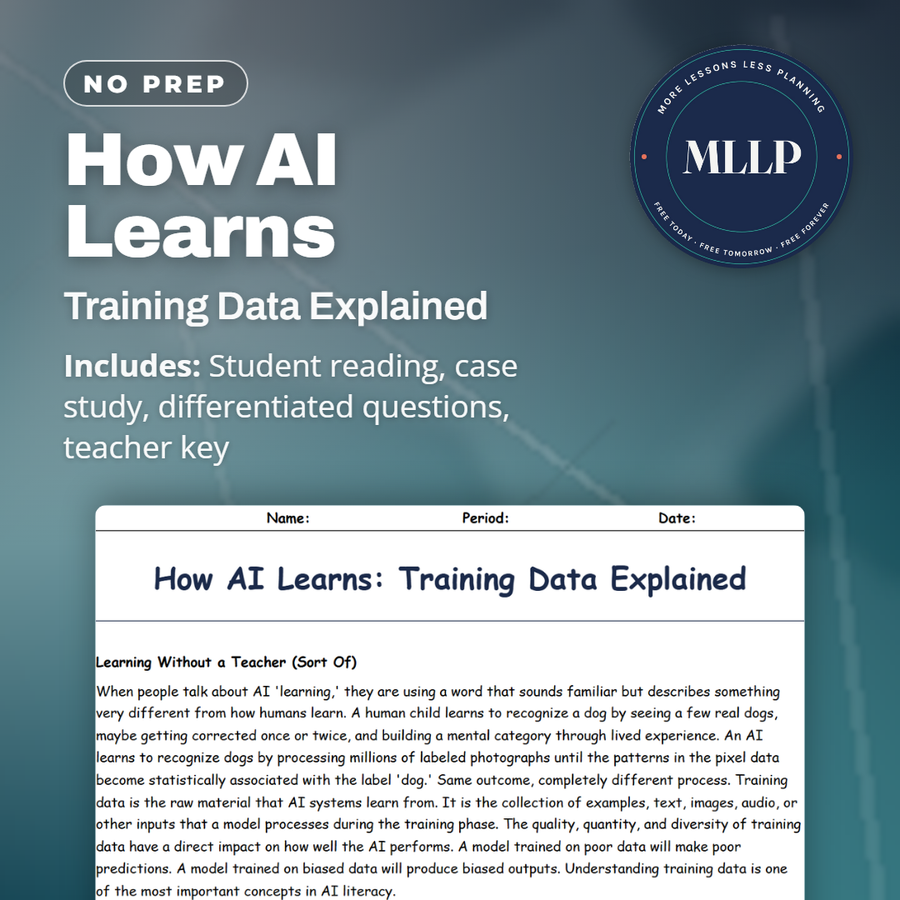
When people talk about AI 'learning,' they are using a word that sounds familiar but describes something very different from how humans learn. A human child learns to recognize a dog by seeing a few real dogs, maybe getting corrected once or twice, and building a mental category through lived experience. An AI learns to recognize dogs by processing millions of labeled photographs until the patterns in the pixel data become statistically associated with the label 'dog.' Same outcome, completely different process. Training data is the raw material that AI systems learn from. It is the collection of examples, text, images, audio, or other inputs that a model processes during the training phase. The quality, quantity, and diversity of training data have a direct impact on how well the AI performs. A model trained on poor data will make poor predictions. A model trained on biased data will produce biased outputs. Understanding training data is one of the most important concepts in AI literacy.
What Training Data Looks Like
For a text-based AI like ChatGPT, training data consists of enormous collections of written text. This includes books, articles, websites, social media posts, academic papers, code, legal documents, and virtually any other written material that could be gathered at scale. OpenAI has confirmed that GPT models were trained on datasets called Common Crawl (a snapshot of billions of web pages), along with books, Wikipedia, and other curated sources. For image-recognition AI, training data consists of millions of labeled images. Researchers at universities and tech companies spend years building datasets like ImageNet, which contains over 14 million images labeled with categories like 'goldfish,' 'rocking chair,' or 'volcano.' The model processes each image and adjusts its internal settings to better match the label. After millions of iterations, it can reliably identify objects it has never seen before, as long as those objects resemble what it saw in training. For voice AI, training data is recordings of real people speaking. For self-driving cars, it is video footage of real roads. For medical AI, it is patient records and scan data. Every type of AI needs training data that matches the task it is being built for.
The Training Process: Loss and Optimization
The actual process of training an AI model involves a cycle of prediction, measurement, and adjustment. The model makes a prediction on a piece of training data. The prediction is compared to the correct answer using a mathematical formula called a loss function, which measures how wrong the prediction was. Then, using a process called backpropagation, the system calculates how each of the model's internal settings contributed to the error and adjusts them slightly to reduce the error next time. This cycle runs billions of times. Each iteration is called a training step. Over billions of steps, the model's parameters, which are its internal numerical settings, gradually move toward values that produce better and better predictions. The goal is to minimize the loss function, which means getting the predictions as close to the correct answers as possible. This process is called optimization, and the specific algorithm most AI systems use is called gradient descent. For large models, this training process can take weeks or months running on thousands of specialized chips simultaneously. The final result is a trained model with billions of parameters set to values that encode the patterns the model learned from the training data.
Like what you read? The full reading, the case study, and every question set are in the free download below, along with the answer key.
Why this matters
Priya did nothing wrong; the system that embarrassed her in front of her class every day was built on a dataset that simply never included enough faces like hers. This reading matters because students are already living inside AI systems, school apps, phone face ID, recommendation feeds, built the same way: learning patterns from whatever data someone happened to collect. I want them to understand that garbage in, garbage out is not a slogan but a specific technical mechanism, one they can trace step by step from a training set to a real kid standing at a front office window. That understanding is what lets them ask the right question the next time a system fails someone and the excuse is that it was tested extensively.
From one teacher to another
Priya checks in at the front office every single day because her school's new attendance app cannot recognize her face, and her case study is where this reading proves its point. Before students reach Priya, they work through what training data actually is: the web pages, books, and labeled images like ImageNet's fourteen million photos that a model learns from, and the training cycle itself, prediction, loss function, backpropagation, repeated billions of times until the errors shrink. The reading also separates supervised learning from unsupervised learning and explains what RLHF adds on top. By the time students reach Priya's story, they can explain, in specific technical terms, why a facial recognition system trained mostly on lighter-skinned faces failed her and two classmates every day while working instantly for everyone else.
What you get
Download
Where should I send the next one?
Everything here is free and it stays that way. Leave your email and I'll send you the new lessons as they go up. You can unsubscribe from any one of them.
Related resources
How AI Generates Images: From Words to Pictures
How AI Generates Voice and Video
The Black Box Problem: When AI Can't Explain Itself

The Cost of AI: Energy, Water, and Data Centers

The Internet as a Textbook: Where AI Gets Its Information

Tokens, Parameters, and Why Bigger Isn't Always Better
Every lesson on this site is free to download and use. If one of them saved you a prep period, you can chip in a few bucks toward my three kids' daycare fund. That's genuinely where tips go.