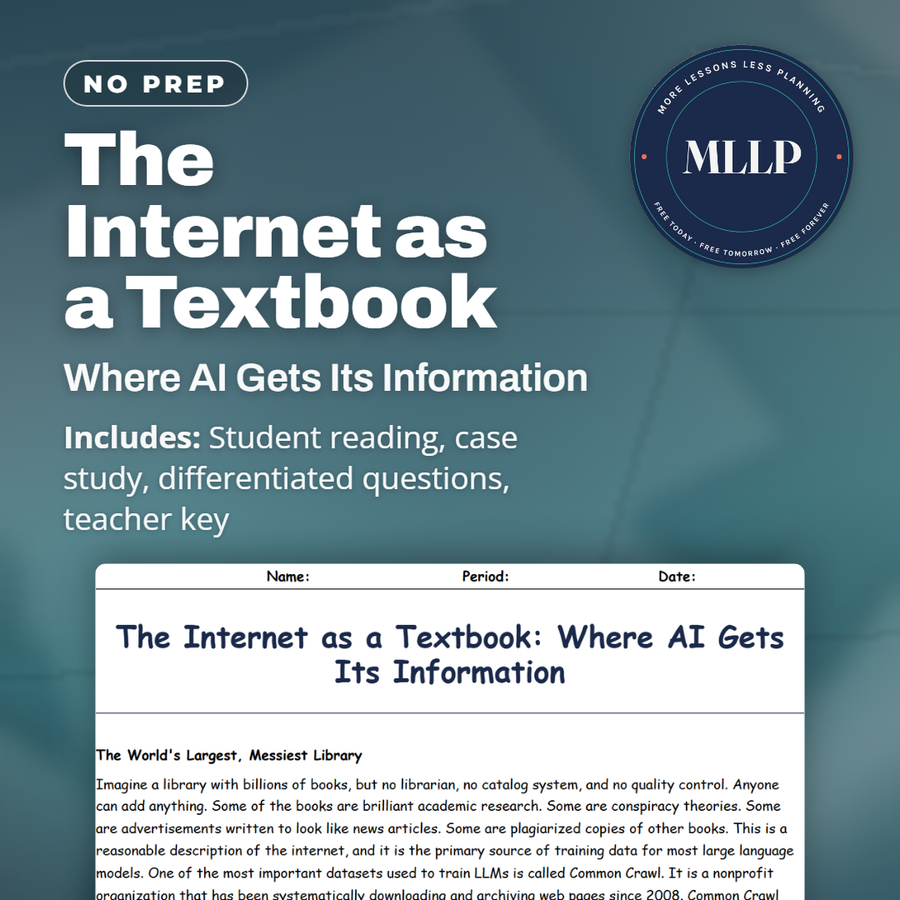
The Internet as a Textbook: Where AI Gets Its Information
Quality reviewed September 2026
Facts verified September 20, 2026
- Subject
- Career & Life Skills
- Grades
- Grades 9-12
- Length
- 9-page student worksheet
- Time
- About one 50-minute class period
- Great for
- Sub plans and independent work
- Includes
- Reading passage, comprehension questions + full answer key
- Format
- Print-and-go PDF
What students do
- Common Crawl, arXiv, and GitHub anchor a five-term matching set built from the reading's own vocabulary
- Amara's search for Tigrinya sources anchors two case study questions on training data bias
- Three fill-in-the-blank sentences pull bias, lawsuit, and code straight from the passage
- Answer three multiple choice questions on Common Crawl, the 2023 NYT lawsuit, and language bias
What it covers
- Six passages on where AI training data comes from, from Common Crawl to code repositories
- A case study on Amara's research into her grandmother's Tigrinya language and AI's blind spots
- A key info table naming Common Crawl, arXiv, GitHub, and the New York Times lawsuit
Start reading this worksheet
The World's Largest, Messiest Library
Imagine a library with billions of books, but no librarian, no catalog system, and no quality control. Anyone can add anything. Some of the books are brilliant academic research. Some are conspiracy theories. Some are advertisements written to look like news articles. Some are plagiarized copies of other books. This is a reasonable description of the internet, and it is the primary source of training data for most large language models. One of the most important datasets used to train LLMs is called Common Crawl. It is a nonprofit organization that has been systematically downloading and archiving web pages since 2008. Common Crawl releases its data publicly, and it contains petabytes of raw web content: hundreds of billions of web pages in dozens of languages. AI companies use Common Crawl as a foundation for training data because it is enormous and freely available.
What Gets Included (and What Gets Cut)
Raw web data is far too messy to use directly. Before training, AI companies apply filters to remove low-quality content. Common techniques include removing duplicate pages, filtering out content that appears to be spam or auto-generated garbage, removing pages with very little text, and excluding sites known for harmful or illegal content. Even after filtering, what remains is a reflection of the internet itself: content written primarily in English, produced disproportionately by people in wealthy countries, skewed toward topics that are popular online, and filled with the biases, assumptions, and perspectives of whoever wrote it. Less-represented languages, cultures, and viewpoints get fewer pages on the internet and therefore less representation in the training data. This is a fundamental problem with using the internet as a textbook.
Books and Academic Sources
Beyond the web, AI companies have trained on digitized books. Projects like Project Gutenberg have digitized millions of books with expired copyrights, making them freely available. OpenAI reportedly used two book datasets, called Books1 and Books2, in training earlier versions of GPT. However, reports have suggested that some of these datasets may have included copyrighted books without permission from the authors, which has led to multiple ongoing lawsuits from writers and publishers. Academic papers represent another significant source. Papers published on preprint servers like arXiv, which publishes millions of open-access papers in physics, math, computer science, and other fields, have been widely used in AI training. Wikipedia is also a standard component because it offers well-organized, factual text on millions of topics across many languages. However, Wikipedia itself has known gaps, biases, and quality variations across different topics and languages.
Like what you read? The full reading, the case study, and every question set are in the free download below, along with the answer key.
Why this matters
Every student here will use AI tools that were built on a specific slice of the internet, one that overrepresents English and wealthy countries and underrepresents languages like Tigrinya. Knowing that Common Crawl and Wikipedia sit behind the answers an AI gives helps a student notice when a response is thin because the topic barely exists online, not because the topic is unimportant. The copyright lawsuits from the New York Times and the Authors Guild also show students that the text an AI learned from was not always freely given, which matters for how they think about ownership of their own writing and photos posted online.
From one teacher to another
This worksheet traces where AI training data actually comes from, starting with Common Crawl, the nonprofit that has archived billions of web pages since 2008. Students read about the filtering process AI companies use to strip out spam and harmful content, then see how books, Wikipedia, and arXiv papers round out the mix. A passage on GitHub explains why models trained on code get better at math and logical reasoning. The case study follows Amara, a student who tries to use AI to research her grandmother's Tigrinya language and gets thin, inaccurate answers because Tigrinya content is scarce online. The reading closes with the New York Times lawsuit against OpenAI and the language imbalance that makes English dominate AI outputs.
What you get
Download
Where should I send the next one?
Everything here is free and it stays that way. Leave your email and I'll send you the new lessons as they go up. You can unsubscribe from any one of them.
Related resources
How AI Generates Images: From Words to Pictures
How AI Generates Voice and Video
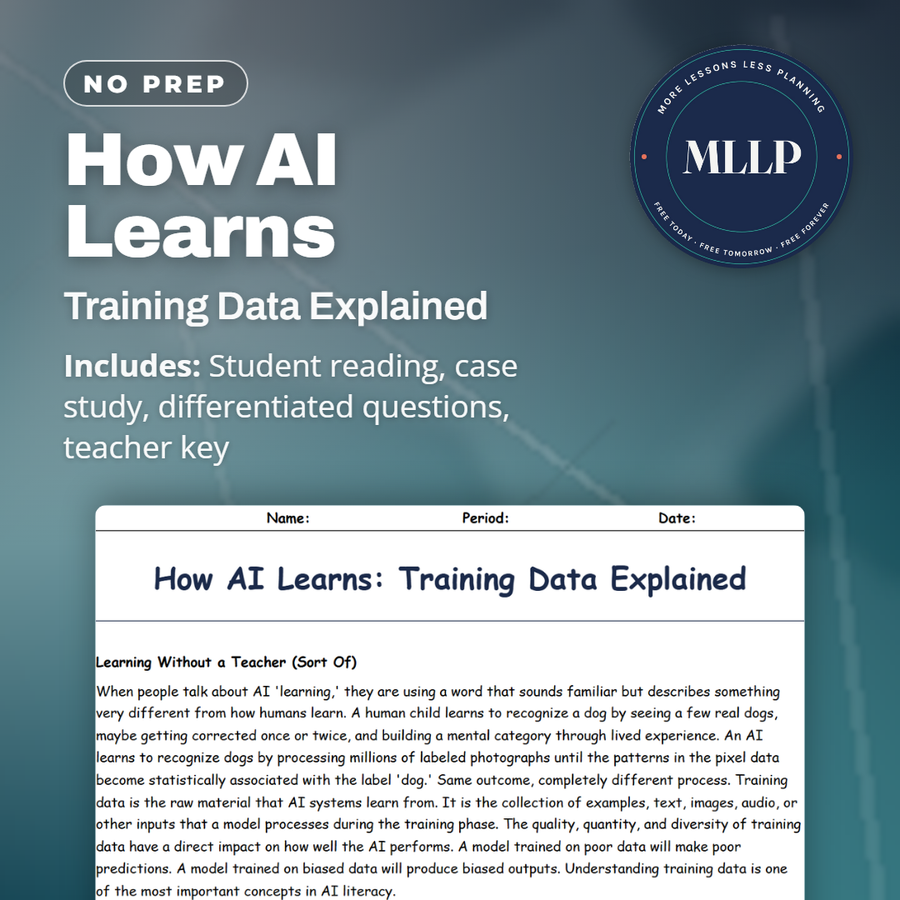
How AI Learns: Training Data Explained
The Black Box Problem: When AI Can't Explain Itself
The Cost of AI: Energy, Water, and Data Centers
Tokens, Parameters, and Why Bigger Isn't Always Better
Every lesson on this site is free to download and use. If one of them saved you a prep period, you can chip in a few bucks toward my three kids' daycare fund. That's genuinely where tips go.