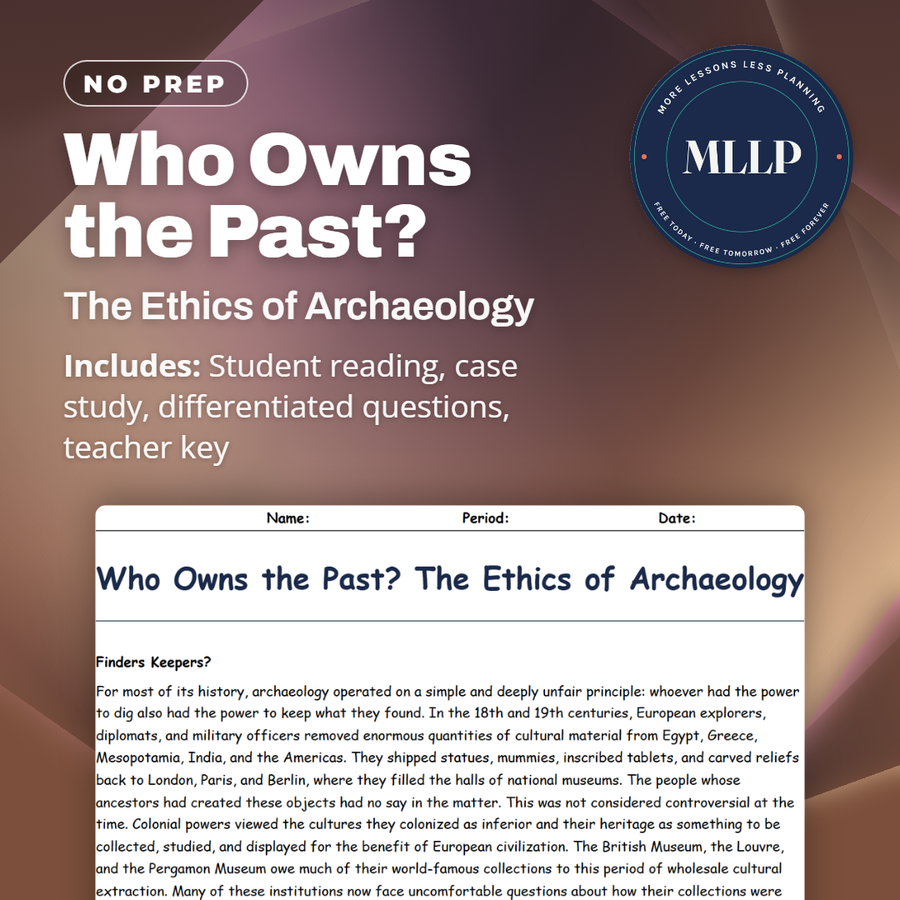
Who Owns the Past? The Ethics of Archaeology
Quality reviewed September 2026
Facts verified September 21, 2026
- Subject
- Social Studies
- Grades
- Grades 9-12
- Length
- 10-page student worksheet
- Time
- About one 50-minute class period
- Great for
- Sub plans and independent work
- Includes
- Reading passage, comprehension questions + full answer key
- Format
- Print-and-go PDF
What students do
- Decide whether Sarah Whitehawk's university should have returned the 47 individuals sooner under NAGPRA
- Explain how NAGPRA changed the legal relationship between museums, universities, and Native American tribes
- Compare the Greek and British Museum positions on returning the Elgin Marbles to Athens
- Five terms, including repatriation and patrimony, get matched to their correct definitions
What it covers
- NAGPRA and the decades-long legal fight over the Elgin Marbles
- Why community-based archaeology gives descendant communities a real say in research
- Councilwoman Sarah Whitehawk's case study over 47 sets of ancestral remains
Start reading this worksheet
Finders Keepers?
For most of its history, archaeology operated on a simple and deeply unfair principle: whoever had the power to dig also had the power to keep what they found. In the 18th and 19th centuries, European explorers, diplomats, and military officers removed enormous quantities of cultural material from Egypt, Greece, Mesopotamia, India, and the Americas. They shipped statues, mummies, inscribed tablets, and carved reliefs back to London, Paris, and Berlin, where they filled the halls of national museums. The people whose ancestors had created these objects had no say in the matter. This was not considered controversial at the time. Colonial powers viewed the cultures they colonized as inferior and their heritage as something to be collected, studied, and displayed for the benefit of European civilization. The British Museum, the Louvre, and the Pergamon Museum owe much of their world-famous collections to this period of wholesale cultural extraction. Many of these institutions now face uncomfortable questions about how their collections were assembled and whether the objects in them should be returned. The ethics of archaeology have changed dramatically over the past century. Today, most professional archaeologists recognize that the communities connected to archaeological sites have a legitimate stake in how those sites are excavated and how the objects found there are treated. But translating that recognition into practice has been slow, contentious, and far from complete. The question of who owns the past (who has the right to dig, study, interpret, and keep what is found) remains one of the most heated debates in the field.
NAGPRA: A Law That Changed Everything
In the United States, the most significant legal development in the ethics of archaeology was the passage of the Native American Graves Protection and Repatriation Act in 1990, known by its acronym NAGPRA. The law requires any institution that receives federal funding (which includes virtually every museum and university in the country) to inventory its collections of Native American human remains, funerary objects, sacred objects, and objects of cultural patrimony, and to return them to culturally affiliated tribes upon request. Before NAGPRA, the remains of tens of thousands of Native Americans sat in museum storage rooms, university laboratories, and private collections across the country. Many had been collected during the 19th and early 20th centuries under circumstances that ranged from legally questionable to outright grave robbery. Some were taken from battlefields. Others were dug up from burial grounds without the knowledge or consent of living descendants. The Smithsonian Institution alone held the remains of more than 18,000 individuals. NAGPRA transformed the relationship between archaeologists and Native American communities. The law forced institutions to consult with tribes, acknowledge their connection to ancestral remains, and begin the process of return. It also established that Native American cultural interests have legal standing that must be balanced against scientific research interests. The law was not universally welcomed (some scientists argued that repatriation would mean losing irreplaceable research material), but it represented a fundamental shift in who gets to make decisions about the past.
The Elgin Marbles: The Fight That Won't End
Perhaps the world's most famous repatriation dispute involves the Parthenon Marbles, more commonly known as the Elgin Marbles after Lord Elgin, the British diplomat who removed them from the Parthenon in Athens between 1801 and 1812. Elgin claimed he had permission from the Ottoman authorities who controlled Greece at the time, though the legality of that permission has been disputed ever since. The marbles, which include large sections of the Parthenon's sculptural frieze, several metopes, and figures from the pediments, have been displayed in the British Museum since 1816. Greece has been demanding their return for nearly two centuries. The Greek government argues that the marbles were taken illegally during a period of foreign occupation, that they are an integral part of one of the world's most important cultural monuments, and that their removal was an act of cultural vandalism. Greece has built a state-of-the-art museum, the Acropolis Museum, specifically designed to house the marbles if they are returned, with a gallery that aligns with the Parthenon itself. The British Museum's position is that it acquired the marbles legally, that they have been well preserved in London, and that the museum serves as a 'universal museum' where world cultures can be seen and compared in one place. Critics of this position point out that the concept of a 'universal museum' conveniently benefits the nations that did the collecting while disadvantaging the nations that were collected from. The debate shows no sign of resolution, but it has become a symbol of the broader struggle over cultural heritage, colonial legacy, and the ethics of who gets to possess the past.
Like what you read? The full reading, the case study, and every question set are in the free download below, along with the answer key.
Why this matters
Sarah Whitehawk's fight to bring 47 ancestors home is not a settled piece of history, it is the kind of story still breaking in the news, since museums in Germany, the United Kingdom, and the United States are actively deciding right now whether to return objects and remains taken during the colonial era. Students who have heard about public debates over monuments and building names are already familiar with the underlying question this reading raises: who gets to decide what a community's own heritage means. The reading's account of NAGPRA shows that laws can force institutions to act, but Sarah's three-year wait for a response shows that a law on paper does not always move an institution quickly in practice. For a generation that will inherit these unresolved cases, whether the Elgin Marbles or thousands of remains still sitting in storage, understanding both sides of the argument matters more than picking a side quickly.
From one teacher to another
For most of archaeology's history, whoever held the power to dig also held the power to keep whatever they found, which is how the British Museum, the Louvre, and the Pergamon Museum filled their halls with material removed from Egypt, Greece, and dozens of other colonized regions. This worksheet covers NAGPRA, the 1990 U.S. law that forced museums and universities to return Native American remains and sacred objects to affiliated tribes, and the decades-long fight over the Elgin Marbles between Greece and the British Museum. It also covers community-based archaeology, an approach where descendant communities participate directly in research design and interpretation rather than being consulted after the fact. In the case study, Lakota councilwoman Sarah Whitehawk pushes back against a university's bureaucratic delays in returning the remains of 47 individuals excavated from ancestral land in the 1950s. Students weigh her argument against the university's claim that the remains hold significant scientific value.
What you get
Download
Where should I send the next one?
Everything here is free and it stays that way. Leave your email and I'll send you the new lessons as they go up. You can unsubscribe from any one of them.
Related resources
Archaeology in Pop Culture: What Movies Get Wrong
Archaeology's Biggest Mistakes and Hoaxes
Careers in Archaeology: What Can You Actually Do?
Context Is Everything: Why Location Matters More Than the Object
Experimental Archaeology: Rebuilding the Past to Understand It
Famous Archaeologists Who Changed the Game
Every lesson on this site is free to download and use. If one of them saved you a prep period, you can chip in a few bucks toward my three kids' daycare fund. That's genuinely where tips go.