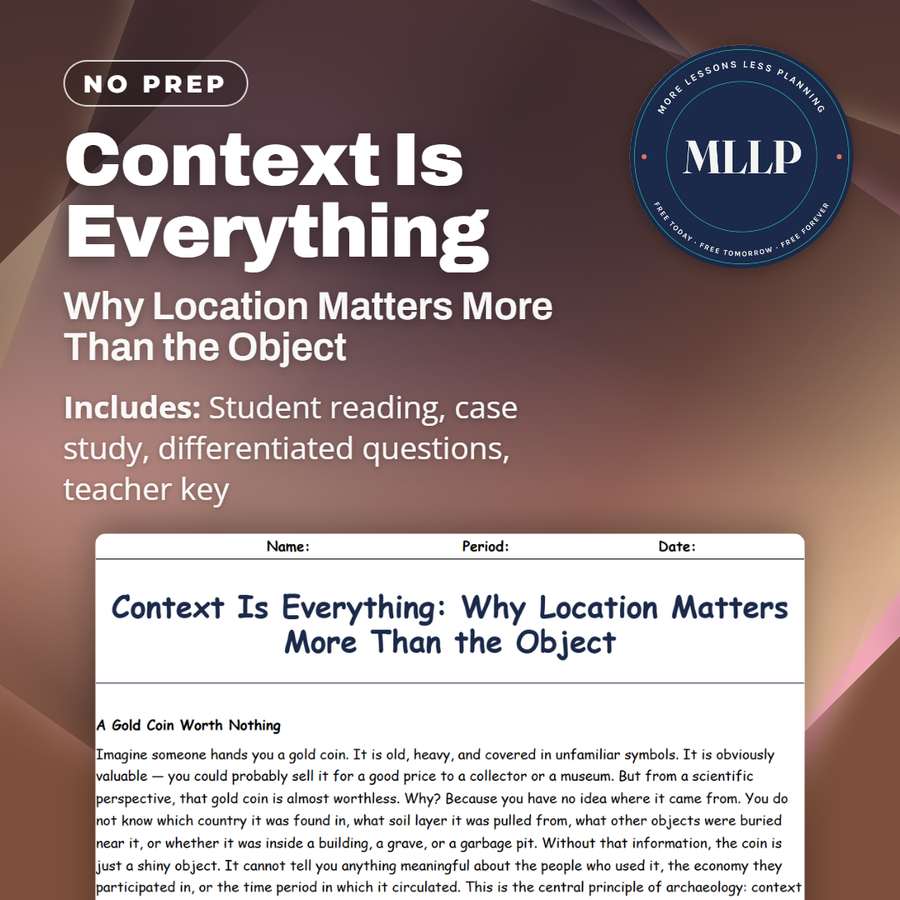
Context Is Everything: Why Location Matters More Than the Object
Quality reviewed September 2026
Facts verified September 21, 2026
- Subject
- Social Studies
- Grades
- Grades 9-12
- Length
- 9-page student worksheet
- Time
- About one 50-minute class period
- Great for
- Sub plans and independent work
- Includes
- Reading passage, comprehension questions + full answer key
- Format
- Print-and-go PDF
What students do
- Decide whether Dr. Amara Okafor should buy a golden mask that has no excavation record behind it
- Explain the difference between an artifact's provenience and its provenance using the reading's own examples
- Trace how looting a single bracelet from a hypothetical burial collapses the story the whole group told
- Five terms, including in situ and stratum, get matched to their definitions from the passages
What it covers
- The real difference between an artifact's provenience and its provenance
- Why looting destroys the relationships between artifacts, not the artifacts alone
- Dr. Amara Okafor's case study weighing a beautiful mask against its missing paperwork
Start reading this worksheet
A Gold Coin Worth Nothing
Imagine someone hands you a gold coin. It is old, heavy, and covered in unfamiliar symbols. It is obviously valuable. You could probably sell it for a good price to a collector or a museum. But from a scientific perspective, that gold coin is almost worthless. Why? Because you have no idea where it came from. You do not know which country it was found in, what soil layer it was pulled from, what other objects were buried near it, or whether it was inside a building, a grave, or a garbage pit. Without that information, the coin is just a shiny object. It cannot tell you anything meaningful about the people who used it, the economy they participated in, or the time period in which it circulated. This is the central principle of archaeology: context is everything. The physical setting in which an artifact is found, including its depth, its location, its orientation, and its relationship to surrounding objects and features, provides far more information than the object itself. A gold coin found in a merchant's house tells a different story than the same coin found in a child's grave. A coin found in a destruction layer might indicate when a city was sacked. A coin found hundreds of miles from where it was minted reveals long-distance trade. All of this information comes from context, not from the coin.
Provenience vs. Provenance
Archaeologists use two similar-sounding terms that are actually quite different. Provenience refers to the exact, three-dimensional location where an artifact was found during an excavation: its grid coordinates, its depth below the surface, and its position relative to other objects and soil layers. Provenience is recorded in the field using precise measurements and is the foundation of all archaeological interpretation. When an archaeologist says, 'This pottery sherd was found in situ at a depth of 1.3 meters in unit N5E2, within a layer of ash above a packed clay floor,' they are describing provenience. Provenance, by contrast, refers to the ownership history of an object: who has possessed it and how it has changed hands over time. A museum might track the provenance of a Greek vase from its purchase at an auction in 1920, back to a private collection in London in 1880, and before that to an Italian dealer in 1850. Provenance matters because it helps determine whether an object was legally obtained or illegally looted. But provenance tells you nothing about where the vase was originally buried, what was found next to it, or what archaeological context it came from. The distinction matters because objects with provenance but no provenience are scientifically crippled. A museum can own a stunning artifact with a well-documented ownership history going back 200 years, but if no one recorded where it was actually excavated, the object has lost its archaeological voice. It can be admired, but it cannot speak.
What Looting Really Destroys
When people hear about archaeological looting, they usually think about stolen objects, such as a golden mask ripped from a tomb or a carved statue smuggled out of a country. And yes, the theft of objects is a serious problem. But from an archaeological perspective, the far greater damage is the destruction of context. Looters do not record where they dig. They do not map soil layers, photograph features, or catalog what they find next to what. They rip through stratigraphy with shovels and picks, destroying the relationships between artifacts that would have told archaeologists how and when a site was used. Consider a hypothetical example. An undisturbed burial contains a skeleton, a ceramic vessel, two bronze bracelets, and a handful of seeds. To an archaeologist, this assemblage tells a rich story: the seeds reveal the season of burial, the bracelets indicate the person's social status, the ceramic style dates the burial to a specific century, and the skeleton's bones reveal the individual's age, sex, diet, and health. All of these interpretations depend on the objects being found together, in their original positions. A looter who steals the bracelets destroys this entire web of meaning. The bracelets end up in a private collection, admired for their beauty but stripped of everything that made them historically significant. The scale of looting worldwide is staggering. Satellite imagery has revealed thousands of looting pits scarring archaeological sites across the Middle East, Central America, and South Asia. In some countries, entire communities rely on looting as a source of income, driven by poverty and demand from wealthy collectors in Europe and North America. International laws like the 1970 UNESCO Convention try to combat the illicit trade in antiquities, but enforcement is difficult and the market remains lucrative. Every looted artifact on the international market represents not just a stolen object, but a destroyed context: a chapter of human history that can never be read.
Like what you read? The full reading, the case study, and every question set are in the free download below, along with the answer key.
Why this matters
A surprising number of teenagers own a metal detector or know someone who does, and this reading gives them a framework for a question that comes up on real detecting forums: is it fine to just dig something up and keep it. The passage's answer, that removing an object without recording exactly where it came from destroys information that can never be recovered, applies just as much to a coin turned up in a field as it does to a golden mask offered to a museum. Dr. Okafor's dilemma also connects to a market students may have scrolled past without noticing, the trade in undocumented antiquities that fuels looting at sites most of them will never see. Understanding provenience gives students a reason for a rule that can otherwise sound like pointless bureaucracy: recording where something was found is the only way the object can ever tell its real story.
From one teacher to another
A gold coin with no recorded findspot is nearly worthless to science, no matter what a collector would pay for it, because without knowing where it was buried, at what depth, and next to what, nobody can say who used it or when. This worksheet has students work through the difference between provenience, an artifact's exact excavation location, and provenance, its ownership history, and why an object can have one without the other. A hypothetical burial full of seeds, bracelets, and a ceramic vessel shows how looting one item collapses the entire story the group told together. In the case study, museum curator Dr. Amara Okafor has to decide whether to buy a golden mask from a dealer who offers beautiful craftsmanship but no excavation records at all. Students weigh her decision against the reading's central claim that a beautiful object with no context is, in her professor's words, a beautiful lie.
What you get
Download
Where should I send the next one?
Everything here is free and it stays that way. Leave your email and I'll send you the new lessons as they go up. You can unsubscribe from any one of them.
Related resources
Archaeology in Pop Culture: What Movies Get Wrong
Archaeology's Biggest Mistakes and Hoaxes
Careers in Archaeology: What Can You Actually Do?
Experimental Archaeology: Rebuilding the Past to Understand It
Famous Archaeologists Who Changed the Game
How Climate Change Is Both Revealing and Destroying Archaeological Sites
Every lesson on this site is free to download and use. If one of them saved you a prep period, you can chip in a few bucks toward my three kids' daycare fund. That's genuinely where tips go.