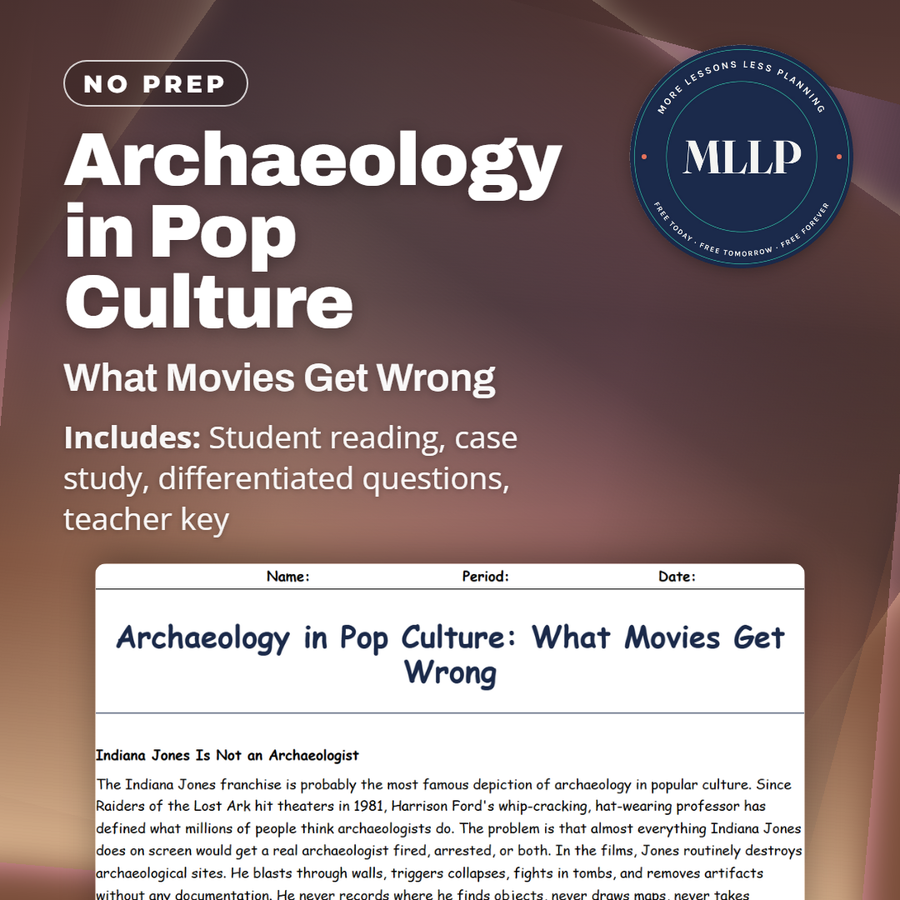
Archaeology in Pop Culture: What Movies Get Wrong
Quality reviewed September 2026
Facts verified September 21, 2026
- Subject
- Social Studies
- Grades
- Grades 9-12
- Length
- 9-page student worksheet
- Time
- About one 50-minute class period
- Great for
- Sub plans and independent work
- Includes
- Reading passage, comprehension questions + full answer key
- Format
- Print-and-go PDF
What students do
- Compare Indiana Jones's on-screen looting to what real archaeologists call documentation, permits, and provenience
- Sort five terms, including public archaeology and media representation, to their correct definitions
- Trace Dr. Sofia Rivera's classroom visit from disappointed questions about curses to her pottery fragment story
- Three key terms, looting, stereotype, and public archaeology, get filled in from context clues in the passages
What it covers
- Why the Indiana Jones and Tomb Raider franchises get archaeology wrong on screen
- The unglamorous reality of fieldwork, screening dirt, and years of lab work
- How Hollywood myths affect enrollment, funding, and public support for site protection
Start reading this worksheet
Indiana Jones Is Not an Archaeologist
The Indiana Jones franchise is probably the most famous depiction of archaeology in popular culture. Since Raiders of the Lost Ark hit theaters in 1981, Harrison Ford's whip-cracking, hat-wearing professor has defined what millions of people think archaeologists do. The problem is that almost everything Indiana Jones does on screen would get a real archaeologist fired, arrested, or both. In the films, Jones routinely destroys archaeological sites. He blasts through walls, triggers collapses, fights in tombs, and removes artifacts without any documentation. He never records where he finds objects, never draws maps, never takes photographs, and never publishes a report. He treats priceless archaeological sites as obstacle courses to be navigated and plundered. His motivation is almost always to obtain a single spectacular object, such as the Ark of the Covenant, the Holy Grail, a Crystal Skull, rather than to understand the culture that created it. Worse, Jones regularly steals artifacts from other countries and brings them back to American institutions. 'It belongs in a museum!' he declares in The Last Crusade, apparently unaware that the people whose ancestors created those objects might disagree about which museum, or whether a museum is the right place at all. In real archaeology, removing artifacts without permission is looting, and claiming that a Western museum is the rightful home for another culture's heritage is a colonial attitude that the field has spent decades trying to move beyond.
Lara Croft and the Treasure Problem
If Indiana Jones is archaeology's most famous fictional practitioner, Lara Croft from the Tomb Raider franchise is a close second. The video game series, which debuted in 1996, follows a wealthy British adventurer who explores ancient ruins in search of powerful artifacts. Like Jones, Croft destroys everything she touches. She shoots her way through tombs, triggers traps, blows up walls, and treats archaeological sites as levels in a video game, which, of course, they literally are. The Tomb Raider franchise reinforces one of the most damaging stereotypes about archaeology: that it is essentially a treasure hunt. The goal is always to find the one special object (a magical artifact, a lost relic, a hidden weapon), and the process of getting there involves combat, puzzle-solving, and physical danger. There is never any mention of research questions, permits, grid systems, or soil analysis. The idea that archaeology is about understanding people rather than acquiring objects is completely absent. Other films and television shows perpetuate similar myths. The Mummy franchise portrays excavation as a trigger for supernatural curses. National Treasure turns archaeological sites into puzzle boxes hiding colonial-era secrets. Even more serious films like Tomb of the Dragon Emperor and Sahara treat ancient sites as action movie backdrops rather than places of genuine historical significance. The cumulative effect is that millions of people worldwide believe archaeology is about adventure, treasure, and danger, when the reality could not be more different.
The Real Work: Slow, Careful, and Mostly Boring
If Hollywood were to make an accurate film about archaeology, it would be very boring by blockbuster standards. The main character would spend months writing grant applications, weeks setting up a grid system, and days on their hands and knees scraping dirt with a trowel. The most exciting moment might be finding a pottery sherd that confirms a hypothesis about trade networks. The climax would be the publication of a site report that gets cited in three other papers. Real archaeological fieldwork is physically demanding, intellectually rigorous, and overwhelmingly unglamorous. Excavators work in extreme heat, cold, rain, and dust. They rise before dawn and work until the light fades. They spend hours screening buckets of dirt through wire mesh, looking for tiny artifacts that the trowel missed. They fill out forms documenting the color, texture, and composition of every soil layer they encounter. They photograph everything from multiple angles and write detailed descriptions in their field notebooks. The laboratory work that follows excavation is even less cinematic. Washing, sorting, and cataloging thousands of pottery fragments. Measuring and drawing stone tools. Identifying animal bones under a microscope. Running statistical analyses on ceramic distributions. Writing chapters of a site report that may take years to complete. None of this makes for good cinema, but all of it is essential to producing the knowledge that makes archaeology valuable.
Like what you read? The full reading, the case study, and every question set are in the free download below, along with the answer key.
Why this matters
Most of what a teenager knows about archaeology came from a movie screen, not a classroom, and that gap has consequences beyond a wrong answer on a quiz. Kids who show up to an archaeology program expecting Indiana Jones sometimes quit once they see how much of the job is paperwork and pottery washing, and that mismatch costs departments students who might have loved the actual work. It also shapes voting and funding decisions. A community that pictures archaeology as treasure hunting is less likely to back laws that protect a site from being paved over, and less likely to support the argument that stolen artifacts should go home. The reading points to a real fix already underway: archaeologists posting their actual fieldwork on YouTube and TikTok, trading Hollywood's version for the real one, one pottery sherd at a time.
From one teacher to another
Indiana Jones destroys almost every site he sets foot in, blasting through walls and hauling off a single spectacular object without ever writing down where he found it. Real fieldwork looks nothing like that. This worksheet has students read four passages about how movies and video games shape what the public thinks archaeologists do, from Lara Croft's shoot-first version of a dig to the actual grind of screening dirt through wire mesh and washing pottery for months. A case study follows Dr. Sofia Rivera, whose eighth-grade audience wanted gold and curses until she connected a handful of pottery fragments to the daily life of a girl who lived 900 years ago. The worksheet closes with the reading's argument about why the gap between the movie version and the real one matters for funding, enrollment, and public support.
What you get
Download
Where should I send the next one?
Everything here is free and it stays that way. Leave your email and I'll send you the new lessons as they go up. You can unsubscribe from any one of them.
Related resources
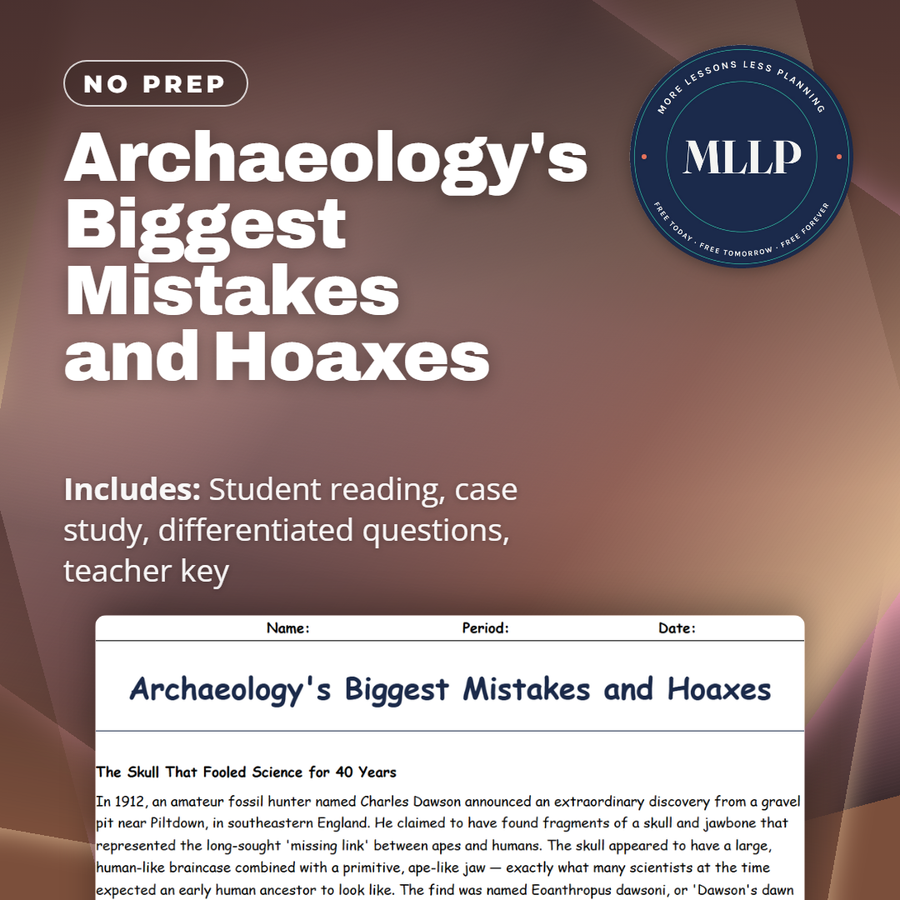
Archaeology's Biggest Mistakes and Hoaxes
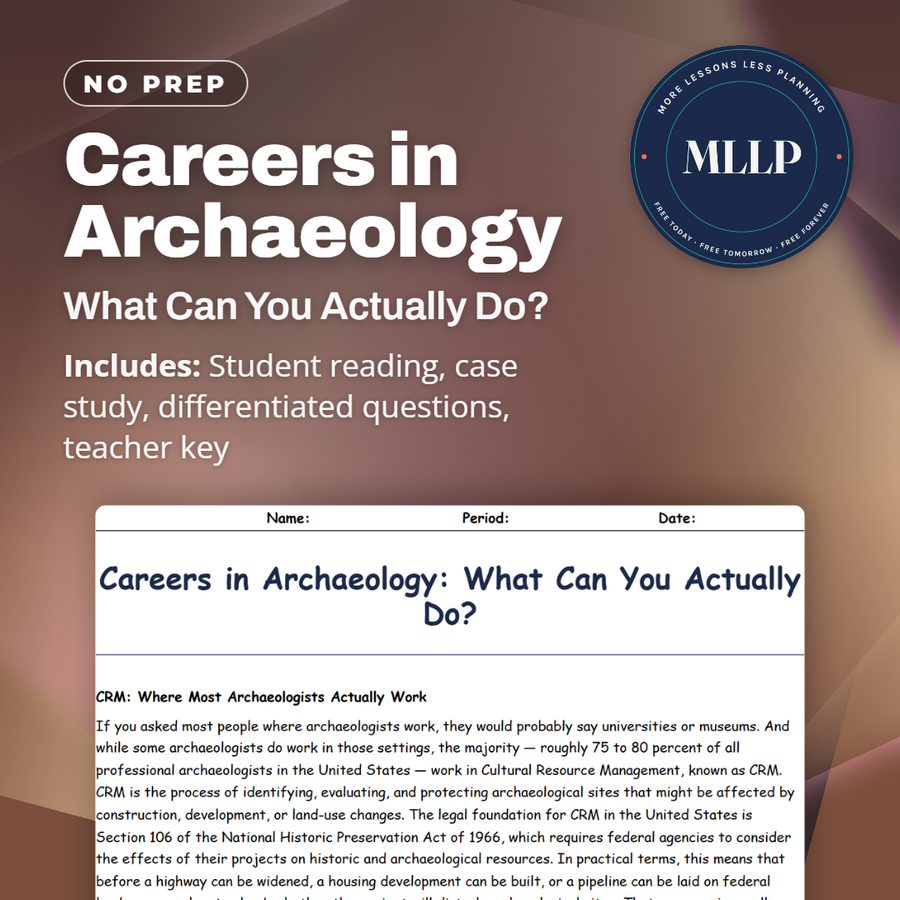
Careers in Archaeology: What Can You Actually Do?
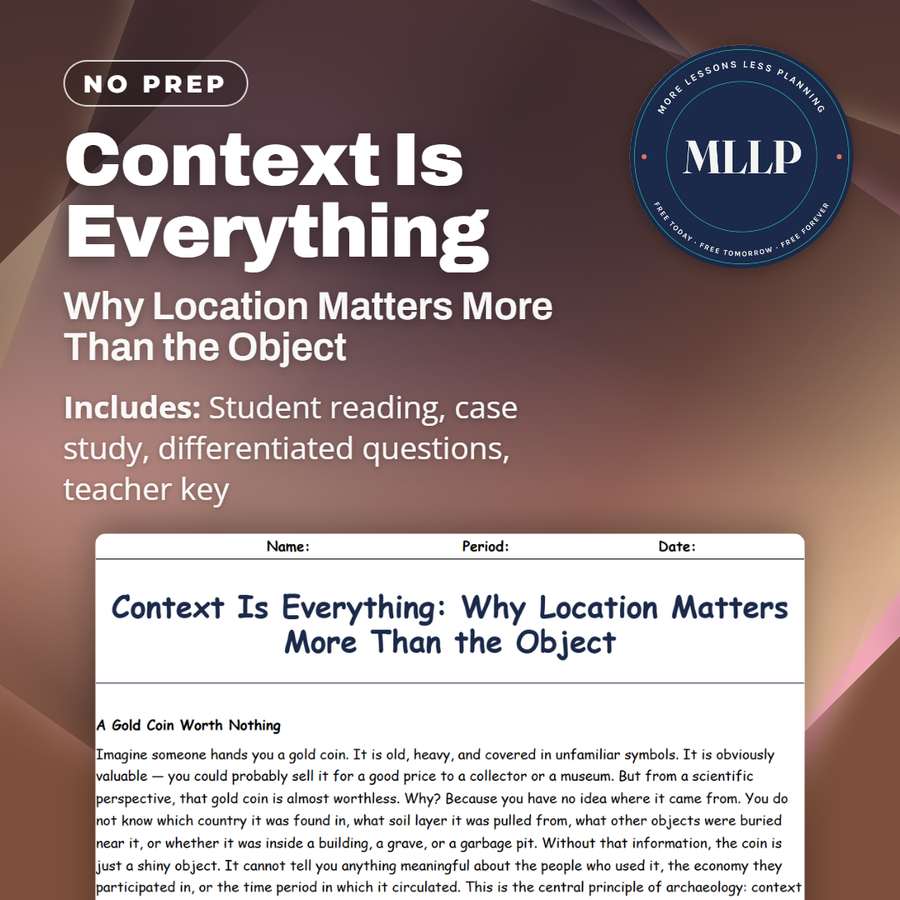
Context Is Everything: Why Location Matters More Than the Object
Experimental Archaeology: Rebuilding the Past to Understand It
Famous Archaeologists Who Changed the Game
How Climate Change Is Both Revealing and Destroying Archaeological Sites
Every lesson on this site is free to download and use. If one of them saved you a prep period, you can chip in a few bucks toward my three kids' daycare fund. That's genuinely where tips go.