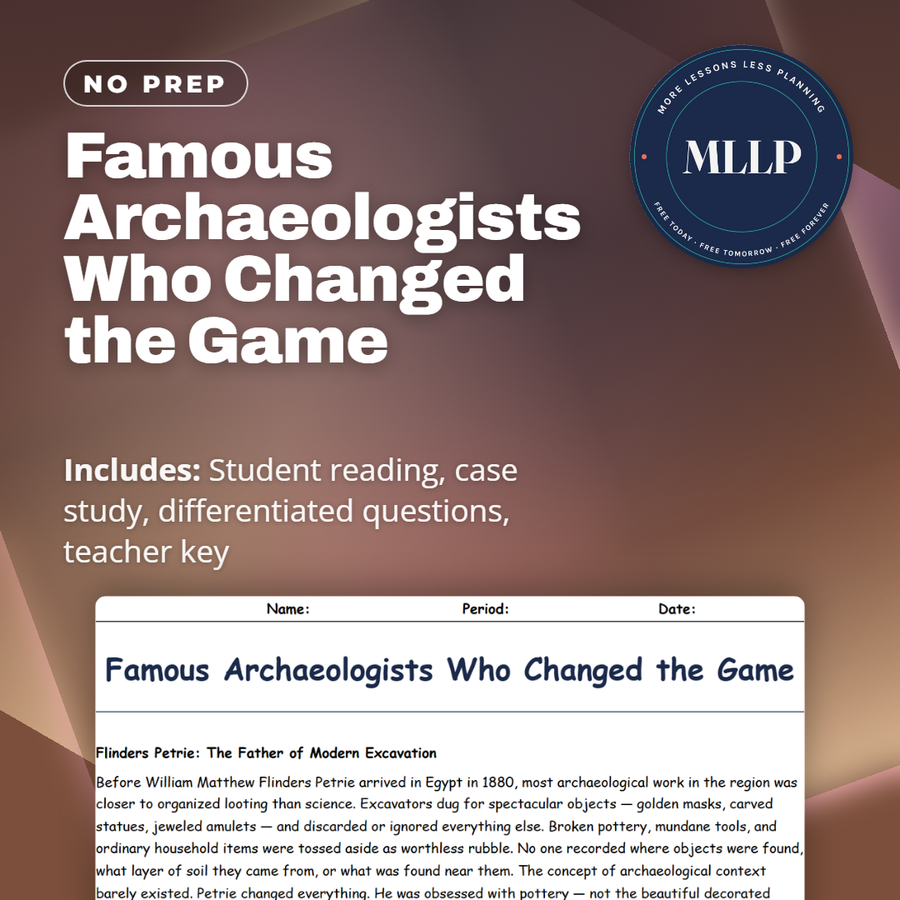
Famous Archaeologists Who Changed the Game
Quality reviewed September 2026
Facts verified September 21, 2026
- Subject
- Social Studies
- Grades
- Grades 9-12
- Length
- 10-page student worksheet
- Time
- About one 50-minute class period
- Great for
- Sub plans and independent work
- Includes
- Reading passage, comprehension questions + full answer key
- Format
- Print-and-go PDF
What students do
- Decide whether Amina Njeri should join an excavation where Kenyan staff are left out of publication
- Compare the gender bias Mary Leakey faced with the national power imbalance Amina observes on her team
- Explain how Petrie's pottery sequence dating let him date sites without any written records
- Stratigraphy, sequence dating, field notes, and systematic method get matched to what each one actually does on a dig
What it covers
- Petrie's pottery sequence dating and Mary Leakey's Laetoli footprints discovery
- Howard Carter, Hiram Bingham, and archaeology's colonial history of who gets credit
- Amina Njeri's case study on power and credit in a modern foreign-led excavation
Start reading this worksheet
Flinders Petrie: The Father of Modern Excavation
Before William Matthew Flinders Petrie arrived in Egypt in 1880, most archaeological work in the region was closer to organized looting than science. Excavators dug for spectacular objects (golden masks, carved statues, jeweled amulets) and discarded or ignored everything else. Broken pottery, mundane tools, and ordinary household items were tossed aside as worthless rubble. No one recorded where objects were found, what layer of soil they came from, or what was found near them. The concept of archaeological context barely existed. Petrie changed everything. He was obsessed with pottery, not the beautiful decorated vessels that collectors prized, but the plain, undecorated fragments that littered every site in Egypt. Petrie realized that pottery styles changed over time in predictable ways, and that by carefully studying these changes, he could date archaeological layers and entire sites. He developed a system called sequence dating, which used pottery typology to arrange sites in chronological order even when no written records existed. This was revolutionary. For the first time, archaeologists had a systematic method for determining relative dates based on material evidence. Petrie also insisted on recording everything, not just the spectacular finds, but every potsherd, every flint flake, every fragment of bone. He kept meticulous field notes, drew detailed plans of his excavations, and published his results promptly. He was appalled by the sloppy, destructive methods of his contemporaries and spent years fighting to establish basic professional standards. His influence was enormous. Nearly every systematic technique used in field archaeology today can trace its roots back to Petrie's insistence that the mundane matters as much as the magnificent.
Howard Carter and the Boy King
Howard Carter's discovery of Tutankhamun's tomb in November 1922 remains the most famous archaeological find in history. The story has all the elements of a Hollywood script: years of fruitless searching, a wealthy patron threatening to cut off funding, a last-ditch effort in an area everyone else had given up on, and then, the discovery of a sealed doorway leading to rooms filled with gold, jewels, chariots, and a perfectly preserved royal mummy. But the story behind the spectacle reveals both Carter's strengths and his limitations. Carter was a talented artist and a meticulous excavator who had spent years working in Egypt's Valley of the Kings. His patron, Lord Carnarvon, had funded the search for several seasons with diminishing returns. By 1922, Carnarvon was ready to pull the plug. Carter persuaded him to fund one final season, and within days of starting work, a water boy on Carter's team stumbled upon a stone step that led down to a sealed doorway. What followed was a ten-year process of carefully documenting and removing over 5,000 objects from the four-room tomb. Carter's methods were advanced for his era: he photographed every object in place before moving it and kept detailed records of the tomb's contents. But he also operated within the colonial framework of his time. The Egyptian government received the objects, but the knowledge, the fame, and the narrative all flowed to the West. Carter became a global celebrity. The Egyptian workers and officials who made the discovery possible were largely forgotten. Egyptologist Zahi Hawass and others have worked in recent decades to recenter Egyptian voices in the story of their own heritage.
Mary Leakey: Footprints in the Ash
Mary Leakey is one of the most important figures in the study of human origins, yet for much of her career she was overshadowed by her husband, Louis Leakey. The two worked together at Olduvai Gorge in Tanzania, one of the richest sites for early human fossils in the world. But many of the most significant discoveries were Mary's. In 1959, she found the skull of Zinjanthropus boisei (now called Paranthropus boisei), a 1.75-million-year-old hominin that fundamentally changed the understanding of human evolution. The discovery attracted funding and attention that transformed Olduvai from an obscure research site into one of the most important archaeological locations on Earth. Mary's most iconic discovery came in 1978, when her team found a trail of fossilized footprints at Laetoli, also in Tanzania. The footprints, preserved in volcanic ash, were 3.6 million years old and showed that early hominins were walking upright far earlier than previously believed. The Laetoli footprints are considered one of the most significant discoveries in paleoanthropology: direct physical evidence of bipedal locomotion in our distant ancestors. Mary Leakey was largely self-taught. She never earned a university degree, which was used against her by academics who questioned her credentials. She was also a brilliant illustrator whose detailed drawings of stone tools and fossils set a standard for scientific illustration that endures today. Despite her contributions, she was often credited as Louis's assistant rather than a leading researcher in her own right. It was not until after Louis's death in 1972 that Mary fully stepped out of his shadow and received the recognition she deserved.
Like what you read? The full reading, the case study, and every question set are in the free download below, along with the answer key.
Why this matters
Mary Leakey found the Laetoli footprints and the Zinjanthropus skull that transformed Olduvai Gorge into a major research site, yet for years the credit and the funding followed her husband's name instead of hers, and that pattern of uneven credit has not disappeared. Students working on any group project have felt some version of what Amina Njeri weighs in the case study, watching someone else's name end up on the finished work while the people who did the labor stay invisible. The reading's account of Hiram Bingham publicizing Machu Picchu, a site Quechua farmers already knew about, raises the same question in a bigger form: who gets to be remembered as the discoverer of something other people never lost. These are live questions, not historical footnotes, since museums and universities are still working through exactly whose names belong on research their institutions built on other people's labor.
From one teacher to another
Flinders Petrie arrived in Egypt in 1880 to find excavators tossing aside plain pottery in favor of golden masks, and he spent his career proving that the boring fragments mattered more than the spectacular ones. This worksheet covers Petrie's pottery sequence dating alongside Howard Carter's ten-year excavation of Tutankhamun's tomb, Mary Leakey's 3.6-million-year-old Laetoli footprints, and Kathleen Kenyon's stratigraphic method at Jericho. It also covers Hiram Bingham, credited with publicizing Machu Picchu despite the site being known to local Quechua communities for generations. In the case study, Kenyan archaeology student Amina Njeri weighs a spot on a foreign-led excavation where Kenyan staff handle fieldwork but are left out of the analysis and publications. Students connect her situation to the gender bias Mary Leakey faced for decades before she stepped out of her husband's shadow.
What you get
Download
Where should I send the next one?
Everything here is free and it stays that way. Leave your email and I'll send you the new lessons as they go up. You can unsubscribe from any one of them.
Related resources
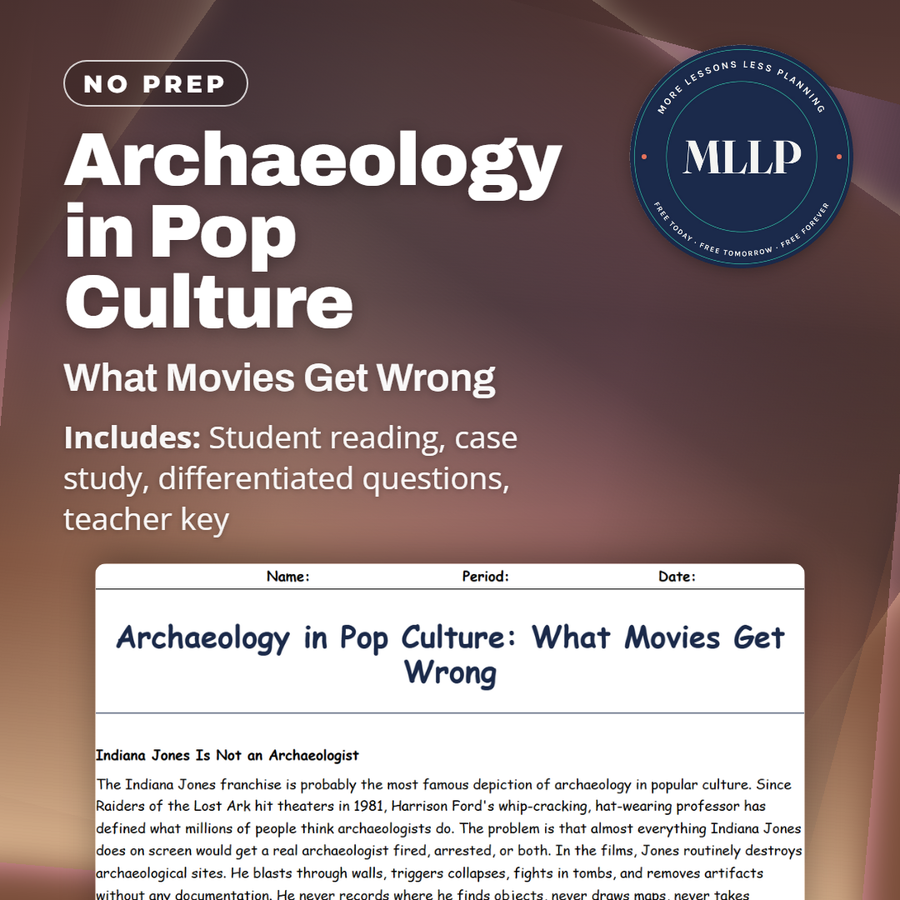
Archaeology in Pop Culture: What Movies Get Wrong
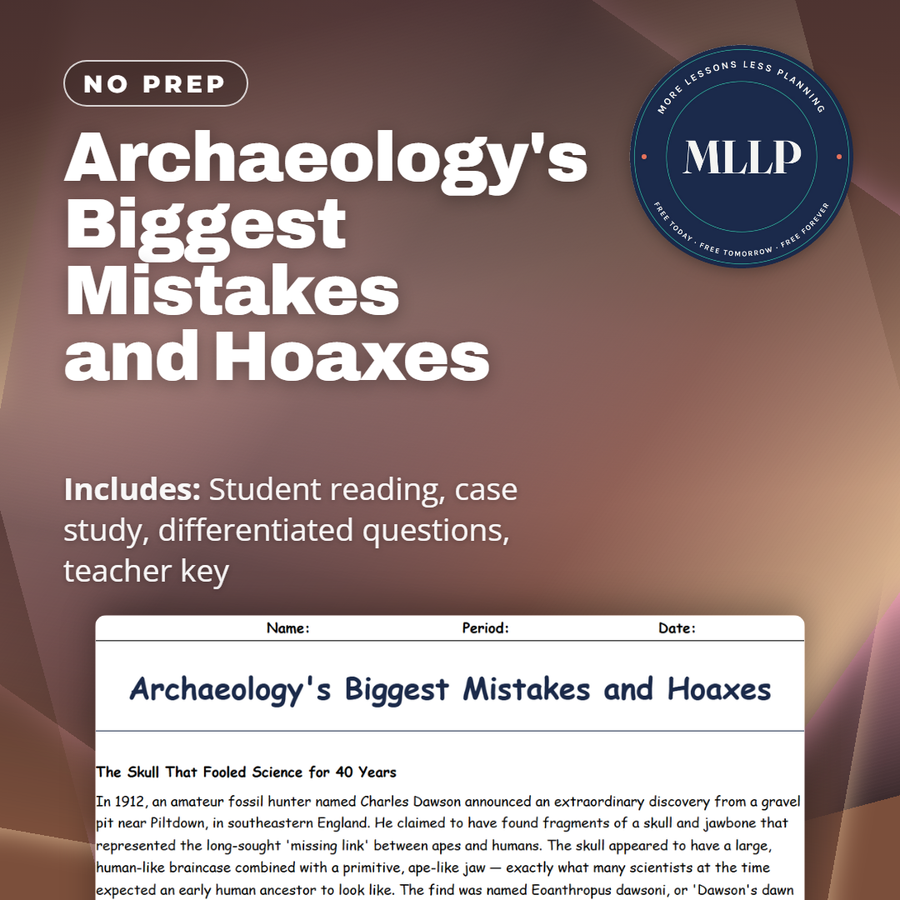
Archaeology's Biggest Mistakes and Hoaxes
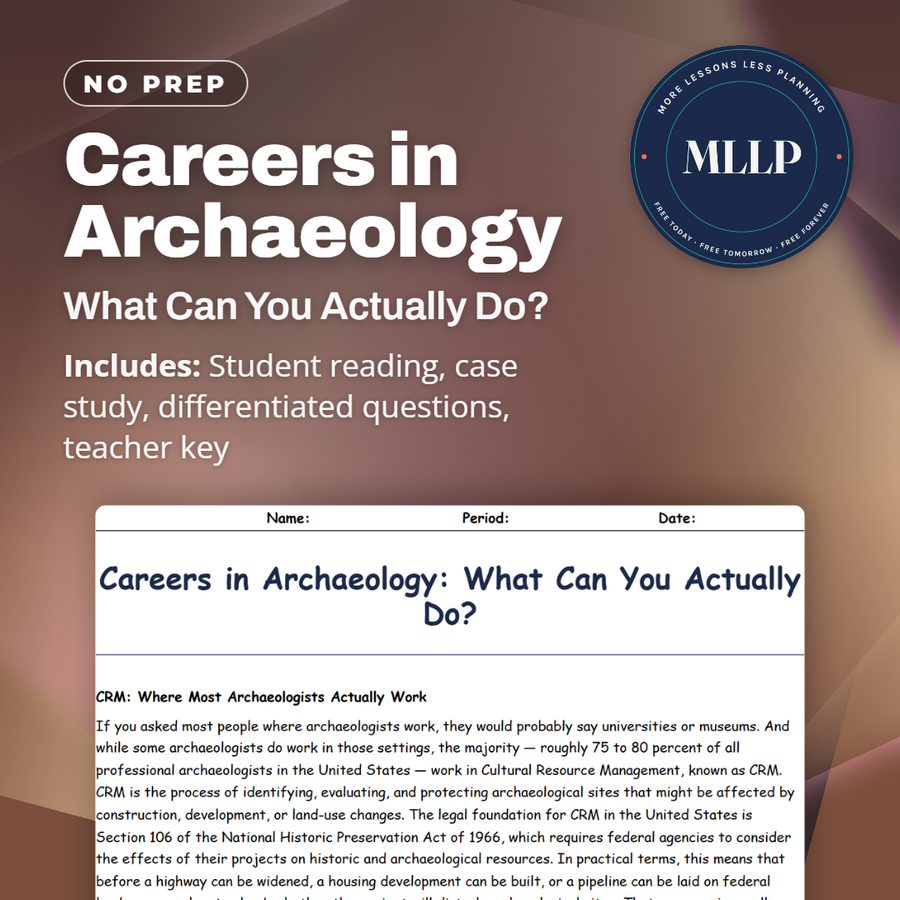
Careers in Archaeology: What Can You Actually Do?
Context Is Everything: Why Location Matters More Than the Object
Experimental Archaeology: Rebuilding the Past to Understand It
How Climate Change Is Both Revealing and Destroying Archaeological Sites
Every lesson on this site is free to download and use. If one of them saved you a prep period, you can chip in a few bucks toward my three kids' daycare fund. That's genuinely where tips go.