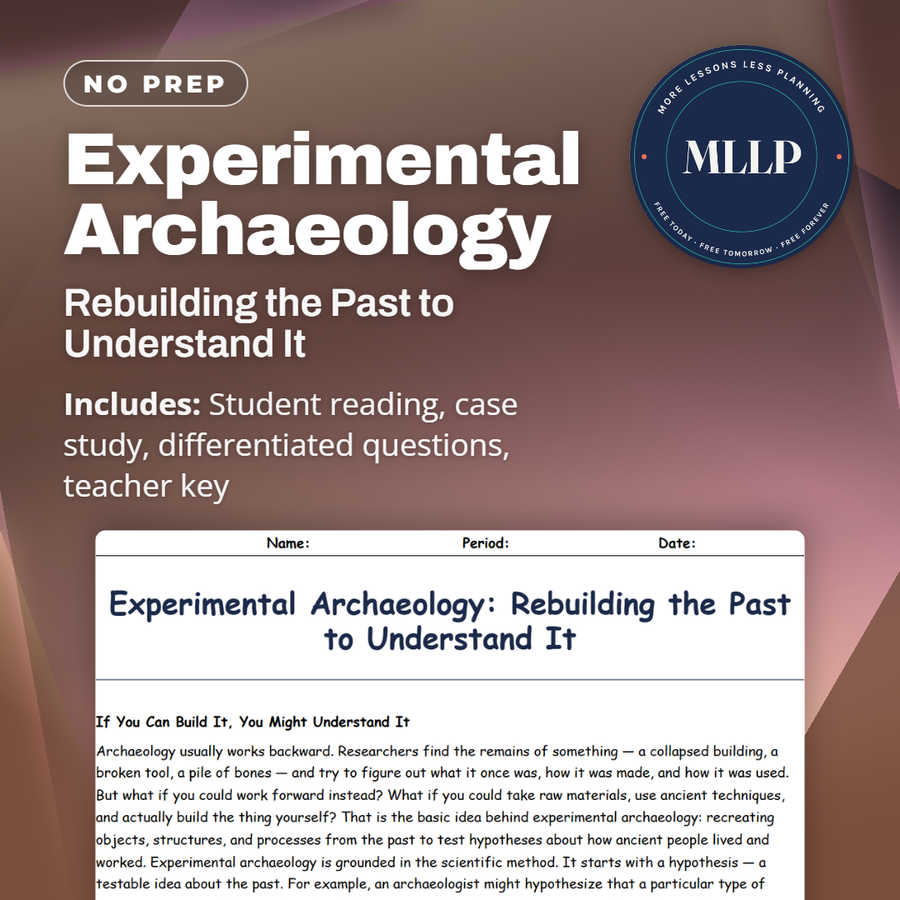
Experimental Archaeology: Rebuilding the Past to Understand It
Quality reviewed September 2026
Facts verified September 21, 2026
- Subject
- Social Studies
- Grades
- Grades 9-12
- Length
- 10-page student worksheet
- Time
- About one 50-minute class period
- Great for
- Sub plans and independent work
- Includes
- Reading passage, comprehension questions + full answer key
- Format
- Print-and-go PDF
What students do
- Explain the difference between proving something was possible and proving it actually happened
- Follow Dr. Kenji Watanabe's 14-hour Bronze Age boat crossing and what it did and did not prove
- Compare Thor Heyerdahl's Kon-Tiki voyage to the genetic evidence that later contradicted his theory
- Three fill-in-the-blank terms, hypothesis, replication, and flintknapping, come from the reading's own definitions
What it covers
- How experimental archaeology tests hypotheses by rebuilding ancient tools, boats, and food
- Why Kon-Tiki proved a voyage was possible without proving it actually took place
- Dr. Kenji Watanabe's three-year Bronze Age boat project and its 14-hour crossing
Start reading this worksheet
If You Can Build It, You Might Understand It
Archaeology usually works backward. Researchers find the remains of something, such as a collapsed building, a broken tool, or a pile of bones, and try to figure out what it once was, how it was made, and how it was used. But what if you could work forward instead? What if you could take raw materials, use ancient techniques, and actually build the thing yourself? That is the basic idea behind experimental archaeology: recreating objects, structures, and processes from the past to test hypotheses about how ancient people lived and worked. Experimental archaeology is grounded in the scientific method. It starts with a hypothesis, a testable idea about the past. For example, an archaeologist might hypothesize that a particular type of stone tool was used for cutting animal hide. To test this, they would make a replica of the tool using the same raw materials and techniques, then use it to cut hide and compare the resulting wear patterns to the marks found on ancient tools. If the patterns match, the hypothesis is supported. If they do not, the archaeologist revises their theory and tries again. This approach has produced remarkable insights. Researchers have discovered that some ancient construction techniques were far more sophisticated than previously assumed, that certain tools required years of practice to master, and that ancient people often solved engineering problems in ways that modern engineers find ingenious. Experimental archaeology turns speculation into testable propositions and replaces assumptions with evidence.
Kon-Tiki: Sailing Into the Unknown
One of the most famous experiments in archaeological history was not conducted by a professional archaeologist at all. In 1947, Norwegian explorer Thor Heyerdahl sailed a balsa wood raft named Kon-Tiki from South America to Polynesia, a journey of over 4,300 miles across the open Pacific Ocean. Heyerdahl wanted to prove that ancient South Americans could have colonized the Pacific islands using only the technology available to them: balsa wood logs, hemp rope, and simple sails. The voyage took 101 days and ended when the raft crashed on a reef in French Polynesia. Heyerdahl and his five-person crew survived, and the expedition became a worldwide sensation. The Kon-Tiki expedition demonstrated that transoceanic travel on primitive rafts was physically possible: the Pacific could be crossed with Stone Age technology. This was a genuine contribution to our understanding of what ancient people were capable of doing. However, proving that something was possible is not the same as proving that it actually happened. Modern genetic and linguistic evidence strongly suggests that Polynesia was settled from Southeast Asia, not South America. The Kon-Tiki expedition showed that South Americans could have reached Polynesia, but subsequent research has shown that they almost certainly did not colonize it. This is an important lesson about experimental archaeology: a successful experiment demonstrates feasibility, not historical fact. It proves that something could have happened, not that it did. The distinction matters, and the best experimental archaeologists are careful to acknowledge it.
Flintknapping and Fire-Starting
Some of the most productive experimental archaeology happens at a much smaller scale than ocean voyages. Flintknapping, the art of shaping stone tools by striking flakes from a rock core, is one of the most widely practiced forms of experimental archaeology. Modern knappers spend years learning to replicate ancient tool types, and in the process, they have discovered things that studying finished tools alone could never reveal. For example, experimental flintknapping has shown that making a simple stone hand axe requires a minimum of 20 to 30 minutes of skilled work and produces a predictable pattern of waste flakes. By studying these waste patterns, archaeologists can reconstruct the manufacturing process even when only the waste flakes survive at a site, which is often the case, since finished tools were carried away and used elsewhere while the manufacturing debris was left behind. Flintknapping experiments have also revealed that different types of stone require different techniques, that some tools required multiple stages of production, and that the skill level needed to produce fine tools was comparable to that of a modern craftsperson. Fire-starting experiments have been equally illuminating. Researchers have tested ancient fire-starting methods: friction-based techniques using wooden drills, percussion methods using flint and pyrite, and fire-plow techniques, to determine how long each takes, what materials are required, and what conditions are needed for success. These experiments have helped archaeologists understand why certain sites show evidence of fire use and others do not, and have provided insight into the cognitive abilities of early humans who mastered fire hundreds of thousands of years ago.
Like what you read? The full reading, the case study, and every question set are in the free download below, along with the answer key.
Why this matters
The distinction this reading spends the most time on, that showing something was possible is not the same as proving it happened, is a reasoning skill that shows up far outside archaeology. A student who understands why Heyerdahl's raft voyage did not prove that ancient South Americans settled Polynesia is better equipped to question a headline that says a new discovery could rewrite history, or a claim that a mysterious technology built the pyramids. The reading also makes a case for a kind of learning most classrooms cannot offer: knowledge that only comes from actually trying to do the thing, whether that is knapping a stone tool or waterproofing a boat with beeswax. Dr. Watanabe's admission that the crossing was miserable but proved his point is a reminder that testing an idea with your hands often teaches more than reading about it ever could.
From one teacher to another
Archaeology usually works backward, starting from a broken tool or a collapsed wall and reasoning toward what it once was. Experimental archaeology flips that process, testing a hypothesis by actually building the thing with ancient materials and techniques. This worksheet covers Thor Heyerdahl's 1947 Kon-Tiki raft voyage across the Pacific, flintknapping experiments that reveal how long a stone hand axe takes to make, and stranger projects like brewing 4,000-year-old Sumerian beer from a clay tablet recipe. The case study follows maritime archaeologist Dr. Kenji Watanabe, who spent three years building a Bronze Age boat replica to answer critics who said ancient vessels were too fragile for open-water crossings. Students examine his 14-hour Mediterranean crossing alongside the reading's core lesson: proving something was possible is not the same as proving it happened.
What you get
Download
Where should I send the next one?
Everything here is free and it stays that way. Leave your email and I'll send you the new lessons as they go up. You can unsubscribe from any one of them.
Related resources
Archaeology in Pop Culture: What Movies Get Wrong
Archaeology's Biggest Mistakes and Hoaxes
Careers in Archaeology: What Can You Actually Do?
Context Is Everything: Why Location Matters More Than the Object
Famous Archaeologists Who Changed the Game
How Climate Change Is Both Revealing and Destroying Archaeological Sites
Every lesson on this site is free to download and use. If one of them saved you a prep period, you can chip in a few bucks toward my three kids' daycare fund. That's genuinely where tips go.