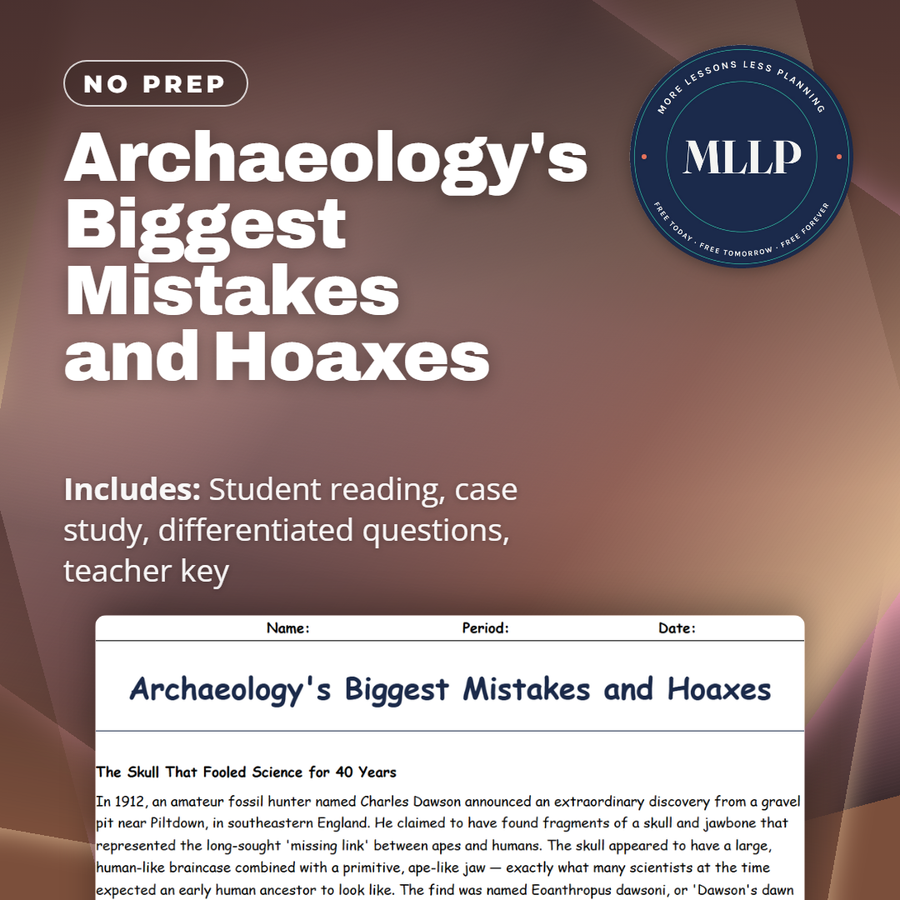
Archaeology's Biggest Mistakes and Hoaxes
Quality reviewed September 2026
Facts verified September 21, 2026
- Subject
- Social Studies
- Grades
- Grades 9-12
- Length
- 10-page student worksheet
- Time
- About one 50-minute class period
- Great for
- Sub plans and independent work
- Includes
- Reading passage, comprehension questions + full answer key
- Format
- Print-and-go PDF
What students do
- Explain why confirmation bias kept British scientists from questioning Piltdown Man for 40 years
- Follow reporter Maya Chen as she checks a Viking runestone's inscription against real Old Norse word forms
- Match five terms, including forgery and peer review, to their correct definitions
- Three fill-in-the-blank answers, Piltdown Man, peer review, and forgery, come straight from the reading's own cases
What it covers
- How the Piltdown Man, Cardiff Giant, and James Ossuary hoaxes fooled scientists and the public
- Confirmation bias and why people want a sensational discovery to be true
- Why peer review, testing, and skepticism eventually exposed each fraud
Start reading this worksheet
The Skull That Fooled Science for 40 Years
In 1912, an amateur fossil hunter named Charles Dawson announced an extraordinary discovery from a gravel pit near Piltdown, in southeastern England. He claimed to have found fragments of a skull and jawbone that represented the long-sought 'missing link' between apes and humans. The skull appeared to have a large, human-like braincase combined with a primitive, ape-like jaw, exactly what many scientists at the time expected an early human ancestor to look like. The find was named Eoanthropus dawsoni, or 'Dawson's dawn man,' and it was embraced by much of the British scientific establishment. For over 40 years, Piltdown Man was featured in textbooks, museum exhibits, and academic papers as genuine evidence of human evolution. It was not until 1953 that scientists at the British Museum applied new chemical testing methods and exposed the truth: the skull was a medieval human cranium, and the jawbone belonged to an orangutan. Both had been deliberately stained with chemicals to look old, and the teeth had been filed down to appear more human. The forgery was crude by modern standards, but it had fooled some of the world's leading scientists for four decades. The Piltdown hoax succeeded for several reasons. British scientists wanted to believe that a major evolutionary discovery had been made in England, which created a bias toward accepting the find. The few researchers who raised doubts were dismissed or ignored. And the artifacts were kept under tight control at the British Museum, making independent examination difficult. Piltdown Man is now a cautionary tale about confirmation bias: the tendency to accept evidence that supports what you already believe while ignoring evidence that contradicts it.
The Cardiff Giant and the Art of the Con
In October 1869, workers digging a well on a farm near Cardiff, New York, unearthed what appeared to be a ten-foot-tall petrified human body. The discovery caused a sensation. Thousands of people traveled to the farm, paying 50 cents each to see the 'Cardiff Giant.' Religious figures declared it proof of the biblical passage that 'there were giants in the earth in those days.' Scientists debated whether it was a genuine fossil or an ancient statue. Newspapers across the country ran front-page stories. The truth was far less dramatic. The Cardiff Giant was a block of gypsum that had been carved into a human shape by a stonecutter in Chicago, then secretly buried on the farm a year earlier. The mastermind was George Hull, a cigar manufacturer and atheist who had gotten into an argument with a fundamentalist preacher about whether the Bible's references to giants were literal. Hull spent nearly $3,000, a fortune at the time, commissioning the statue, transporting it to New York, and burying it where it would eventually be 'discovered.' What makes the Cardiff Giant interesting from an archaeological perspective is how eagerly the public and even some scientists accepted it as real. The desire to find something extraordinary overrode critical thinking. When Yale paleontologist Othniel Charles Marsh examined the giant and declared it 'a most decided humbug,' Hull eventually confessed. But even after the hoax was exposed, P. T. Barnum created his own replica and displayed it, and some people continued to insist the original was genuine. The Cardiff Giant now sits in the Farmers' Museum in Cooperstown, New York. It is a monument to human gullibility.
The James Ossuary Controversy
Not all archaeological controversies are as clear-cut as Piltdown or the Cardiff Giant. In 2002, an Israeli collector named Oded Golan presented a limestone bone box, called an ossuary, bearing an Aramaic inscription that read: 'James, son of Joseph, brother of Jesus.' If authentic, it would have been the first physical evidence directly linked to Jesus of Nazareth, making it one of the most significant archaeological finds in history. The announcement set off a firestorm. The Biblical Archaeology Review published the story, and media coverage was intense. But almost immediately, experts began raising doubts. The Israel Antiquities Authority convened a committee of epigraphers, geologists, and materials scientists, who concluded that while the ossuary itself was ancient, the second half of the inscription, 'brother of Jesus,' had been added recently using a fake patina. Golan was charged with forgery and fraud in a trial that lasted seven years. In 2012, Golan was acquitted, not because the court determined the inscription was genuine, but because the prosecution failed to prove beyond reasonable doubt that Golan personally forged it. The authenticity of the James Ossuary remains disputed to this day. Some scholars believe it is genuine; others are convinced it is a forgery. The case illustrates how difficult authentication can be when an object lacks provenience: the ossuary came from the antiquities market, not a documented excavation, so there is no independent evidence of where or when it was originally found.
Like what you read? The full reading, the case study, and every question set are in the free download below, along with the answer key.
Why this matters
Students see viral claims online every week that turn out to be fabricated, and the pattern behind archaeology's most famous hoaxes is the same pattern behind a fake video or a doctored screenshot: someone wanted a story to be true badly enough to stop checking it. Piltdown Man survived for four decades partly because the specimens were locked away where doubters could not examine them, a version of the same trick that keeps a modern hoax alive, control the evidence and dismiss the skeptics. The reading also shows what actually catches a fraud: patient testing, second opinions, and a willingness to be wrong, the same habits that help a student sort a real headline from a fake one. Reporter Maya Chen's choice to verify the runestone instead of publishing the exciting version is a small, current example of that same discipline.
From one teacher to another
Piltdown Man fooled the British scientific establishment for more than 40 years before chemical testing in 1953 proved the "missing link" skull was a medieval cranium paired with a filed orangutan jaw. This worksheet walks students through three real archaeological hoaxes, from the 1869 Cardiff Giant that drew crowds paying fifty cents to see a carved gypsum statue, to the contested James Ossuary inscription that led to a seven-year forgery trial. A case study follows journalist Maya Chen as she checks a supposed Viking runestone against Old Norse word forms before reporting the story her competitors already ran with. Students finish by explaining how confirmation bias let Piltdown survive so long, and why peer review and skepticism, not authority, are what eventually exposed all three frauds.
What you get
Download
Where should I send the next one?
Everything here is free and it stays that way. Leave your email and I'll send you the new lessons as they go up. You can unsubscribe from any one of them.
Related resources
Archaeology in Pop Culture: What Movies Get Wrong
Careers in Archaeology: What Can You Actually Do?
Context Is Everything: Why Location Matters More Than the Object
Experimental Archaeology: Rebuilding the Past to Understand It
Famous Archaeologists Who Changed the Game
How Climate Change Is Both Revealing and Destroying Archaeological Sites
Every lesson on this site is free to download and use. If one of them saved you a prep period, you can chip in a few bucks toward my three kids' daycare fund. That's genuinely where tips go.