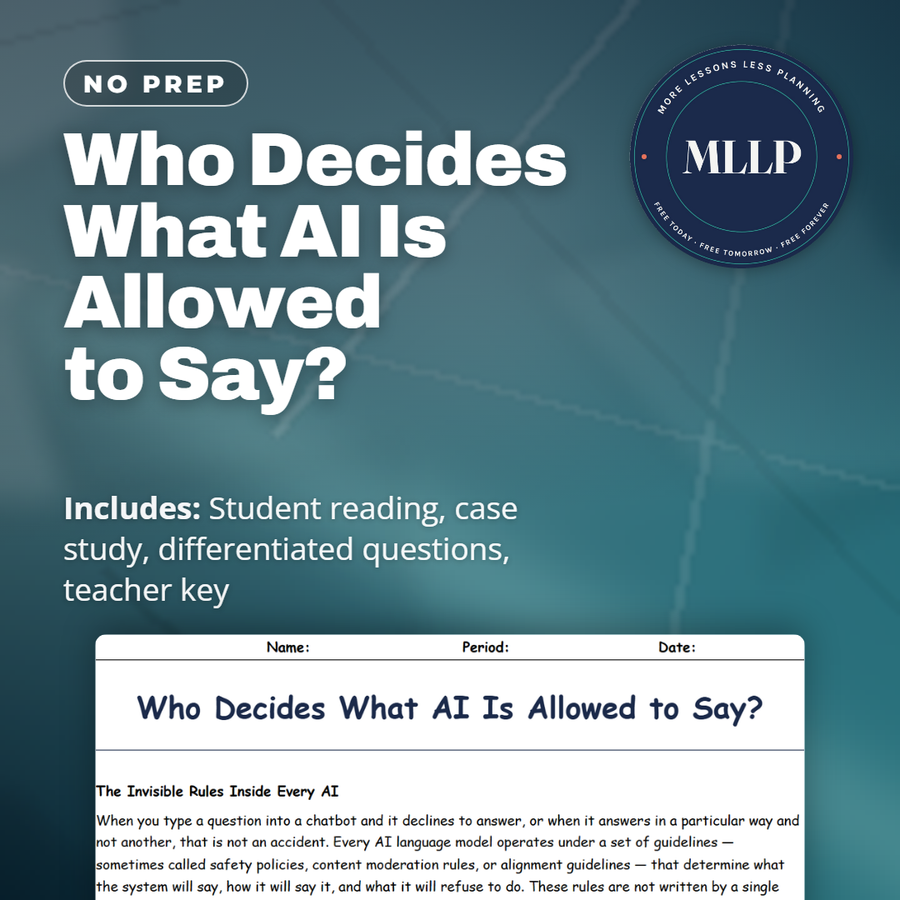
Who Decides What AI Is Allowed to Say?
Quality reviewed September 2026
Facts verified September 20, 2026
- Subject
- Career & Life Skills
- Grades
- Grades 9-12
- Length
- 9-page student worksheet
- Time
- About one 50-minute class period
- Great for
- Sub plans and independent work
- Includes
- Reading passage, comprehension questions + full answer key
- Format
- Print-and-go PDF
What students do
- The labor behind AI safety gets named directly, including where content moderators work and what they're paid
- Trace a chatbot's refusal to answer back to the red-teaming and RLHF labeling that shaped it
- Amara's blocked research questions turn into two case study questions about over-restriction
- Answer multiple choice and fill-in-the-blank questions on cultural asymmetry and content moderation
What it covers
- How AI content rules get written, including red-teaming and RLHF labeling
- The cultural asymmetry problem when Western-trained AI gets deployed worldwide
- Amara's case study on AI research refusals and the over-restriction problem
Start reading this worksheet
The Invisible Rules Inside Every AI
When you type a question into a chatbot and it declines to answer, or when it answers in a particular way and not another, that is not an accident. Every AI language model operates under a set of guidelines (sometimes called safety policies, content moderation rules, or alignment guidelines) that determine what the system will say, how it will say it, and what it will refuse to do. These rules are not written by a single algorithm; they are made by teams of human beings who work at the companies that build the AI. Decisions about what AI is allowed to say are, at their core, decisions about values, and they are currently being made by a very small number of private companies, mostly based in the United States, with very little public accountability. The existence of content guidelines is not inherently problematic. No responsible company would want its AI to help users harm others, produce content that sexualizes children, or generate detailed instructions for weapons. The difficult questions begin when we look at the vast gray area beyond obvious harms: Who decides what counts as "harmful" political speech? What criteria determine whether a topic is too controversial to discuss? How do AI companies balance safety against the risk of being so cautious that the system becomes useless? And whose values and whose culture are embedded in the answers to those questions?
How AI Safety Guidelines Are Made
AI companies typically develop content guidelines through a combination of internal policy teams, ethicists, legal counsel, and red-teaming, a process in which specialists attempt to get the AI to produce harmful or undesirable outputs so that developers can identify and address weaknesses. Major companies also employ contractors, often through third-party firms, to review and label content as safe or unsafe, a process called reinforcement learning from human feedback (RLHF). The workers who do this labeling (often based in countries like Kenya, the Philippines, or Pakistan) are exposed to large volumes of disturbing content including graphic violence, hate speech, and sexual abuse material, and are paid wages that have drawn criticism from labor advocates. The guidelines themselves are typically not fully public. OpenAI, Anthropic, Google, and Meta publish general usage policies, but the detailed rules governing how their models behave (including which topics are off-limits, how the model handles sensitive political questions, and what defaults are applied across different regions) are proprietary. This means that hundreds of millions of people who interact with these systems daily are subject to editorial decisions made by private companies that have not been debated democratically or approved by any government.
The Problem of Political and Cultural Asymmetry
Several researchers and journalists have documented patterns suggesting that AI systems are not politically neutral. Studies have found that some large language models produce different levels of willingness to engage with sensitive topics depending on which political group is being discussed, which religion is referenced, or which country is the subject of a question. In some cases, AI systems have been found to engage more freely with criticism of one religion than another, or to apply different standards of caution to different political ideologies. Whether these patterns reflect intentional choices, artifacts of training data, or biases introduced during human-feedback labeling is often unclear, but the effects are real. The challenge of cultural asymmetry is particularly acute for global deployments. An AI trained primarily on English-language content and calibrated according to norms dominant in American and Western European discourse will bring those norms with it when deployed in India, Nigeria, Brazil, or Saudi Arabia. What counts as acceptable speech, appropriate humor, respectful treatment of religion, or dangerous politics varies enormously across cultures. A system calibrated for one context can produce outputs that are offensive, inaccurate, or actively harmful in another, and the communities affected by those errors typically have no channel through which to influence the people making the decisions.
Like what you read? The full reading, the case study, and every question set are in the free download below, along with the answer key.
Why this matters
Teenagers use chatbots for homework, research, and casual questions every day, and most have never thought about who decided what the chatbot is allowed to tell them. This reading names that decision-making process: a small number of private companies, mostly in one country, setting rules with almost no public input. Amara's case gives students a concrete example of how those rules can backfire, blocking a legitimate research question because the system can't tell the difference between studying propaganda and making it. Once students see that a chatbot's refusal is a choice made by a company, not a neutral fact about the world, they read AI output more critically everywhere else too.
From one teacher to another
Every chatbot follows a set of house rules about what it will and won't say, and this reading pulls back the curtain on where those rules come from. Students see how red-teaming and RLHF labeling shape a model's behavior, and how the humans doing that labeling are often contractors in Kenya or the Philippines reviewing disturbing content for low pay. The reading also digs into cultural asymmetry, the way a chatbot trained mostly on American and European norms carries those norms into Nigeria or Saudi Arabia without anyone asking whether that's appropriate. The case study follows Amara, a student researching AI-generated political propaganda whose own chatbot refuses to answer her research questions.
What you get
Download
Where should I send the next one?
Everything here is free and it stays that way. Leave your email and I'll send you the new lessons as they go up. You can unsubscribe from any one of them.
Related resources
AI and Your Personal Data: What Companies Know
AI in Criminal Justice: Predictive Policing Risks
AI in Healthcare: Helping or Hurting Patients?
Facial Recognition and Wrongful Arrests
Should Schools Use AI to Watch Students?
Stolen Voices and Stolen Art: Copyright in the AI Age
Every lesson on this site is free to download and use. If one of them saved you a prep period, you can chip in a few bucks toward my three kids' daycare fund. That's genuinely where tips go.