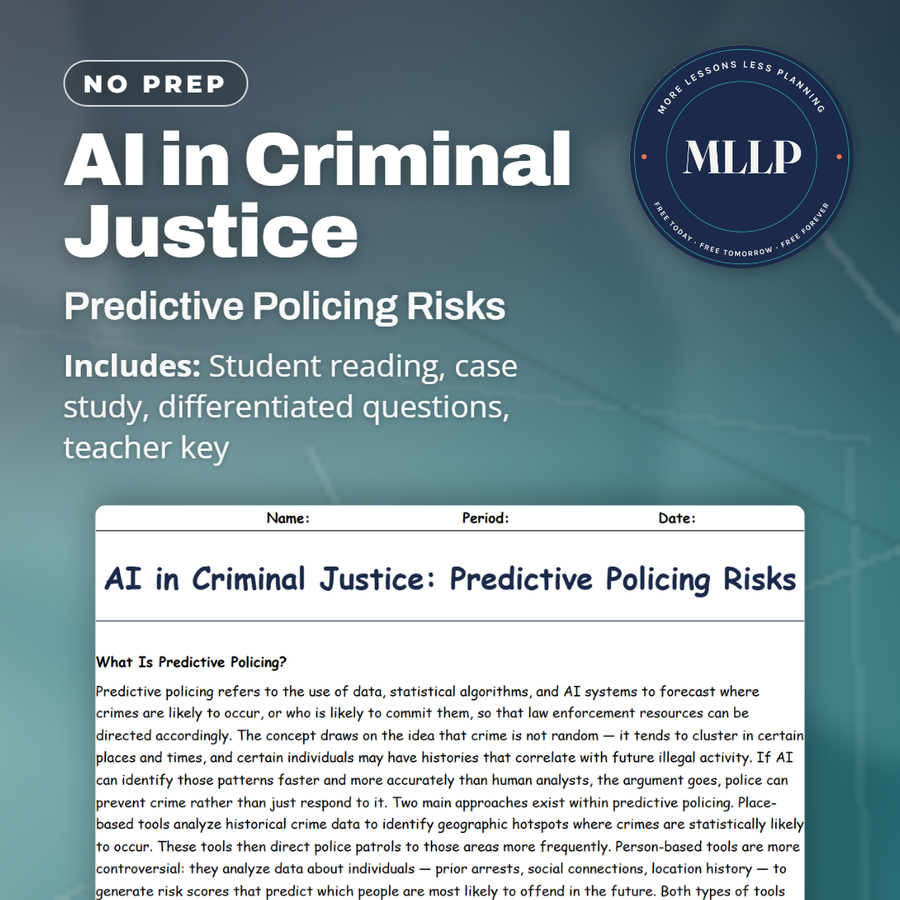
AI in Criminal Justice: Predictive Policing Risks
Quality reviewed September 2026
Facts verified September 20, 2026
- Subject
- Career & Life Skills
- Grades
- Grades 9-12
- Length
- 9-page student worksheet
- Time
- About one 50-minute class period
- Great for
- Sub plans and independent work
- Includes
- Reading passage, comprehension questions + full answer key
- Format
- Print-and-go PDF
What students do
- The hotspot feedback loop and Jerome's COMPAS score both get explained using the reading's own evidence
- ProPublica's 2016 Broward County finding on COMPAS gets connected to the exact numbers it reported
- Match five terms, including recidivism and due process, to their definitions
- Explain why courts have allowed COMPAS scores to influence sentencing despite the due process concern
What it covers
- The feedback loop that turns police patrols into more patrols
- COMPAS and ProPublica's 2016 finding on racial disparities in risk scores
- A case study on a teenager's misdemeanor sentence and a secret algorithm
Start reading this worksheet
What Is Predictive Policing?
Predictive policing refers to the use of data, statistical algorithms, and AI systems to forecast where crimes are likely to occur, or who is likely to commit them, so that law enforcement resources can be directed accordingly. The concept draws on the idea that crime is not random: it tends to cluster in certain places and times, and certain individuals may have histories that correlate with future illegal activity. If AI can identify those patterns faster and more accurately than human analysts, the argument goes, police can prevent crime rather than just respond to it. Two main approaches exist within predictive policing. Place-based tools analyze historical crime data to identify geographic hotspots where crimes are statistically likely to occur. These tools then direct police patrols to those areas more frequently. Person-based tools are more controversial: they analyze data about individuals (prior arrests, social connections, location history) to generate risk scores that predict which people are most likely to offend in the future. Both types of tools are currently in use across numerous jurisdictions in the United States, and both have generated serious criticism from civil rights advocates, researchers, and affected communities.
The Feedback Loop at the Heart of Hotspot Policing
At first glance, directing police to areas where crime has historically been more frequent seems straightforwardly reasonable. If a particular neighborhood has high rates of reported robbery, increasing patrols there seems logical. But critics identify a fundamental problem: the crime data those algorithms use reflects where police have been, not necessarily where crime actually occurs. When more officers patrol a neighborhood, they make more arrests there, including arrests for low-level offenses like drug possession that might go undetected in less-patrolled areas. Those arrests generate new data, which the algorithm interprets as evidence that the neighborhood is high-crime, which directs more officers there, which generates more arrests. This feedback loop means that predictive policing algorithms can become self-fulfilling prophecies. Communities that have historically been over-policed (which in the United States are disproportionately Black and Latino communities) generate more arrest data, which focuses more policing on them, which generates more arrests, which confirms the algorithm's prediction. The algorithm is not measuring crime; it is measuring policing. And because those two things are not identical, the result is a systematic amplification of existing inequities rather than an objective assessment of where crime actually occurs.
COMPAS and the Risk of Predicting People
Perhaps the most controversial predictive tool in criminal justice is not used to direct patrols but to influence sentencing and parole decisions. COMPAS (Correctional Offender Management Profiling for Alternative Sanctions) is a risk assessment algorithm that judges and parole boards use to evaluate the likelihood that a defendant will reoffend. It generates a "risk score" based on answers to a questionnaire that covers factors like employment history, social ties, family criminal history, and neighborhood. The score can influence whether someone receives probation or prison, and how long they remain incarcerated. In 2016, investigative journalists at ProPublica published a landmark analysis of COMPAS scores in Broward County, Florida. They found that the algorithm falsely flagged Black defendants as future criminals at nearly twice the rate it falsely flagged white defendants. Conversely, white defendants were more likely to be incorrectly labeled low-risk, and then go on to reoffend. The company behind COMPAS disputed the methodology, and subsequent academic debate established that multiple definitions of fairness exist and that it is mathematically impossible to satisfy all of them simultaneously with a single algorithm. But the core finding, that a tool influencing real sentences disproportionately mislabeled Black defendants as high-risk, was not effectively refuted.
Like what you read? The full reading, the case study, and every question set are in the free download below, along with the answer key.
Why this matters
I picked this one because most of my students have never heard of COMPAS, but plenty of them live in neighborhoods that get patrolled more heavily than others, so the feedback loop is not abstract to them. Jerome's case shows how a number on a report can follow someone even when it is predicting a future crime he has not committed. Santa Cruz banned this practice outright in 2020, other cities are still using it, which makes this a live policy question, not a settled one.
From one teacher to another
This reading follows the two main forms of predictive policing, place based hotspot tools and person based risk scores, and shows how each one can go wrong. Students see the feedback loop problem first: more patrols in a neighborhood produce more arrests, and the algorithm reads those arrests as proof the neighborhood is dangerous, sending even more officers there. Then the reading turns to COMPAS, the risk assessment tool ProPublica examined in Broward County, Florida in 2016, finding it falsely flagged Black defendants as future criminals at nearly twice the rate of white defendants. The case study follows Jerome, 19, whose COMPAS score of 7 out of 10 came partly from questions about his brother's incarceration and his neighborhood, not from anything he did.
What you get
Download
Where should I send the next one?
Everything here is free and it stays that way. Leave your email and I'll send you the new lessons as they go up. You can unsubscribe from any one of them.
Related resources
AI and Your Personal Data: What Companies Know
AI in Healthcare: Helping or Hurting Patients?
Facial Recognition and Wrongful Arrests

Should Schools Use AI to Watch Students?

Stolen Voices and Stolen Art: Copyright in the AI Age

The Right to Know You're Talking to a Bot
Every lesson on this site is free to download and use. If one of them saved you a prep period, you can chip in a few bucks toward my three kids' daycare fund. That's genuinely where tips go.