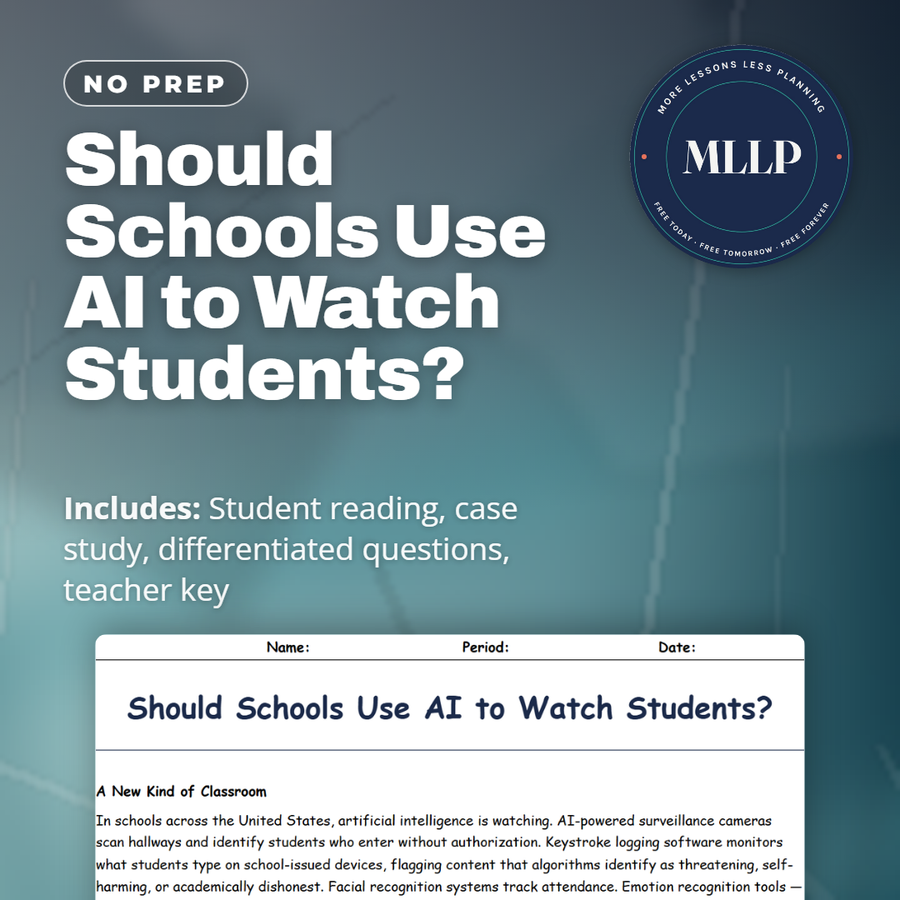
Should Schools Use AI to Watch Students?
Quality reviewed September 2026
Facts verified September 20, 2026
- Subject
- Career & Life Skills
- Grades
- Grades 9-12
- Length
- 9-page student worksheet
- Time
- About one 50-minute class period
- Great for
- Sub plans and independent work
- Includes
- Reading passage, comprehension questions + full answer key
- Format
- Print-and-go PDF
What students do
- Miguel's flagged essay gets connected to the term self censorship and what the reading says it costs students
- Lockport's 2020 facial recognition controversy and FERPA's gaps both get worked through using the reading's details
- Write out one benefit and one harm that Miguel's case shows happening at the same time
- Explain what the Brennan Center's 2019 report found about school surveillance evidence
What it covers
- Proctoring software, keystroke logging, and facial recognition in schools
- Lockport, New York's 2020 facial recognition controversy
- A case study on a flagged personal essay and what happened after
Start reading this worksheet
A New Kind of Classroom
In schools across the United States, artificial intelligence is watching. AI-powered surveillance cameras scan hallways and identify students who enter without authorization. Keystroke logging software monitors what students type on school-issued devices, flagging content that algorithms identify as threatening, self-harming, or academically dishonest. Facial recognition systems track attendance. Emotion recognition tools, used in some international schools, claim to detect whether students are engaged or distressed by analyzing their facial expressions. Social media monitoring programs scan students' personal accounts for content that the school considers concerning. These tools accelerated significantly during and after the COVID-19 pandemic. When schools shifted to remote learning in 2020, proctoring software became widespread: tools that monitor students taking tests from home by activating their cameras, tracking their eye movements, and flagging unusual behavior as potential cheating. Many districts retained or expanded these tools after returning to in-person instruction. Proponents argue that these surveillance systems protect students from threats, maintain academic integrity, and help identify students in crisis. Critics argue that they create a fundamentally different educational environment, one that normalizes constant monitoring and disproportionately harms students from already-marginalized communities.
Proctoring Software and the Equity Problem
Online proctoring software like Proctorio, ExamSoft, and Respondus Monitor became ubiquitous during remote learning and remain in use at many institutions. These tools use AI to analyze students' facial expressions, eye movements, background environments, and typing patterns to flag suspicious behavior for human review or automated score nullification. Students who are flagged may face academic consequences or be required to retake exams. The equity concerns with these tools are substantial and documented. The facial recognition components of some proctoring software perform less accurately on darker-skinned faces, meaning Black and Latino students are more likely to be falsely flagged. Students who take exams in shared family spaces, with siblings present, or without a private quiet room are flagged for environmental conditions over which they have no control. Students with anxiety disorders, autism, or ADHD have reported that the experience of being watched and analyzed causes significant distress that affects their performance. In 2020 and 2021, students at multiple universities filed formal complaints arguing that proctoring software discriminated against them on the basis of race and disability.
Keystroke Logging and the Right to Think Privately
Bark, Gaggle, and similar products are used by thousands of school districts to monitor what students write on school-issued devices. These tools use natural language processing to flag messages, documents, and searches that suggest bullying, self-harm, threats, or cyberbullying. When a flag is triggered, a human reviewer at the company examines the content and may alert school administrators or, in cases involving safety threats, law enforcement. Supporters point to cases in which these tools identified students at serious risk of self-harm or violence in time to intervene. The companies report thousands of cases annually in which their alerts led to wellness checks that may have prevented harm. Critics raise several concerns. First, the monitoring extends to content that students write and delete, including private journal entries and unsent messages, without students or parents always being clearly informed. Second, the tools generate many false positives: students writing fiction, studying violent historical events, or simply venting to a friend are regularly flagged and referred for review. Third, the knowledge that their words are monitored may cause students to self-censor: to avoid writing about mental health struggles, asking questions about sexuality or identity, or researching sensitive topics they need to understand.
Like what you read? The full reading, the case study, and every question set are in the free download below, along with the answer key.
Why this matters
Miguel's essay is the story I keep coming back to because it happened to a kid who did everything right, wrote honestly, got support, and recovered, and still ended up in a counselor's office without his parents knowing first. Students in my classes use school devices every day and most have no idea what Bark or Gaggle actually flags or where that information goes. This reading gives them language for a trade off they are already living inside, whether a school that watches everything is actually safer or just more controlled.
From one teacher to another
Miguel wrote an honest personal narrative about a depression he had already worked through, and three days later a counselor pulled him out of class because his school's monitoring software had flagged it. This reading walks students through the systems behind that moment: proctoring tools like Proctorio that watch faces and eye movement during remote tests, keystroke loggers like Bark and Gaggle that scan what students type, and facial recognition systems like the one Lockport, New York deployed in 2020 using a database that included suspended students. It lays out the equity problems researchers have documented, including proctoring software that performs worse on darker skinned faces, and it names the self censorship risk, that students stop writing honestly once they know a company is reading everything.
What you get
Download
Where should I send the next one?
Everything here is free and it stays that way. Leave your email and I'll send you the new lessons as they go up. You can unsubscribe from any one of them.
Related resources
AI and Your Personal Data: What Companies Know
AI in Criminal Justice: Predictive Policing Risks
AI in Healthcare: Helping or Hurting Patients?
Facial Recognition and Wrongful Arrests
Stolen Voices and Stolen Art: Copyright in the AI Age
The Right to Know You're Talking to a Bot
Every lesson on this site is free to download and use. If one of them saved you a prep period, you can chip in a few bucks toward my three kids' daycare fund. That's genuinely where tips go.