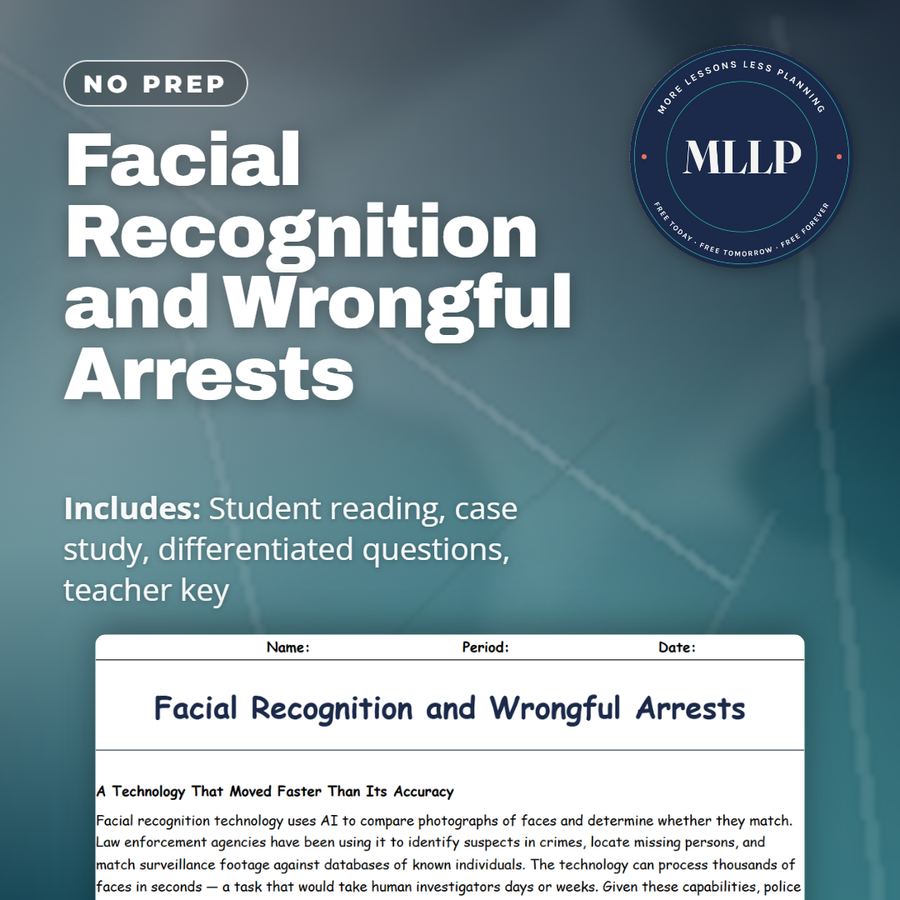
Facial Recognition and Wrongful Arrests
Quality reviewed September 2026
Facts verified September 20, 2026
- Subject
- Career & Life Skills
- Grades
- Grades 9-12
- Length
- 9-page student worksheet
- Time
- About one 50-minute class period
- Great for
- Sub plans and independent work
- Includes
- Reading passage, comprehension questions + full answer key
- Format
- Print-and-go PDF
What students do
- Robert Williams's wrongful arrest and Marcus's eight days in jail get compared side by side
- The difference between a facial recognition hit and a verified match gets tested against real scenarios
- Trace the NIST accuracy findings back to why four wrongful arrest cases all involved Black men
- Explain what investigators should have checked in the surveillance footage before arresting Marcus
What it covers
- Four documented wrongful arrests, including Robert Williams in Detroit
- The NIST accuracy findings behind facial recognition's racial gap
- A case study on a warehouse worker arrested over a robbery he did not commit
Start reading this worksheet
A Technology That Moved Faster Than Its Accuracy
Facial recognition technology uses AI to compare photographs of faces and determine whether they match. Law enforcement agencies have been using it to identify suspects in crimes, locate missing persons, and match surveillance footage against databases of known individuals. The technology can process thousands of faces in seconds, a task that would take human investigators days or weeks. Given these capabilities, police departments across the United States and around the world began adopting facial recognition systems rapidly in the 2010s and 2020s. What those departments often did not fully account for was the technology's accuracy problem: specifically, its tendency to perform significantly worse on certain groups of people. Multiple independent studies, including research commissioned by the National Institute of Standards and Technology (NIST), found that many commercial facial recognition systems produce false positive matches (incorrectly identifying an innocent person as a suspect) at rates up to 100 times higher for Black women than for white men. These accuracy gaps have had direct, documented, and devastating consequences for real people.
Robert Williams: Arrested for a Crime He Did Not Commit
In January 2020, Robert Williams, a Black man living in suburban Detroit, Michigan, was arrested in front of his wife and daughters on his front lawn. He had been accused of shoplifting watches from a luxury store in 2018. The evidence against him consisted of surveillance footage, a photograph from a loyalty card database, and a match returned by a facial recognition system used by the Detroit Police Department. The match turned out to be wrong. Williams spent 30 hours in jail before investigators looked more carefully at the evidence. When a detective showed him a photo array, a standard investigative procedure, Williams held the image next to his face and said, "I hope you don't think all Black men look alike." The detective acknowledged the match was not strong. Williams was released and the case was eventually dropped, but the experience (the arrest, the night in jail, the trauma for his family) was not reversible. Williams later sued the city of Detroit and became the first known case of a wrongful arrest attributed to a faulty facial recognition match in the United States.
Alonzo Sawyer and Michael Oliver: The Pattern Continues
Robert Williams was not the only one. In 2020, Alonzo Sawyer, a Black man in Baltimore, Maryland, was arrested based on a facial recognition match for a robbery he did not commit. He spent ten days in jail before investigators concluded the match was incorrect. In 2019, Michael Oliver, a Black man in Michigan, was arrested and charged with a felony after a facial recognition system erroneously identified him as a suspect in a road rage incident. Oliver's case took months to resolve, during which he lost his job. A fourth case involved Nijeer Parks, a Black man in New Jersey who was arrested in 2019 and spent ten days in jail based on a false facial recognition match. All four documented wrongful arrest cases attributed to facial recognition errors in the United States involved Black men. This is not a coincidence. It reflects the documented accuracy gap in these systems: they are significantly less accurate on darker-skinned faces, which means that when false positive matches occur, they disproportionately affect Black individuals. Critics argue that deploying a technology with known accuracy disparities in life-altering law enforcement decisions without adequate safeguards is itself a form of institutional discrimination.
Like what you read? The full reading, the case study, and every question set are in the free download below, along with the answer key.
Why this matters
I teach this one because every name in it is real and every arrest actually happened. Robert Williams held his own photo next to his face and told the detective he hoped they did not think all Black men look alike, and that line tends to stop a classroom cold. The reading also gives students the tool to push back on the technology itself, the difference between a probability ranking and actual proof, which matters well beyond policing.
From one teacher to another
Four Black men, Robert Williams, Alonzo Sawyer, Michael Oliver, and Nijeer Parks, make up every documented U.S. wrongful arrest tied to facial recognition, and this reading tells all four stories. It starts with Williams, arrested on his own front lawn in front of his wife and daughters in January 2020 for a shoplifting case a faulty match pinned on him, then held for 30 hours in jail before a detective admitted the match was weak. The reading explains the NIST finding behind these cases, that some commercial systems produce false positives up to 100 times more often for Black women than for white men, and it draws the line between a software hit and a verified match. The case study follows Danielle's brother Marcus, held eight days over a robbery he did not commit, who lost his warehouse job before the mismatch was caught.
What you get
Download
Where should I send the next one?
Everything here is free and it stays that way. Leave your email and I'll send you the new lessons as they go up. You can unsubscribe from any one of them.
Related resources
AI and Your Personal Data: What Companies Know
AI in Criminal Justice: Predictive Policing Risks
AI in Healthcare: Helping or Hurting Patients?
Should Schools Use AI to Watch Students?
Stolen Voices and Stolen Art: Copyright in the AI Age
The Right to Know You're Talking to a Bot
Every lesson on this site is free to download and use. If one of them saved you a prep period, you can chip in a few bucks toward my three kids' daycare fund. That's genuinely where tips go.