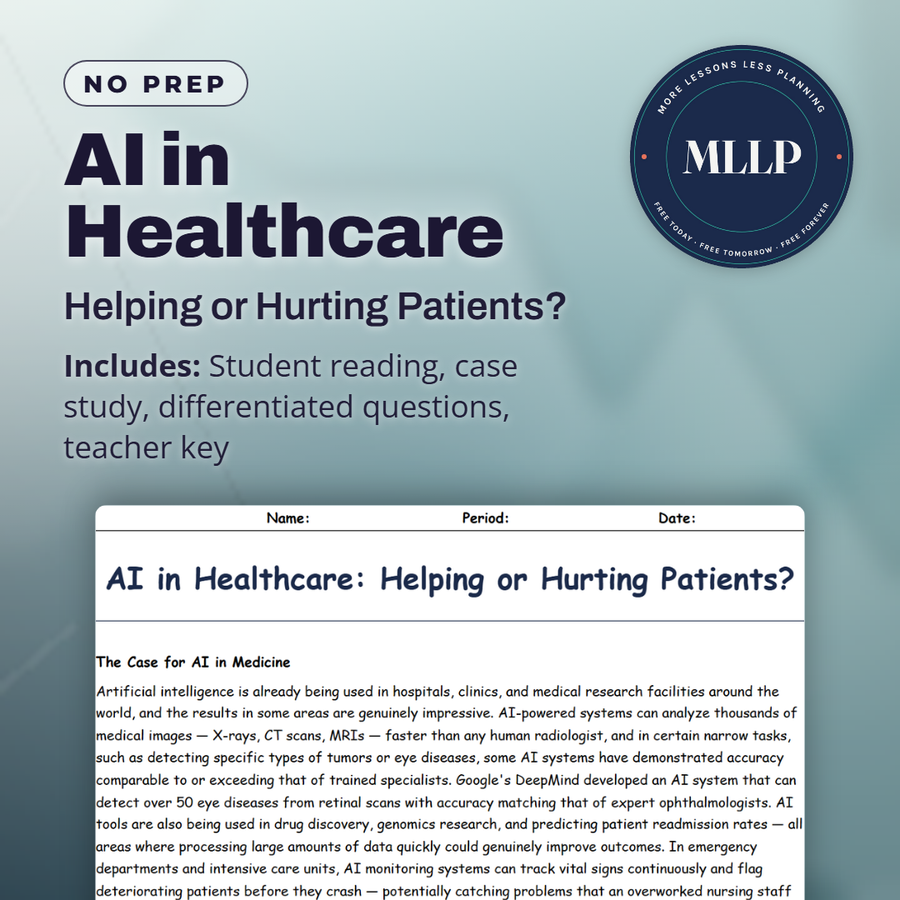
AI in Healthcare: Helping or Hurting Patients?
Quality reviewed September 2026
Facts verified September 20, 2026
- Subject
- Career & Life Skills
- Grades
- Grades 9-12
- Length
- 9-page student worksheet
- Time
- About one 50-minute class period
- Great for
- Sub plans and independent work
- Includes
- Reading passage, comprehension questions + full answer key
- Format
- Print-and-go PDF
What students do
- The Optum algorithm's use of healthcare spending as a stand-in for need gets unpacked step by step
- Priya's 14 alerts in one shift connect directly to the term alert fatigue
- Sort key terms, including proxy variable and sepsis, into their correct definitions
- Fill in three numbers pulled directly from the Optum and JAMA Dermatology passages
What it covers
- A biased healthcare algorithm that affected roughly 200 million patients a year
- Alert fatigue and a sepsis prediction tool with a high false alarm rate
- A case study on a nurse who nearly missed a real sepsis case
Start reading this worksheet
The Case for AI in Medicine
Artificial intelligence is already being used in hospitals, clinics, and medical research facilities around the world, and the results in some areas are genuinely impressive. AI-powered systems can analyze thousands of medical images (X-rays, CT scans, MRIs) faster than any human radiologist, and in certain narrow tasks, such as detecting specific types of tumors or eye diseases, some AI systems have demonstrated accuracy comparable to or exceeding that of trained specialists. Google's DeepMind developed an AI system that can detect over 50 eye diseases from retinal scans with accuracy matching that of expert ophthalmologists. AI tools are also being used in drug discovery, genomics research, and predicting patient readmission rates: all areas where processing large amounts of data quickly could genuinely improve outcomes. In emergency departments and intensive care units, AI monitoring systems can track vital signs continuously and flag deteriorating patients before they crash, potentially catching problems that an overworked nursing staff might miss during a busy shift. In radiology, AI can serve as a second reader, helping catch cancers that a fatigued radiologist might overlook. These applications represent real promise: AI as a tool that amplifies human expertise, catches human error, and helps medical professionals do their jobs better.
An Algorithm That Was Wrong About Race
In 2019, researchers published a landmark study in the journal Science documenting a serious bias problem in one of the most widely used AI algorithms in American healthcare. The algorithm (developed by Optum, a subsidiary of UnitedHealth Group) was used by hospitals and health systems across the country to identify high-risk patients who should receive additional care management services. The algorithm was used to make care decisions for approximately 200 million patients per year. The researchers found that the algorithm was significantly less likely to refer Black patients for additional care than equally sick white patients. In fact, to receive the same level of care referrals as white patients, Black patients had to be considerably sicker. The algorithm did not use race as a variable. Instead, it used healthcare costs as a proxy for health needs; the reasoning was that patients with higher medical costs must have more health needs. The problem was that Black patients in the United States spend less on healthcare than white patients with the same health conditions, largely due to longstanding barriers to healthcare access, including historical discrimination, geographic disparities, and insurance gaps. The algorithm interpreted lower spending as lower need, effectively translating systemic inequality in healthcare access into a direct disadvantage in who received care management.
Skin Tone and Dermatology AI
Dermatology, the branch of medicine dealing with skin conditions, has been a particularly active area for AI development. AI tools that analyze photographs of skin lesions and moles have shown impressive accuracy in detecting melanoma and other skin cancers. However, most of these systems were developed and trained primarily on datasets of images from lighter-skinned patients. Skin conditions look different on darker skin, and symptoms that are easy to detect on light skin may present differently or be harder to photograph accurately on darker skin. A 2021 study published in JAMA Dermatology found that most publicly available dermatology AI datasets were severely lacking in representation of darker skin tones. When AI systems trained on those datasets are deployed in clinical settings, they perform less accurately for patients with darker skin. This means the patients at highest risk of having their diagnoses delayed or missed are the same patients who already face disparities in access to dermatological care. The problem compounds: underrepresentation in data leads to less accurate AI, which leads to worse care, which leads to worse health outcomes for groups already facing health inequity.
Like what you read? The full reading, the case study, and every question set are in the free download below, along with the answer key.
Why this matters
This is the reading I use when a student says AI in medicine sounds like an easy win. The Optum algorithm never used race as an input and still under-treated Black patients for years before anyone caught it, which is the whole point about proxy variables. Priya's story about alert fatigue also lands with kids who have watched a parent or grandparent deal with a hospital, because it shows that more alerts is not the same thing as better care.
From one teacher to another
Students start with the genuine upside, an AI system from Google's DeepMind that detects more than 50 eye diseases from retinal scans as accurately as expert ophthalmologists, before the reading turns to what goes wrong. A 2019 study in Science found that an algorithm used by Optum for roughly 200 million patients a year under-referred Black patients for extra care, because it used healthcare spending as a stand-in for health need. The reading also covers dermatology AI trained mostly on lighter skin tones and a sepsis prediction tool that fired so many false alarms that nurses stopped trusting it. Priya, the nurse in the case study, received 14 sepsis alerts in one shift, and the one patient she checked and moved past turned out to have a confirmed sepsis diagnosis by morning.
What you get
Download
Where should I send the next one?
Everything here is free and it stays that way. Leave your email and I'll send you the new lessons as they go up. You can unsubscribe from any one of them.
Related resources
AI and Your Personal Data: What Companies Know
AI in Criminal Justice: Predictive Policing Risks
Facial Recognition and Wrongful Arrests
Should Schools Use AI to Watch Students?
Stolen Voices and Stolen Art: Copyright in the AI Age
The Right to Know You're Talking to a Bot
Every lesson on this site is free to download and use. If one of them saved you a prep period, you can chip in a few bucks toward my three kids' daycare fund. That's genuinely where tips go.