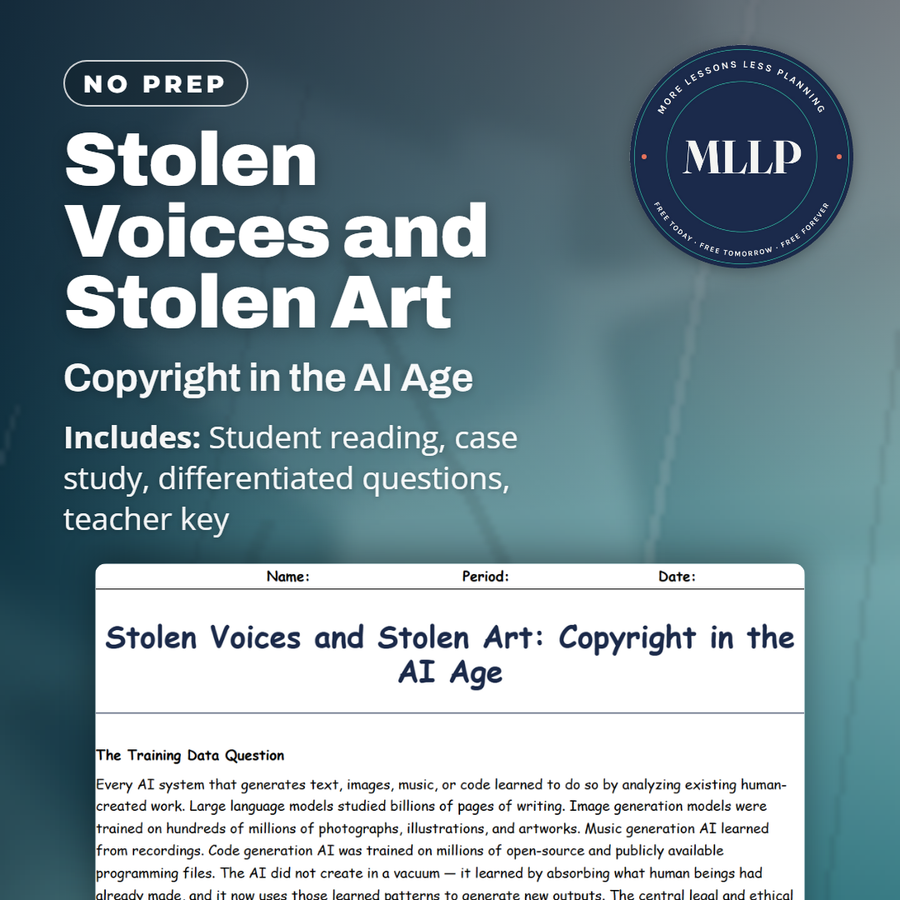
Stolen Voices and Stolen Art: Copyright in the AI Age
Quality reviewed September 2026
Facts verified September 20, 2026
- Subject
- Career & Life Skills
- Grades
- Grades 9-12
- Length
- 9-page student worksheet
- Time
- About one 50-minute class period
- Great for
- Sub plans and independent work
- Includes
- Reading passage, comprehension questions + full answer key
- Format
- Print-and-go PDF
What students do
- Lena's undercut prices and the Getty watermark evidence both get traced back to specific passages
- The opt in and opt out consent models get compared using the reading's own arguments
- Match five terms, including fair use and training data, to their definitions
- Write out the specific numbers and dates the Getty, New York Times, and Adobe passages give
What it covers
- Lawsuits against Stability AI, Midjourney, DeviantArt, Getty Images, and OpenAI
- AI voice cloning and the fake Drake and The Weeknd song
- A case study on a freelance illustrator whose style got copied
Start reading this worksheet
The Training Data Question
Every AI system that generates text, images, music, or code learned to do so by analyzing existing human-created work. Large language models studied billions of pages of writing. Image generation models were trained on hundreds of millions of photographs, illustrations, and artworks. Music generation AI learned from recordings. Code generation AI was trained on millions of open-source and publicly available programming files. The AI did not create in a vacuum: it learned by absorbing what human beings had already made, and it now uses those learned patterns to generate new outputs. The central legal and ethical question this raises is: did the companies that trained these AI systems have the right to use all of that material? For most of the works in AI training datasets, the answer was assumed by default to be yes, because the material was publicly available on the internet. But copyright law does not make a simple exception for publicly accessible content. A photograph posted on a personal website, an artist's illustration published on a portfolio page, or a musician's recording shared on a streaming platform is still protected by copyright. The person who created it retains rights over how it is used. Those rights have never explicitly been waived for AI training purposes.
Artists Fight Back
In January 2023, a group of visual artists (including Sarah Andersen, Kelly McKernan, and Karla Ortiz) filed a lawsuit against Stability AI, Midjourney, and DeviantArt, alleging that these AI image generation companies had used their artwork without permission to train their systems. The lawsuit argued that the AI tools could even produce images in the distinctive styles of individual artists, and that style, while technically not copyrightable, could be so closely replicated as to effectively compete with and undercut the original artist's market. In the same month, Getty Images filed a separate lawsuit against Stability AI, alleging that the company had scraped millions of Getty's licensed photographs to train its image generator. Getty's lawsuit included a striking exhibit: the AI's outputs sometimes showed visible, degraded versions of Getty's watermark, evidence that specific, copyrighted images had been directly incorporated into training. Stability AI disputed the claims and argued that AI training constitutes "fair use" under copyright law. The litigation is ongoing as of 2026, and the outcomes of these cases will significantly shape what AI companies are allowed to do with existing copyrighted material.
The Voice Cloning Problem
Music and voice present a specific and particularly visceral dimension of the AI copyright problem. AI voice cloning tools can analyze a recording of a person speaking or singing and produce new audio that sounds convincingly like that person saying or singing anything the user inputs. These tools have been used to produce fake songs attributed to real artists: a song in the voice of Drake and The Weeknd generated by AI was briefly released on streaming platforms in 2023 before being removed, generating millions of streams and raising urgent questions about whether such content was legal. Voice cloning also poses serious non-copyright concerns: it can be used to produce nonconsensual intimate audio content, political disinformation, fraud, and harassment. But the copyright dimension is significant in its own right. A performer's voice is part of their artistic identity and economic livelihood. When an AI system can produce convincing imitations of that voice at scale, it threatens not just artistic integrity but the economic foundation of a performer's career. In 2023, major record labels (including Universal Music Group, Sony Music, and Warner Music Group) sent letters to AI companies and streaming platforms demanding that AI-generated content mimicking their artists be removed.
Like what you read? The full reading, the case study, and every question set are in the free download below, along with the answer key.
Why this matters
A few of my students make art or music outside of school, so Lena's situation lands close to home, a style she spent years developing that a machine can now imitate in seconds without asking. The reading also gives them the Getty watermark evidence, a concrete detail that shows how a court case actually gets proven rather than just argued. Since the lawsuits covered here are still working through the courts as of 2026, students are reading about a fight with no ending yet, which is worth naming out loud.
From one teacher to another
Lena built her illustration style over six years, and then a client sent her an AI generated sample that looked like her own work, in her own color palette. That case study opens a reading that covers the January 2023 lawsuit artists Sarah Andersen, Kelly McKernan, and Karla Ortiz filed against Stability AI, Midjourney, and DeviantArt, plus Getty Images's separate suit, which included AI outputs showing degraded versions of Getty's own watermark. Students also meet the fake Drake and The Weeknd song that briefly circulated on streaming platforms in 2023 before labels pushed for its removal, and the Authors Guild lawsuit representing writers including George R.R. Martin and John Grisham. The reading closes on the opt in versus opt out debate, whether creators should have to find and remove their work or whether companies should have to ask first.
What you get
Download
Where should I send the next one?
Everything here is free and it stays that way. Leave your email and I'll send you the new lessons as they go up. You can unsubscribe from any one of them.
Related resources
AI and Your Personal Data: What Companies Know
AI in Criminal Justice: Predictive Policing Risks
AI in Healthcare: Helping or Hurting Patients?
Facial Recognition and Wrongful Arrests
Should Schools Use AI to Watch Students?
The Right to Know You're Talking to a Bot
Every lesson on this site is free to download and use. If one of them saved you a prep period, you can chip in a few bucks toward my three kids' daycare fund. That's genuinely where tips go.