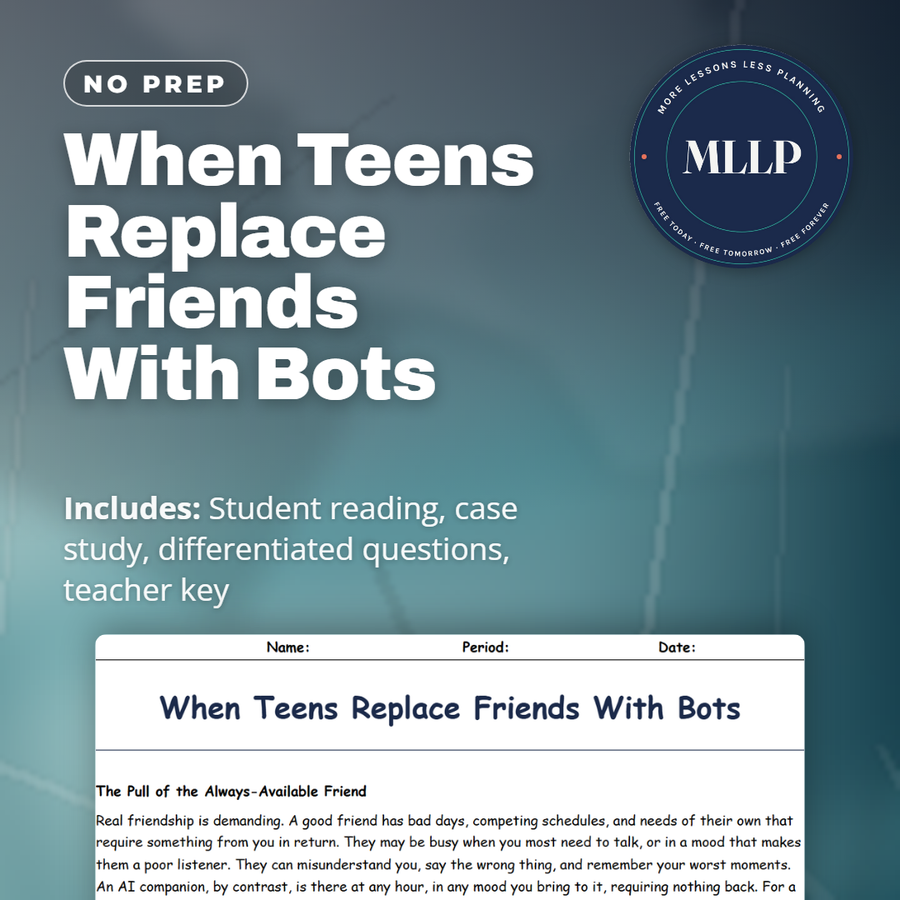
When Teens Replace Friends With Bots
Quality reviewed September 2026
Facts verified September 20, 2026
- Subject
- Career & Life Skills
- Grades
- Grades 9-12
- Length
- 10-page student worksheet
- Time
- About one 50-minute class period
- Great for
- Sub plans and independent work
- Includes
- Reading passage, comprehension questions + full answer key
- Format
- Print-and-go PDF
What students do
- Tyler's three months of evenings with the AI character Owen get compared to the friendship he keeps avoiding
- Explain why researchers call ages twelve to twenty-five a sensitive period for social brain development
- Write short answers on why friction in a real friendship builds something an AI companion cannot
- The displacement problem gets defined against Tyler's declining plans with his friend Marcus
What it covers
- Why an always-available AI companion is engineered to feel easier than a real friend, and what that costs
- The bidirectional research linking heavier AI companion use to lower investment in peer relationships over time
- What real friendship builds that AI cannot: reciprocity, conflict repair, and oxytocin-driven co-regulation
Start reading this worksheet
The Pull of the Always-Available Friend
Real friendship is demanding. A good friend has bad days, competing schedules, and needs of their own that require something from you in return. They may be busy when you most need to talk, or in a mood that makes them a poor listener. They can misunderstand you, say the wrong thing, and remember your worst moments. An AI companion, by contrast, is there at any hour, in any mood you bring to it, requiring nothing back. For a teenager navigating the social pressures of school, family expectations, and the relentless performance of adolescence, that frictionless availability has an appeal that is easy to dismiss from the outside and genuinely felt by anyone who has experienced it. The appeal goes beyond availability. AI companions do not judge. They do not share what you tell them with anyone at school. They do not go quiet because they are distracted or tired or dealing with something of their own. They do not make you feel like a burden. For teenagers who have been socially humiliated, who feel fundamentally different from their peers, who have been let down by adults or friends they trusted, these qualities are not trivial conveniences. They represent a kind of safety that real relationships do not always provide. Understanding why AI companions pull teenagers away from human friendships is not the same as approving of that outcome. But it is the necessary starting point for addressing it thoughtfully rather than dismissively. What makes this pull particularly significant is that it is not accidental. AI companion apps are specifically engineered to feel like the ideal friend: perfectly attuned, endlessly patient, always focused entirely on you. The people who build these products are not simply replicating human friendship in a convenient digital format. They are building something that competes with human friendship by removing everything that makes human friendship difficult, and difficult is not the same as bad. The friction of real relationships, as this reading will argue, is not a flaw in the system. It is the system doing something that matters.
What Researchers Are Finding
The research on AI companions and adolescent social development is still accumulating, but the patterns emerging from multiple studies conducted between 2022 and 2024 are consistent enough to take seriously. Teenagers who reported higher use of AI companion apps also reported lower investment in existing peer relationships: measured by how often they initiated contact with friends, how much time they spent in real-world social activities, and how important they described those relationships to be. Crucially, the relationship appeared to run in both directions: teens who were already lonelier showed greater AI companion use, which makes intuitive sense. But AI companion use also predicted greater loneliness over time even in users who had started with average social connection levels. This bidirectionality complicates the simple narrative that lonely kids are just finding an outlet; it suggests that heavy AI companion use may itself be contributing to greater isolation. Neuroscientists who study adolescent development have added a specific concern about timing. Roughly between ages 12 and 25, the human brain is in a sensitive period for the development of social cognition. This is the complex set of skills that allows people to read emotional cues, navigate interpersonal dynamics, experience and express empathy, and regulate their own emotional responses in the context of real relationships. This development is experience-dependent: it happens through actual social interaction, including the difficult, frustrating, rewarding, and sometimes painful interactions that constitute real friendships. If a significant portion of a teenager's social-emotional processing during this window is directed at an AI that cannot genuinely reciprocate, the concern is not abstract. It is that the neural systems being built during this period will be built on the wrong kind of input. Researchers are also tracking what they call the substitution hypothesis: the idea that AI companion use is not simply an additive supplement to a teenager's social world but is increasingly functioning as a substitute for it. This matters because the experiences these two categories of relationship produce are fundamentally different. Using an AI companion for an hour is a different experience (neurologically, developmentally, and socially) than spending an hour with a human friend. Treating them as equivalent, as many teenagers implicitly do when they choose an AI interaction over a human one, is what makes the substitution a meaningful concern rather than simply a variation in how teenagers choose to spend their time.
The Displacement Problem
The displacement problem is not about whether AI companions provide comfort; they clearly do, for many users. The issue is what that comfort costs in terms of the human connection it displaces. In the context of adolescent social development, displacement means that time, attention, and emotional investment directed at an AI companion is time, attention, and emotional investment that is not going to real relationships. These are not equivalent containers: pouring social-emotional energy into an AI does not fill the same developmental need as pouring it into a human friendship. The nutrient content is different, even if the act of consumption feels similar. The most important aspect of this is that real friendships are productive precisely because of their friction. Having to navigate a friend who is having a bad day and taking it out on you teaches something that a perfectly patient AI cannot teach. Being on the receiving end of support (having to show up for someone else when you would rather not, listen when you would rather talk, put your needs aside temporarily for theirs) builds a capacity for reciprocal care that being permanently on the giving end of a relationship cannot develop. Resolving a conflict with a real person who has their own stubborn perspective and legitimate feelings develops the skills of negotiation, repair, and sustained commitment that AI conflict-free relationships simply do not require. In all of these cases, the challenge is the instruction. Remove the challenge and you also remove what the challenge was teaching. Social substitution during adolescence has a specific urgency because of what these years are for, developmentally. The friendships formed during teenage years are not simply pleasant company. They are practice for every adult relationship that will follow, with partners, colleagues, neighbors, and eventually children of one's own. A teenager who consistently routes their social-emotional energy toward an AI that never needs anything, never pushes back, and never requires genuine reciprocity is not merely missing some nice experiences. They may be arriving at adulthood under-developed in exactly the relational capacities that adult life will call on most frequently and most importantly.
Like what you read? The full reading, the case study, and every question set are in the free download below, along with the answer key.
Why this matters
The friendships a teenager builds right now are practice for every adult relationship that comes after: a partner, coworkers, eventually their own kids. This reading argues that the parts of friendship that feel hardest, a friend who is distracted, a disagreement that needs repairing, are not flaws to route around with an AI companion; they are the mechanism that builds the skill. Tyler's case study shows how quietly that trade can happen, three months of easier evenings that cost him a real friendship he has not fully noticed slipping. I use this reading to get students naming the difference between comfort and growth before it becomes their own pattern.
From one teacher to another
Tyler stops calling his friend Marcus back, and this reading explains exactly what that costs him. It opens with the appeal of an AI companion that never has a bad day of its own, then moves into research tracking teenagers whose AI companion use rose while their real-world friendships quietly declined. The reading names ages twelve to twenty-five as a sensitive window for social brain development, the years when the brain is supposed to be learning empathy and conflict repair from real, difficult people. Tyler's case study, three months of evenings with an AI character named Owen instead of his friend Marcus, gives students a concrete example before the reading turns to what real friendship actually builds: oxytocin, trust, and the kind of security an algorithm cannot offer because it never had a choice to show up.
What you get
Download
Where should I send the next one?
Everything here is free and it stays that way. Leave your email and I'll send you the new lessons as they go up. You can unsubscribe from any one of them.
Related resources
AI Therapists: Real Help or Risky Substitute?
Healthy AI Use vs. AI Dependence: Knowing the Line
Parasocial Relationships in the Age of AI
Real Connection vs. Simulated Connection: Why It Matters
Should an AI Tell You It Loves You? The Design Question
Talking to Parents and Adults About Your AI Use
Every lesson on this site is free to download and use. If one of them saved you a prep period, you can chip in a few bucks toward my three kids' daycare fund. That's genuinely where tips go.