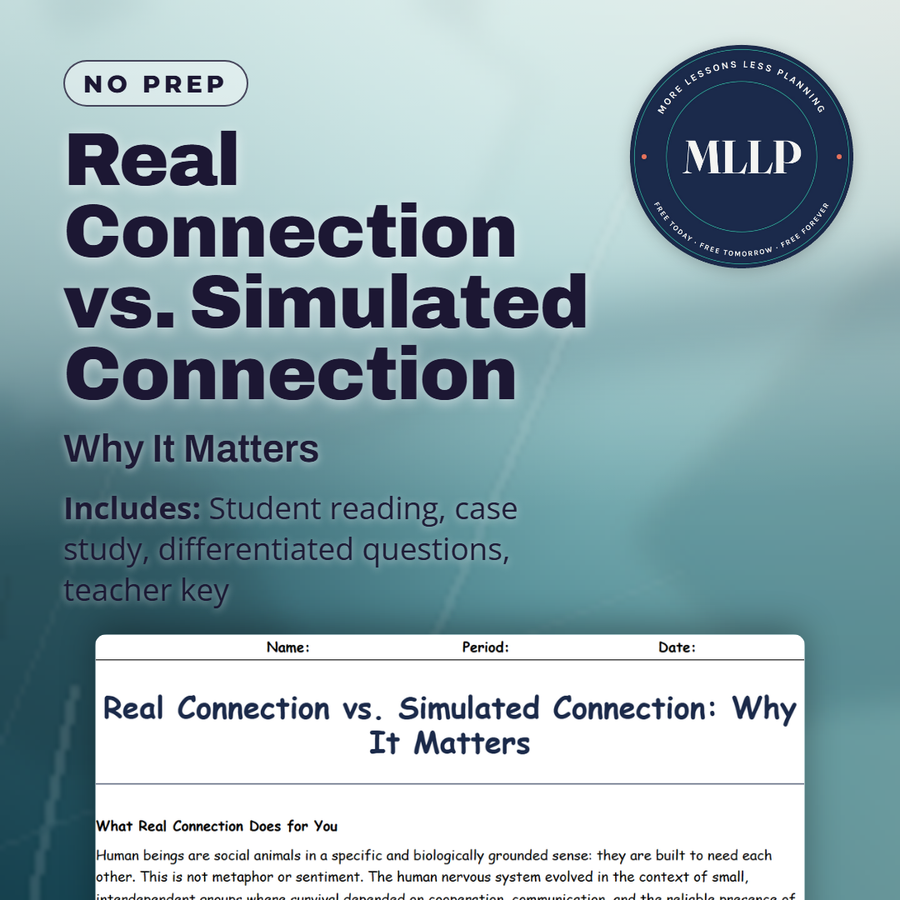
Real Connection vs. Simulated Connection: Why It Matters
Quality reviewed September 2026
Facts verified September 20, 2026
- Subject
- Career & Life Skills
- Grades
- Grades 9-12
- Length
- 10-page student worksheet
- Time
- About one 50-minute class period
- Great for
- Sub plans and independent work
- Includes
- Reading passage, comprehension questions + full answer key
- Format
- Print-and-go PDF
What students do
- Explain co-regulation, the nervous-system effect a friend's voice produces that text on a screen cannot
- Trace the 26 to 29 percent mortality risk the reading links to social isolation, and what it compares to
- Compare Eli's Monday conversation with an AI companion to his Wednesday phone call with his friend Jordan
- Weigh what the reading says AI companions can genuinely offer against what only a real person can
What it covers
- The biology of real connection, oxytocin, co-regulation, and the threat-detection system
- Why AI cannot replicate being genuinely known, and the health research linking isolation to earlier death
- Eli's case study comparing an AI conversation to a phone call with a friend who had been through the same thing
Start reading this worksheet
What Real Connection Does for You
Human beings are social animals in a specific and biologically grounded sense: they are built to need each other. This is not metaphor or sentiment. The human nervous system evolved in the context of small, interdependent groups where survival depended on cooperation, communication, and the reliable presence of other people. The physiological systems that regulate stress, produce feelings of safety, and sustain long-term health are calibrated to operate in the presence of genuine social connection. When those systems are deprived of their expected input (other humans, in real relationship), they register a form of distress that is, in its biological structure, quite similar to other forms of physical pain. Loneliness is not just a feeling; it is a signal from a biological system that something it needs is missing. The research on social connection and health is among the most consistent and replicated in all of medicine. People with strong, high-quality social relationships live longer (on average, significantly longer) than those who are isolated. They recover from illness more quickly, show better immune function, demonstrate more resilience under stress, and report higher levels of sustained wellbeing across their lifespans. A meta-analysis published in 2015 that reviewed data from more than 3 million people found that social isolation and loneliness were associated with a roughly 26 to 29 percent increased risk of mortality, a magnitude comparable to the health risk of smoking 15 cigarettes a day. The relationship between genuine human connection and physical health is not soft or speculative; it is one of the most robustly supported findings in public health research. Understanding why social connection has these effects requires understanding what real connection actually does at the neurological level. Face-to-face interaction with another human being activates a set of brain systems that are specifically calibrated for that purpose: the oxytocin system, which produces feelings of trust and bonding; the mirror neuron system, which allows you to simulate another person's experience and feel something like what they feel; and the threat-detection system, which uses social signals (tone, eye contact, facial expression) to continuously assess safety and update the nervous system's stress state. These systems are not activated in the same way or to the same depth by text-based interaction, whether with a human or an AI. The brain knows the difference, even when the conscious mind does not always notice.
What AI Can and Cannot Replicate
A sophisticated AI companion can produce many of the surface-level experiences of social connection: the feeling of being heard, the sense that someone is interested in you, the comfort of a response that seems to understand your situation. These are real experiences (the emotional comfort they provide is not imaginary), and for people in acute isolation, they have genuine short-term value. The question is not whether AI companions provide something but whether what they provide is equivalent to, or a substitute for, what real human connection provides. On this question, the research is consistent: it is not and it cannot be. The most fundamental thing AI cannot replicate is the epistemic reality of being known. When another human being knows you (knows your history, has witnessed your failures and your growth, chooses to remain in relationship with you across time), that knowledge creates a specific kind of psychological security that AI cannot produce. An AI can be trained to reference your history and respond as if it knows you, but it does not know you in the sense that matters: it has not chosen you, it has not witnessed you, it has no stake in your future. The security of being genuinely known depends on the existence of a real other (someone who could have left or judged you and did not), and AI, by its nature, cannot provide this. The apparent intimacy of an AI companion interaction is real in its felt quality; it is not real in its substance. AI cannot replicate co-regulation, the process by which two people in physical proximity regulate each other's nervous systems. When you sit with a calm person, your own stress physiology adjusts in response to their presence: your breathing slows, your cortisol levels drop, your threat-detection system receives signals of safety that it cannot receive from text on a screen. This is why human presence provides comfort that remote communication, however warm, does not fully match; and why remote communication, however sophisticated, provides comfort that AI interaction does not fully match. The chain of reduction from in-person to remote to AI-mediated is not just a matter of convenience; each step removes something that the human nervous system was built to receive.
The Neurological Gap AI Cannot Bridge
The neurological gap between AI interaction and genuine human connection is not primarily about the quality of the language generated. It is about the biology of social cognition. Human beings read social signals through a system that evolved to process extraordinarily complex, multimodal information: the microexpressions in a face, the prosody of a voice, the posture of a body, the subtle synchronization of breathing and movement that occurs between people in genuine rapport. Text-based interaction, whether with a human or an AI, strips most of this information away. What remains is language, and language is powerful, but it is not the full signal. The social brain system (the network of brain regions that process social information, attribute mental states to others, and regulate social behavior) is experience-dependent in a specific way: it develops and is maintained through real social interaction. Research on social isolation shows that the social brain system begins to show functional changes after extended periods without genuine human contact. It becomes more reactive to perceived threats, less accurate at reading positive social signals, and less capable of the complex social judgment that human relationships require. AI companion interaction does not substitute for the real social input that keeps this system calibrated; it provides a signal that resembles social interaction in some respects but lacks the depth, complexity, and biological reality that the social brain system is calibrated to process. The threat-detection system is particularly relevant. This system, centered in the amygdala and connected to the autonomic nervous system, uses social signals to continuously assess whether the environment is safe. It reads the faces, voices, and bodies of the people around you and uses that reading to calibrate your stress response. Real human relationships, over time, produce a specific update to this system: repeated experience of being with someone who is trustworthy, warm, and reliably present teaches the threat-detection system to read the world as safer. This update cannot be produced by AI. The threat-detection system responds to actual social information from actual other humans; a text generator, however warm its outputs, does not produce the biological signal that the system is calibrated to receive. Real relationships, over time, make you feel safer in the world. AI companions cannot do this.
Like what you read? The full reading, the case study, and every question set are in the free download below, along with the answer key.
Why this matters
This reading is not an argument against ever using an AI companion. It argues for knowing exactly what one can and cannot do for a person's actual nervous system, beyond how a conversation feels in the moment. The research here is specific: isolation carries a mortality risk in the range of smoking a pack of cigarettes a day, and a friend's actual voice regulates stress in a way no chat window can. A student who understands that difference is better equipped to use AI as a supplement on a hard night and still pick up the phone and call Jordan, or whoever their own Jordan happens to be.
From one teacher to another
Eli's body knew something his conscious mind had to work to name. On Monday, an AI companion helped him talk through college application anxiety for forty minutes, and he felt calmer. On Wednesday, the same worry, he called his friend Jordan instead, who had been through it and said so. Twenty five minutes later the feeling had not been managed so much as moved. This reading explains why: real presence regulates a person's nervous system in ways text cannot reach, and decades of research tie strong relationships to a meaningfully longer life. None of that makes an AI companion worthless. It means the reading draws a clear line between something that can help and something that can actually meet the need underneath the loneliness.
What you get
Download
Where should I send the next one?
Everything here is free and it stays that way. Leave your email and I'll send you the new lessons as they go up. You can unsubscribe from any one of them.
Related resources
AI Therapists: Real Help or Risky Substitute?
Healthy AI Use vs. AI Dependence: Knowing the Line
Parasocial Relationships in the Age of AI
Should an AI Tell You It Loves You? The Design Question
Talking to Parents and Adults About Your AI Use
The Character.AI Story: When a Game Becomes Real
Every lesson on this site is free to download and use. If one of them saved you a prep period, you can chip in a few bucks toward my three kids' daycare fund. That's genuinely where tips go.