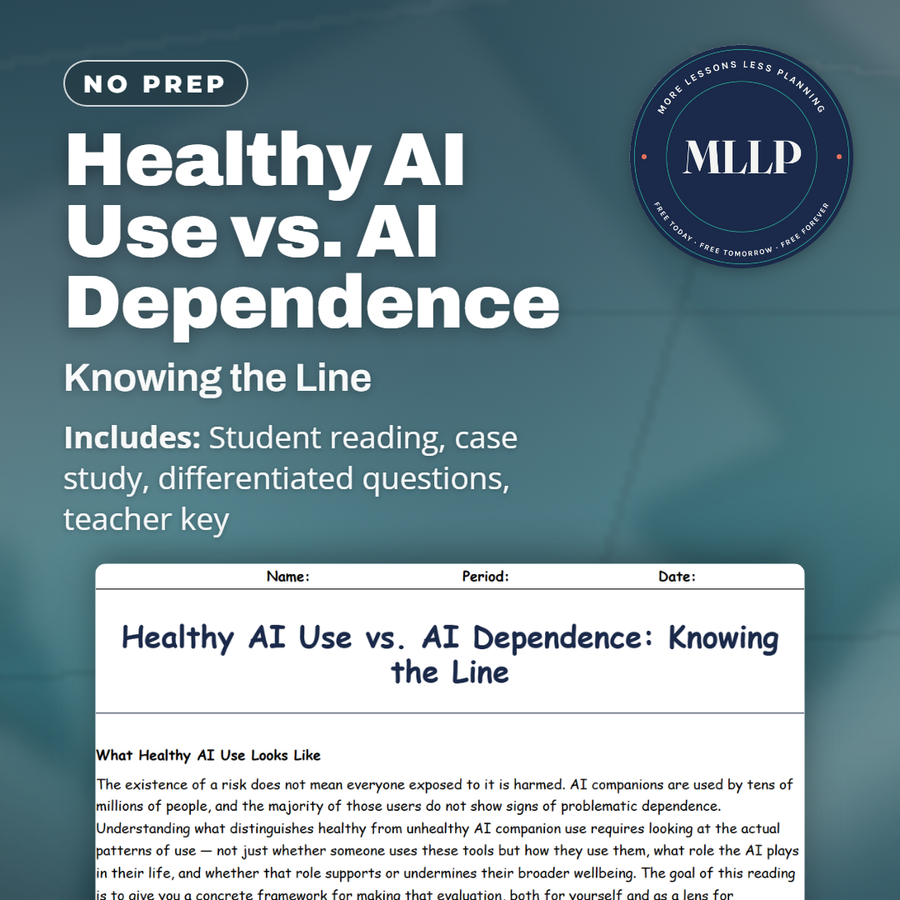
Healthy AI Use vs. AI Dependence: Knowing the Line
Quality reviewed September 2026
Facts verified September 20, 2026
- Subject
- Career & Life Skills
- Grades
- Grades 9-12
- Length
- 10-page student worksheet
- Time
- About one 50-minute class period
- Great for
- Sub plans and independent work
- Includes
- Reading passage, comprehension questions + full answer key
- Format
- Print-and-go PDF
What students do
- Four warning signs, escalation, substitution, withdrawal discomfort, and rationalization, get checked against Cameron's own audit
- Explain why intermittent reinforcement is compared to the same mechanism that makes slot machines hard to walk away from
- Write out the difference between using a tool on purpose and being used by one without noticing
- Weigh Cameron's audit line by line, 28 days opened out of 30, and two declined invitations to a friend's house
What it covers
- What bounded engagement looks like, and the four warning signs that separate healthy use from dependence
- Why AI companions are designed with intermittent reinforcement, the same pull behind a slot machine
- Cameron's honest 28-day audit, and the three-step process the reading recommends for recalibrating
Start reading this worksheet
What Healthy AI Use Looks Like
The existence of a risk does not mean everyone exposed to it is harmed. AI companions are used by tens of millions of people, and the majority of those users do not show signs of problematic dependence. Understanding what distinguishes healthy from unhealthy AI companion use requires looking at the actual patterns of use: not just whether someone uses these tools but how they use them, what role the AI plays in their life, and whether that role supports or undermines their broader wellbeing. The goal of this reading is to give you a concrete framework for making that evaluation, both for yourself and as a lens for understanding what the research shows. Healthy AI companion use is characterized by what researchers call bounded engagement: interaction that is limited in scope and role, that the user can step away from voluntarily, and that complements rather than substitutes for real-world social connection. A student who uses an AI companion to talk through anxiety about an upcoming presentation (processing the fear, practicing responses to potential questions, calming down enough to sleep) and then goes and gives the presentation with the support of real classmates and teachers is using the tool in a way consistent with this pattern. The AI is a supplement, a practice space, a low-stakes processing environment. It serves a specific function and does not colonize other functions. The clearest positive indicator is directionality: healthy AI use tends to push energy outward toward real life, not inward toward the app. After a productive AI companion interaction, a healthy user might feel equipped to have a real conversation they had been avoiding, ready to try something that had felt too intimidating, or clearer about something that had felt confusing. The AI interaction builds toward something real. Contrast this with the pattern associated with problematic use, in which the AI interaction becomes its own end: the goal of the day gradually becomes getting to the next AI conversation, and real-world activities start to feel less important or rewarding by comparison.
Warning Signs of Dependence
The research on problematic AI companion use has identified a consistent set of behavioral patterns that distinguish dependency from healthy engagement. These patterns do not function as a checklist; having one does not mean someone has a problem, and having several does not constitute a clinical diagnosis. But they are worth knowing, both as a self-assessment tool and as a framework for understanding the phenomenon more broadly. The warning signs cluster around four themes: escalation, substitution, withdrawal discomfort, and rationalization. Escalation refers to the pattern in which more interaction is needed to achieve the same emotional effect. A user who started by checking the app occasionally and now finds that less-than-daily interaction leaves them feeling inexplicably off is showing an escalation pattern. Substitution, already discussed at length in other readings in this unit, refers to the use of AI interaction as a functional replacement for human connection: declining invitations, reducing contact with real friends, preferring AI interaction to real-world social engagement not occasionally but consistently. Withdrawal discomfort refers to the genuine discomfort, anxiety, or emotional distress that users experience when they cannot access the AI, discomfort disproportionate to what is actually being lost. And rationalization refers to the mental gymnastics users perform to justify continued or increased use despite awareness of its costs: 'I'll cut back after this week,' 'the AI understands me better than people do,' 'it's not hurting anyone.' Identity investment is a subtler warning sign that the research has recently begun examining. It refers to the degree to which a user's sense of self has become intertwined with their AI relationship: where the AI companion becomes central to their self-narrative, where they describe themselves in terms of their relationship with the AI, or where the thought of ending the relationship feels threatening to their sense of who they are. This pattern is concerning not because self-definition through relationships is inherently problematic (it is normal and healthy in real relationships) but because an AI companion, which cannot genuinely invest in the user's identity in return, creates a one-way version of this dynamic that leaves the user's sense of self anchored to something that cannot actually hold it.
Why AI Is Designed to Pull You In
Understanding the warning signs is only half the picture. Understanding why those warning signs emerge requires understanding the mechanisms that AI companion products use to create and sustain engagement, because those mechanisms are deliberate and powerful. Intermittent reinforcement (the delivery of unpredictably timed, emotionally resonant responses) is one of the most thoroughly studied engagement mechanisms in behavioral psychology. It is the same principle that makes slot machines difficult to walk away from, and it is consciously applied in AI companion design. When an AI companion occasionally delivers a response that is exactly what you needed to hear, the unpredictability of when that will happen again creates a pull to keep returning. Relationship atrophy is a mechanism that operates over longer time scales. As a user's relationship with their AI companion deepens (as the AI accumulates context, develops what feels like familiarity, and the interaction history grows), the real-world relationships that require actual effort begin to seem comparatively demanding. The human friend who forgets what you told them last week, who is sometimes distracted, who has their own needs: they become more annoying by comparison, not because they have changed but because the AI has been trained to never exhibit these traits. Over time, this calibration makes real relationships feel less satisfying, not because they are objectively less valuable but because the comparison is rigged by design. The design mechanisms are not secret, but they are rarely legible to users in the moment of use. A product team that decides to implement intermittent reinforcement knows exactly what behavioral outcome they are optimizing for. A user who experiences the pull of wanting to return is having a neurological response to a deliberately engineered stimulus, and may not connect those two facts. Naming these mechanisms, giving users the conceptual vocabulary to identify what is happening to them, is one of the most effective tools for reducing their automatic power. The pull does not disappear when you understand it, but understanding it gives you the cognitive foothold to respond to it differently.
Like what you read? The full reading, the case study, and every question set are in the free download below, along with the answer key.
Why this matters
Most of the warning signs in this reading do not feel like warning signs from the inside. They feel like comfort, which is exactly what makes them easy to miss. A student who reads this walks away with language for something that is usually just a private, wordless drift, checking the app on impulse, feeling off without it, telling it things nobody else hears. Naming a pattern is the first step toward choosing whether to keep it, and the reading is honest that the fix is not deleting an app, it is rebuilding the real connections the app quietly replaced.
From one teacher to another
Not every teenager who uses an AI companion is heading toward a problem, and this reading says so plainly. Most users show no signs of dependence at all. What it gives students instead of blanket warnings is an actual framework: bounded engagement on one side, escalation, substitution, withdrawal discomfort, and rationalization on the other. Cameron's audit makes the abstract concrete. Opening the app 28 out of 30 days, declining a friend's invitation twice right after an AI conversation, telling the app something never told to a real person, none of it looks dramatic on its own. Together it is a pattern, and the reading walks through how to read it honestly.
What you get
Download
Where should I send the next one?
Everything here is free and it stays that way. Leave your email and I'll send you the new lessons as they go up. You can unsubscribe from any one of them.
Related resources
AI Therapists: Real Help or Risky Substitute?
Parasocial Relationships in the Age of AI
Real Connection vs. Simulated Connection: Why It Matters
Should an AI Tell You It Loves You? The Design Question
Talking to Parents and Adults About Your AI Use
The Character.AI Story: When a Game Becomes Real
Every lesson on this site is free to download and use. If one of them saved you a prep period, you can chip in a few bucks toward my three kids' daycare fund. That's genuinely where tips go.