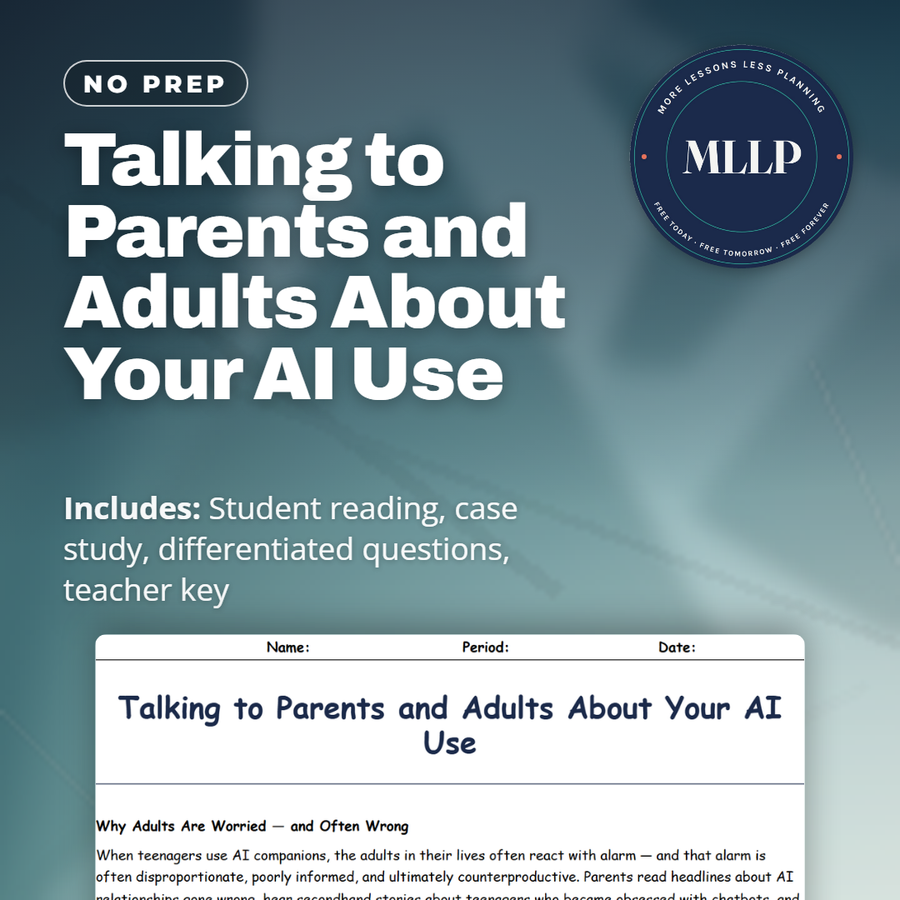
Talking to Parents and Adults About Your AI Use
Quality reviewed September 2026
Facts verified September 20, 2026
- Subject
- Career & Life Skills
- Grades
- Grades 9-12
- Length
- 10-page student worksheet
- Time
- About one 50-minute class period
- Great for
- Sub plans and independent work
- Includes
- Reading passage, comprehension questions + full answer key
- Format
- Print-and-go PDF
What students do
- Explain the category error most adults make when they treat all AI companion use as the same thing
- Trace why Destiny's dinner-table conversation failed and her Saturday walk conversation worked
- Weigh the concealment cycle, why silence often feels safer than telling a parent the truth
- Compare a defensive opening about AI use to one that leads with real information instead
What it covers
- Why adult alarm about AI companion use is often disproportionate, and the category error behind it
- The concealment cycle, and specific strategies for starting a conversation an adult will actually hear
- Destiny's case study, one conversation that went badly and one, a week later, that did not
Start reading this worksheet
Why Adults Are Worried, and Often Wrong
When teenagers use AI companions, the adults in their lives often react with alarm, and that alarm is often disproportionate, poorly informed, and ultimately counterproductive. Parents read headlines about AI relationships gone wrong, hear secondhand stories about teenagers who became obsessed with chatbots, and arrive at conversations with their teenagers carrying a bundle of fears that may or may not correspond to what is actually happening. Understanding why adults react the way they do, and why their reactions are often partially wrong even when their underlying concern is legitimate, is the first step toward having conversations that are actually useful rather than simply uncomfortable. The core problem with most adult reactions to teenage AI companion use is a category error: treating all AI companion use as equivalent. A teenager who uses an AI to process anxiety before a difficult conversation and a teenager who has replaced their entire social life with AI companion interactions are using the same technology in ways that are not remotely comparable in their implications for wellbeing. Adults who do not make this distinction, and who respond to any AI companion use with alarm, are making an error that their teenagers will recognize immediately. That then makes it harder to have honest conversations about the cases where the concern actually is warranted. Overreaction to the harmless cases makes the necessary conversations about the harmful cases harder. Adults also frequently approach these conversations with outdated or incomplete information about how AI companions actually work. Many parents' mental model of AI interaction is formed by science fiction or by early chatbots they encountered: clunky, obviously robotic tools that no one could mistake for real connection. They may not understand that modern AI companions are sophisticated enough to produce genuine felt experience, that they are deliberately designed to maximize emotional attachment, and that the risk profile is therefore genuinely more complex than 'you know it's not real, so what's the problem?' Helping adults update their mental model (giving them the real information rather than simply defending your use) is often more productive than arguing about whether their concern is justified.
The Communication Gap
Research on adolescent disclosure (when and why teenagers tell adults about their experiences) consistently finds that concealment is the default, not the exception. Teenagers conceal not primarily because they are hiding wrongdoing but because they have learned, through experience, that disclosure frequently produces reactions that are worse than silence: overreaction, punishment, loss of privacy, lectures that go on for an hour about decisions that had already been made. When adults reliably respond to disclosure with alarm, judgment, or immediate attempts to fix or control, teenagers learn that disclosure is a net negative: that being honest about what is happening in their lives costs them more than it gains them. This dynamic creates a communication gap that is structurally self-reinforcing. Adults who are not told about teenagers' AI companion use cannot provide useful context, guardrails, or perspective. They also cannot identify the cases where use is becoming genuinely problematic and the teenager could benefit from support. But the adults are often not told because prior disclosures have taught the teenager that disclosure leads to reactions that are unhelpful or punitive. The teenager is not wrong about this, in many families. And the adult is not wrong to be concerned. The gap is produced by both sides responding rationally to a situation that is structured to produce misunderstanding. For teenagers who are genuinely using AI companions in healthy ways, the concealment may seem cost-free: there is nothing wrong happening, so why have the conversation? But the problem with routine concealment of AI use from trusted adults is that it makes it harder to disclose when the use does become something worth examining. If adults have no context for what AI companion use looks like in your life, any disclosure becomes a revelation rather than an update. It carries the full weight of surprise, which triggers alarm rather than conversation. Building a baseline of communication around AI use, even when nothing is wrong, creates the relational infrastructure to have a productive conversation when something is.
Strategies for Starting the Conversation
The most effective approach to starting a conversation with an adult about AI companion use is also the most counterintuitive: lead with the information rather than the defense. Most teenagers approach these conversations anticipating judgment and start with a defensive posture: minimizing use, emphasizing that they know the AI is not real, preemptively countering the objections they expect. This sets up an adversarial dynamic before the conversation has found its footing. A different approach starts by giving the adult the actual information (what the app does, why you use it, what you get from it) before they have formed a judgment based on alarmed imagination. Choosing the right moment is also more important than most people realize. Bringing up a significant topic when an adult is distracted, stressed, or already in a difficult mood invites a reflexive reaction rather than a real response. A moment when the adult is relaxed and available (on a walk, during a shared meal, at a time they have explicitly said they have space) is not just more comfortable; it is more likely to produce the kind of conversation that is actually useful. Related to this is framing: coming to the conversation with a genuine question rather than a position to defend tends to produce dialogue rather than debate. 'I've been reading about AI companion research and I'm thinking about my own use. Can I talk through it with you?' is a fundamentally different opening than 'I need you to know that what I'm doing is fine.' Being specific about what you are actually doing, and what you are not doing, is more useful than general reassurances. Adults worry about the extreme cases they have read about. Giving them specific, accurate information about your actual use gives them something real to respond to, rather than a blank canvas onto which their fears project. If you use an AI companion to process anxiety and you can describe exactly how and when and to what effect, that is a very different conversation from one in which you insist that everything is fine without any specifics. Specificity also implicitly demonstrates the self-awareness that is the most reassuring evidence an adult can receive that a teenager is using a tool thoughtfully rather than being used by it.
Like what you read? The full reading, the case study, and every question set are in the free download below, along with the answer key.
Why this matters
The reading is not telling students to hide their AI companion use, and it is not telling them every adult reaction is unreasonable. It is describing a cycle that keeps good information from reaching the people who could actually help, built from real fear on both sides. Destiny's walk with her mom shows what breaks the cycle: timing, specifics, and a question instead of a defense. A student who tries that approach is not guaranteed an easy conversation, but they are far more likely to end up with a parent who says, like Destiny's mom did, that they are glad to finally know.
From one teacher to another
Destiny's first attempt to tell her mom about her AI companion happened over the stove, mid-dinner, and it went badly: 'those things are dangerous, delete it.' A week later she tried again on a Saturday walk, opening with a real question instead of a defense, and it went differently. This reading explains why. Adults often react to any AI companion use as if it were the same thing, whether it is occasional or all-consuming, and teenagers often stay quiet because past disclosures taught them that honesty gets punished rather than heard. Both reactions make sense on their own. Together they build a gap that only closes when someone changes the pattern, which is exactly what Destiny's second conversation did.
What you get
Download
Where should I send the next one?
Everything here is free and it stays that way. Leave your email and I'll send you the new lessons as they go up. You can unsubscribe from any one of them.
Related resources
AI Therapists: Real Help or Risky Substitute?
Healthy AI Use vs. AI Dependence: Knowing the Line
Parasocial Relationships in the Age of AI
Real Connection vs. Simulated Connection: Why It Matters
Should an AI Tell You It Loves You? The Design Question
The Character.AI Story: When a Game Becomes Real
Every lesson on this site is free to download and use. If one of them saved you a prep period, you can chip in a few bucks toward my three kids' daycare fund. That's genuinely where tips go.