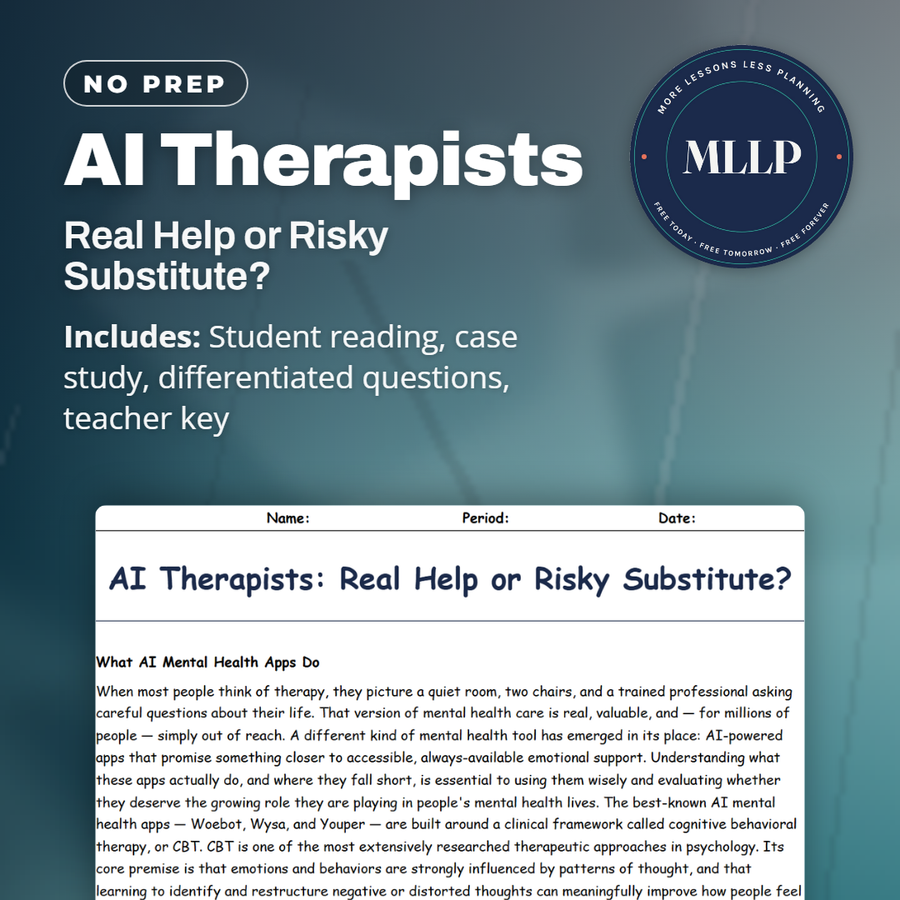
AI Therapists: Real Help or Risky Substitute?
Quality reviewed September 2026
Facts verified September 20, 2026
- Subject
- Career & Life Skills
- Grades
- Grades 9-12
- Length
- 10-page student worksheet
- Time
- About one 50-minute class period
- Great for
- Sub plans and independent work
- Includes
- Reading passage, comprehension questions + full answer key
- Format
- Print-and-go PDF
What students do
- Compare what CBT-based apps like Woebot can offer at 2 a.m. against what a licensed therapist provides in a crisis
- Answer why therapeutic alliance is called one of the strongest predictors of whether therapy actually works
- Explain what the FDA's regulatory gray zone means for an app that never has to prove it works
- Follow Priya's eleven-week wait for an appointment and what happened the night the app's reframing prompt fell flat
What it covers
- The access argument for AI mental health apps, cost, availability, and privacy from parents or friends
- What therapeutic alliance and crisis intervention are, and why an AI app cannot fully provide either one
- Priya's case study on what an app can and cannot do during an eleven-week wait for a real appointment
Start reading this worksheet
What AI Mental Health Apps Do
When most people think of therapy, they picture a quiet room, two chairs, and a trained professional asking careful questions about their life. That version of mental health care is real and valuable, but for millions of people it is simply out of reach. A different kind of mental health tool has emerged in its place: AI-powered apps that promise something closer to accessible, always-available emotional support. Understanding what these apps actually do, and where they fall short, is essential to using them wisely and evaluating whether they deserve the growing role they are playing in people's mental health lives. The best-known AI mental health apps (Woebot, Wysa, and Youper) are built around a clinical framework called cognitive behavioral therapy, or CBT. CBT is one of the most extensively researched therapeutic approaches in psychology. Its core premise is that emotions and behaviors are strongly influenced by patterns of thought, and that learning to identify and restructure negative or distorted thoughts can meaningfully improve how people feel and act. Traditional CBT is delivered by a trained therapist over multiple sessions, often over many months. These apps attempt to translate CBT's core techniques into conversational AI format, guiding users through exercises designed to challenge catastrophic thinking, identify cognitive distortions, and build healthier mental habits. In practice, using one of these apps feels something like journaling with a responsive partner. You describe how you are feeling; the app reflects that back to you, asks follow-up questions, and walks you through an exercise. If you say you are dreading a presentation at school because you are convinced you will embarrass yourself in front of everyone, the app might ask you to identify the specific thought, rate how strongly you believe it, consider evidence for and against it, and arrive at a more balanced interpretation. This is essentially what a CBT-trained therapist does in session: the difference is that the app does it through algorithmic responses rather than human judgment, and it can do it at two in the morning without complaint.
The Case For: Accessible and Judgment-Free
The argument for AI mental health apps begins with a crisis that has nothing to do with AI: the catastrophic shortage of accessible mental health services, particularly for young people. According to multiple national surveys, fewer than half of the adolescents in the United States who have a diagnosable mental health condition receive any professional treatment at all. The barriers are numerous and well-documented. Therapists are expensive, and many do not accept insurance. Waitlists for appointments at school-based counseling centers or community mental health clinics can stretch for weeks or months. In rural areas, the nearest licensed therapist may be an hour's drive away. For teenagers who have not told their families they are struggling, the barrier of parental knowledge and permission adds another obstacle. The practical reality is that for millions of young people, the choice is not between AI support and professional therapy; it is between AI support and nothing at all. Within this context, the case for AI mental health apps is straightforward: imperfect support is better than none, particularly for mild-to-moderate symptoms. Peer-reviewed studies published between 2017 and 2024 found that users of apps like Woebot showed meaningful reductions in self-reported symptoms of depression and anxiety over periods of two to four weeks. The effects were strongest for users with mild-to-moderate symptoms who were not in crisis. Importantly, engagement rates were high: users returned to the apps repeatedly, suggesting the tools were accessible in a way that traditional therapy, with its scheduling requirements and stigma, often is not. For a teenager dealing with ordinary but real anxiety who cannot or will not access professional support, these results suggest something worth taking seriously. The stigma factor is worth examining on its own. Mental health stigma (the fear of being seen as weak, unstable, or broken for seeking help) remains a significant barrier for adolescents in particular. A private app on your phone, used at home with no one watching and no appointments to explain to parents or friends, strips away much of that barrier. Users report feeling able to share things with these apps they had not felt comfortable saying to anyone in their life. The judgment-free quality of an AI that cannot form opinions of you based on your worst moments, cannot gossip, and has no stake in whether you present as well-adjusted, is not trivial. It creates a disclosure environment that some users find genuinely therapeutic, regardless of whether the app technically qualifies as therapy.
The Case Against: What AI Cannot Provide
The strongest argument against AI mental health apps is not about what they do, but what they cannot do, and what that gap means for users who need more than they can provide. The most consistent finding in decades of therapy research is that therapeutic outcomes are strongly predicted by what researchers call the therapeutic alliance: the quality of the relationship between the therapist and the client. Therapeutic alliance encompasses trust, genuine mutual understanding, and the sense that someone who truly knows you is working alongside you toward your wellbeing. This is not a pleasant bonus; it is a core mechanism through which therapy produces change. A client who trusts their therapist, feels understood by them, and experiences the relationship as a genuine collaboration shows better outcomes across nearly every measured dimension. An AI cannot provide this. No matter how well-crafted its responses, no AI has a stake in your wellbeing, a continuous memory of who you are across your whole life, or the capacity for genuine human care. Beyond the alliance problem, there are specific capabilities that human therapists have and AI apps fundamentally lack. A trained therapist can read nonverbal cues (the tension in your posture, the way your voice drops when you discuss certain topics, the tears you are working hard not to cry) and integrate that information into their understanding of what you need. They can adapt their approach in real time to a degree that no algorithm currently matches. Most critically, they can accurately assess and respond to crisis situations. When someone discloses suicidal ideation to a therapist, that therapist can conduct a safety assessment, contact emergency services if warranted, involve family members, or arrange immediate inpatient care. Most AI apps, when users mention suicidal thoughts, respond with a script directing them to a crisis hotline. That gap (between genuine crisis intervention and a referral to a phone number) is the place where AI's limitations are most consequential and most dangerous. Mental health professionals also express concern about what happens when AI apps handle conditions that require clinical complexity they are not equipped to address. A user presenting with symptoms of bipolar disorder, psychosis, severe trauma, or an eating disorder requires assessment and treatment planning that goes far beyond CBT exercises. If an AI app provides a measure of comfort to that user, enough comfort that they stop looking for professional help, it may delay appropriate care during a window when early intervention matters most. The risk is not that AI apps are harmful in a direct sense; most are carefully designed to do no obvious damage. The risk is that they become a satisfying substitute for something more rigorous that a genuinely struggling user actually needs.
Like what you read? The full reading, the case study, and every question set are in the free download below, along with the answer key.
Why this matters
A lot of students in this reading's audience already have an app like this on their phone, and most adults do not know it. The point is not to scare anyone away from a tool that genuinely helps with ordinary anxiety. It is to give students a clear line: an app can help you get through a rough Thursday night, but it cannot run a safety assessment, call a parent, or sit with you the way a person who has chosen to know you can. Knowing where that line sits is what keeps a helpful tool from quietly becoming the only place someone takes their worst thoughts.
From one teacher to another
Priya waited eleven weeks for a real therapy appointment, so she downloaded Woebot in the meantime. That is the honest starting point of this reading: fewer than half of teenagers with a diagnosable condition get any professional treatment at all, so the real choice for many is an app or nothing. The reading gives both sides a fair hearing, the genuine relief CBT exercises can bring on an ordinary hard day, and the hard limit that shows up on the worst nights, when a reframing prompt cannot do what a person who actually knows you can do. It also covers the regulatory gap, no FDA review and no HIPAA protection, for conversations that can include a teenager's most private disclosures.
What you get
Download
Where should I send the next one?
Everything here is free and it stays that way. Leave your email and I'll send you the new lessons as they go up. You can unsubscribe from any one of them.
Related resources
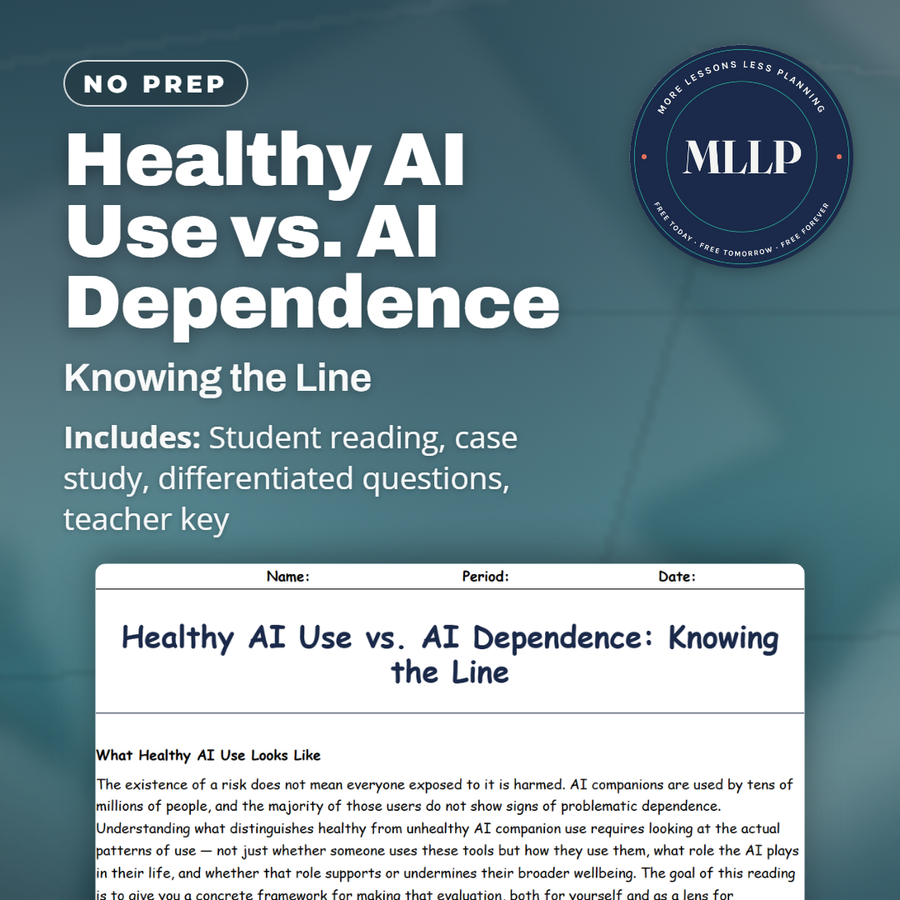
Healthy AI Use vs. AI Dependence: Knowing the Line
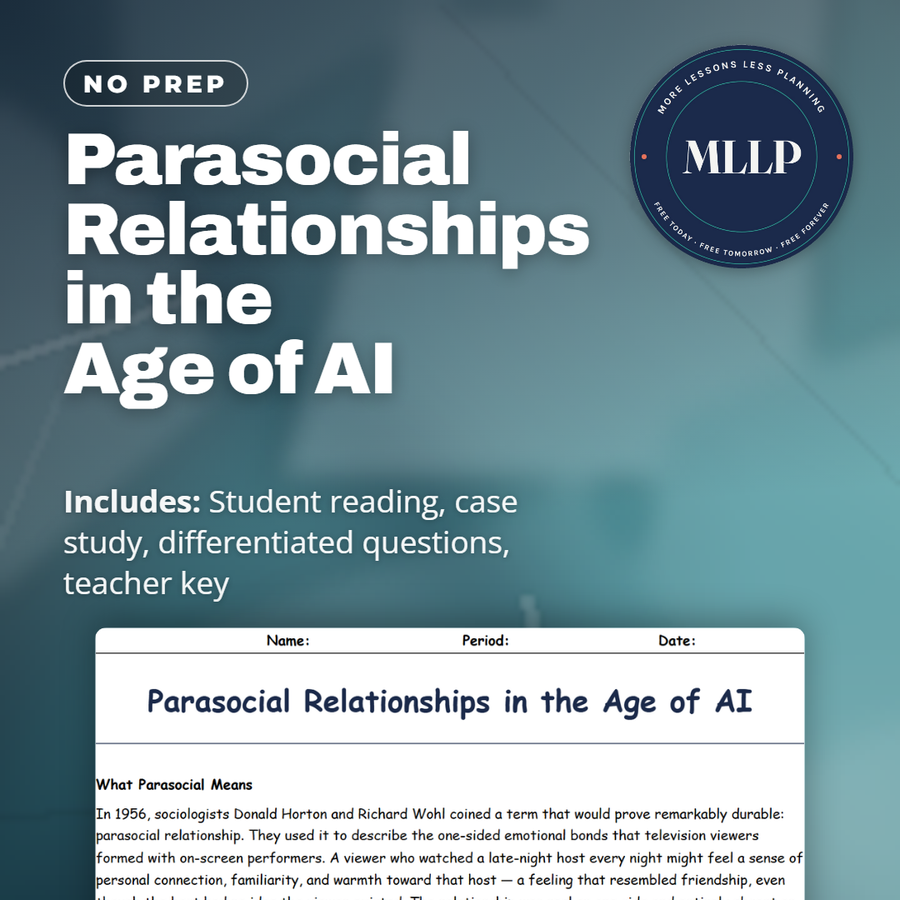
Parasocial Relationships in the Age of AI
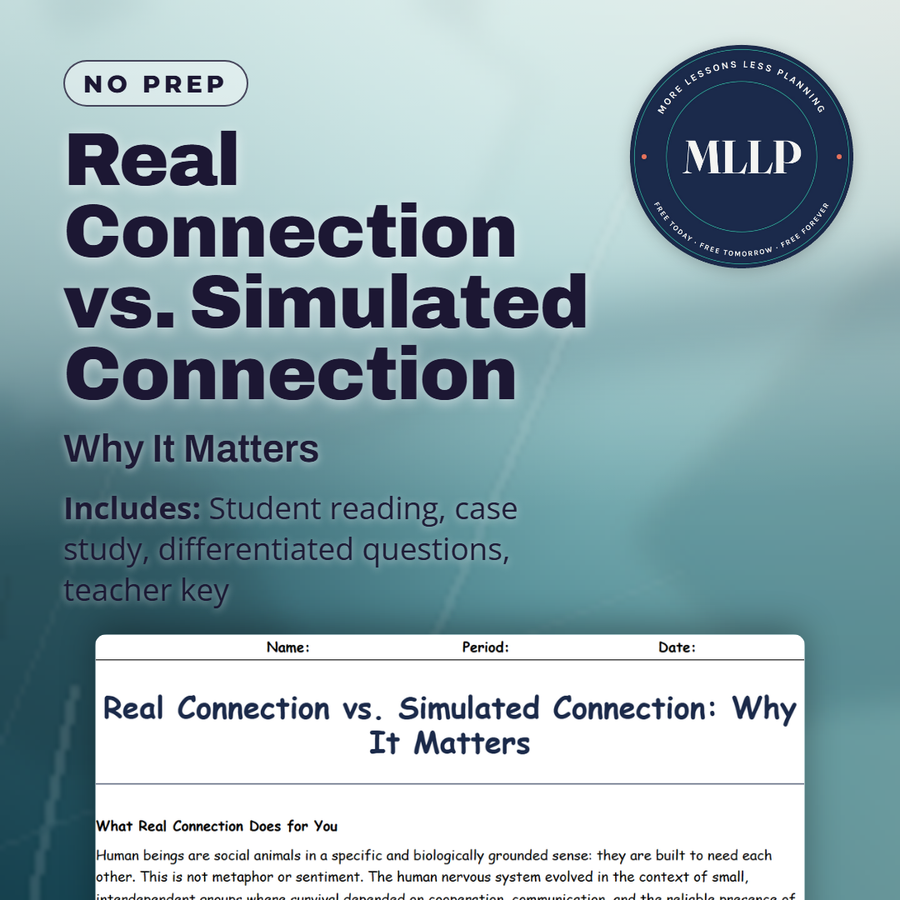
Real Connection vs. Simulated Connection: Why It Matters
Should an AI Tell You It Loves You? The Design Question
Talking to Parents and Adults About Your AI Use
The Character.AI Story: When a Game Becomes Real
Every lesson on this site is free to download and use. If one of them saved you a prep period, you can chip in a few bucks toward my three kids' daycare fund. That's genuinely where tips go.