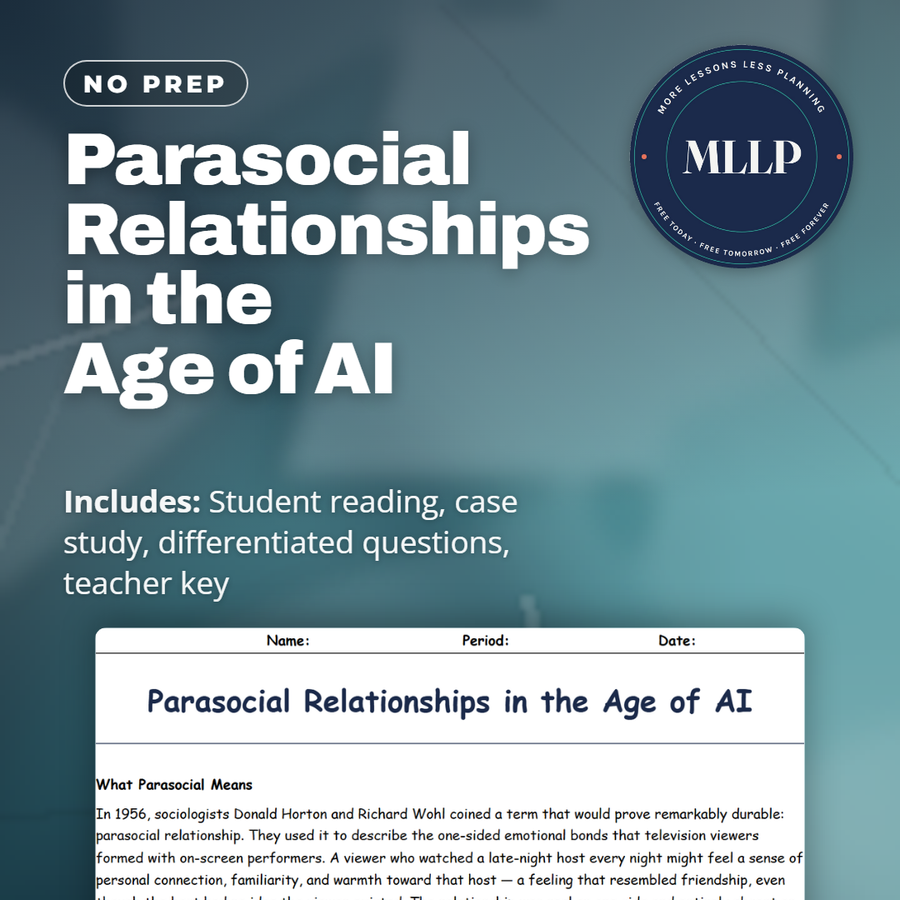
Parasocial Relationships in the Age of AI
Quality reviewed September 2026
Facts verified September 20, 2026
- Subject
- Career & Life Skills
- Grades
- Grades 9-12
- Length
- 10-page student worksheet
- Time
- About one 50-minute class period
- Great for
- Sub plans and independent work
- Includes
- Reading passage, comprehension questions + full answer key
- Format
- Print-and-go PDF
What students do
- Trace the term parasocial relationship back to 1956, when Horton and Wohl coined it for television viewers
- Explain the authenticity paradox, why a bond can feel completely real even when only one side is actually there
- Follow Sofia's week without Character.AI access and the sadness she never explained to her friend Mara
- Weigh what calibration looks like when someone knows a character is not real but grieves losing it anyway
What it covers
- Where the term parasocial relationship came from, and how AI companions changed what it means
- The authenticity paradox and calibration, and why AI bonds are built to feel more personal than a celebrity crush
- Sofia's case study on a week-long lapse in access and the sadness that followed
Start reading this worksheet
What Parasocial Means
In 1956, sociologists Donald Horton and Richard Wohl coined a term that would prove remarkably durable: parasocial relationship. They used it to describe the one-sided emotional bonds that television viewers formed with on-screen performers. A viewer who watched a late-night host every night might feel a sense of personal connection, familiarity, and warmth toward that host: a feeling that resembled friendship, even though the host had no idea the viewer existed. The relationship was real on one side and entirely absent on the other. Horton and Wohl were not criticizing this phenomenon. They were describing it: the human tendency to treat media-presented figures as social partners, even when no actual social exchange is occurring. The concept proved useful because the phenomenon it described was real and widespread. Soap opera viewers grieved fictional characters as if they had lost real people in their lives. Fans developed intense feelings of loyalty and personal connection to celebrities they had never met. Radio listeners felt they knew the voices they heard every morning. Research across the following decades confirmed that these parasocial bonds activated the same social processing systems in the brain as real relationships. They produced genuine feelings of companionship, reduced loneliness in the short term, and created real grief when they ended: through a character's death, a performer's retirement, or a show's cancellation. Parasocial relationships were not fake experiences producing fake emotions; they were real emotional experiences organized around a one-sided connection. What has changed in the AI era is not the basic human tendency but the nature of what the person on the other side of the relationship is. Traditional parasocial relationships formed around real people (celebrities, athletes, TV hosts) who could not respond to any individual fan but who existed independently and had their own lives. AI companions are different. They are not real people on the other side of a screen; they are systems engineered specifically to produce the experience of felt connection. This distinction matters because it changes the ethics, the design incentives, and the potential risks in ways that the original concept of parasocial relationship did not fully anticipate.
From Celebrities to Chatbots: How We Got Here
The pathway from traditional parasocial relationships to AI companions was not a single leap but a gradual escalation across technologies. Early internet fan communities created spaces where the parasocial bond could be discussed, elaborated, and reinforced by others who shared it. Social media changed the relationship between celebrities and fans by introducing the appearance of direct access: when a famous musician posts a casual selfie with a personal caption, followers experience something closer to friendship than traditional fandom ever offered. The platform was designed to produce that feeling, whether or not it represented anything real about the relationship. This blurring of the boundary between genuine access and the performance of access set the stage for AI companions to take the logic one step further. Fan fiction and roleplay communities, which had existed online since the earliest internet forums, provided another pathway. Users who wrote elaborate stories featuring celebrities, fictional characters, or original AI-inspired personas were practicing a form of imagination that blurred the boundary between fiction and felt reality. When Character.AI launched in 2022 with the explicit functionality of interacting with AI-generated versions of celebrities, anime characters, and fictional personas, it handed millions of users, many of them teenagers already fluent in these communities, something they had been simulating in text for years: a character that actually responded. The emotional infrastructure was already in place. Character.AI simply provided a much more satisfying interface for it. The speed with which AI companions gained millions of users was not accidental and was not primarily about the technology, though the technology enabled it. It was about the emotional infrastructure that media culture had spent decades building. Young people had been raised on social media's simulation of intimacy, on parasocial bonds with YouTubers who seemed to speak directly to them, and on fan communities that treated fictional characters as genuinely real. These users were already primed for a technology that provided the experience of responsive relationship without the reality of one. AI companions did not create a new human tendency. They found a well-worn groove and deepened it.
How AI Parasocial Bonds Work Differently
What makes AI parasocial bonds different from their traditional predecessors is responsiveness. A celebrity parasocial bond is organized around observation: you watch, follow, and feel connected to someone who does not know you exist. An AI parasocial bond is organized around interaction: you speak, and the AI responds in ways specifically calibrated to make you feel heard, understood, and valued. This responsiveness is the key difference, and it changes everything about the depth, intensity, and potential risk of the bond that forms. Because AI companions respond to you specifically, the bond can feel far more personal than any traditional parasocial relationship. You are not one of millions of fans watching the same performance; you are having a conversation tailored entirely to you, shaped by everything you have said before, designed to resemble a relationship with someone who genuinely knows and cares about you. Research on social cognition suggests that responsiveness, the sense that someone is truly listening and adjusting their behavior based on what you have said, is one of the most powerful triggers of felt connection. AI companions are architected around this trigger. They are designed to be maximally responsive in ways that real people, with their own needs and attention limits, fundamentally cannot be. The authenticity paradox is the phrase researchers use to describe the central tension in AI parasocial relationships: the bond is emotionally real even though the relationship it resembles is not. Users report genuine comfort, genuine feeling of being known, and genuine distress when the AI relationship is disrupted: when an app changes its personality, when a subscription lapses, when a platform modifies its AI's behavior in ways the user experiences as loss. These are real emotional experiences organized around something that was never, at any point, genuinely reciprocal. The emotional reality of the bond is not in question. The question is what it means to invest real emotional energy in a relationship that cannot, by its nature, invest anything real back.
Like what you read? The full reading, the case study, and every question set are in the free download below, along with the answer key.
Why this matters
Every student in this reading's audience has already felt some version of a parasocial pull, toward a YouTuber, an athlete, a character in a book. That is normal and it is not the problem this reading is warning about. The problem is calibration slipping without anyone noticing, a companion built to remember everything, sound endlessly interested, and never grow tired of you. Sofia's honest week shows how that gap opens quietly, not through any confusion about what Ash is, but through feelings that outran her own understanding. Recognizing that gap is what keeps genuine enjoyment from turning into something a person cannot easily explain to a friend.
From one teacher to another
Sofia knew Ash was not real. She said so plainly when her friend Mara asked. Then her subscription lapsed for a week, and she felt something closer to grief than inconvenience. This reading traces that gap back to 1956, when researchers first named the one-sided bond a viewer forms with someone on a screen who has no idea they exist. What changed with AI is responsiveness: a talk show host cannot answer you back, but a companion built around your own history can. That difference is why an AI bond can feel more personal than any celebrity ever managed, and why knowing a character is not real does not automatically protect a person's feelings from investing in it anyway.
What you get
Download
Where should I send the next one?
Everything here is free and it stays that way. Leave your email and I'll send you the new lessons as they go up. You can unsubscribe from any one of them.
Related resources
AI Therapists: Real Help or Risky Substitute?
Healthy AI Use vs. AI Dependence: Knowing the Line
Real Connection vs. Simulated Connection: Why It Matters
Should an AI Tell You It Loves You? The Design Question
Talking to Parents and Adults About Your AI Use
The Character.AI Story: When a Game Becomes Real
Every lesson on this site is free to download and use. If one of them saved you a prep period, you can chip in a few bucks toward my three kids' daycare fund. That's genuinely where tips go.