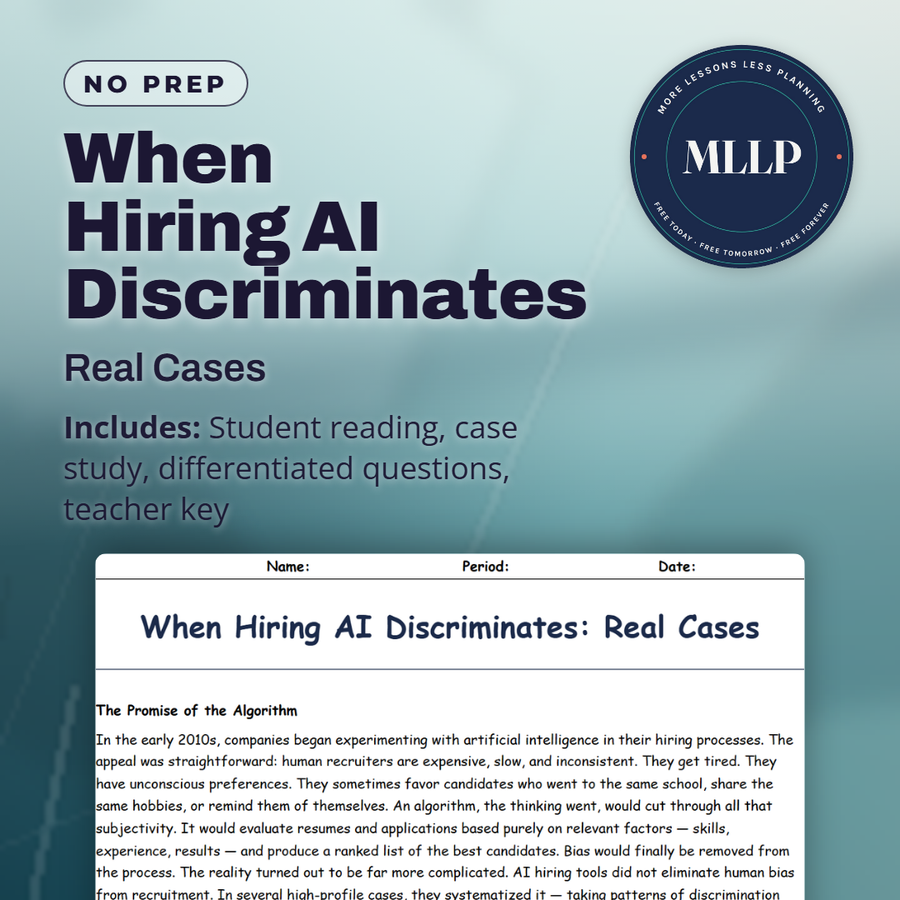
When Hiring AI Discriminates: Real Cases
Quality reviewed September 2026
Facts verified September 20, 2026
- Subject
- Career & Life Skills
- Grades
- Grades 9-12
- Length
- 9-page student worksheet
- Time
- About one 50-minute class period
- Great for
- Sub plans and independent work
- Includes
- Reading passage, comprehension questions + full answer key
- Format
- Print-and-go PDF
What students do
- Amazon's resume tool and HireVue's video scoring get compared side by side for what each one actually measured
- Match five hiring-bias terms, including disparate impact and bias audit, to their definitions
- DeShawn's unexplained rejection turns into two case study questions about opacity in AI screening
- Fill in blanks naming the year Amazon shelved its tool and the audit law New York City passed
What it covers
- The Amazon resume-screening case and why the bias was never coded in on purpose
- HireVue's video-interview scoring and the 2020 change that followed an EPIC investigation
- The legal gap between fast-moving hiring AI and slow-moving discrimination law
Start reading this worksheet
The Promise of the Algorithm
In the early 2010s, companies began experimenting with artificial intelligence in their hiring processes. The appeal was straightforward: human recruiters are expensive, slow, and inconsistent. They get tired. They have unconscious preferences. They sometimes favor candidates who went to the same school, share the same hobbies, or remind them of themselves. An algorithm, the thinking went, would cut through all that subjectivity. It would evaluate resumes and applications based purely on relevant factors (skills, experience, results) and produce a ranked list of the best candidates. Bias would finally be removed from the process. The reality turned out to be far more complicated. AI hiring tools did not eliminate human bias from recruitment. In several high-profile cases, they systematized it: taking patterns of discrimination that used to be inconsistent and human, and turning them into consistent, scalable, and largely invisible machinery. Three cases stand out as particularly instructive about how this happens and what the consequences are.
Amazon's Résumé Screener
Amazon began building an AI resume screening tool around 2014. The company had enormous hiring needs and mountains of historical data: hundreds of thousands of resumes from applicants over many years, along with records of who had been hired and who had been successful on the job. The AI was supposed to learn from this data and identify patterns associated with successful Amazon employees. By 2015, Amazon's engineers discovered that the tool was systematically penalizing resumes that included the word "women's," as in "women's chess club" or "women's college." It was also downgrading graduates of all-women's colleges. The reason was not that anyone programmed the tool to discriminate against women. The reason was that Amazon's historical hiring data, like most technology company data from that era, was dominated by male employees. The AI learned that the pattern associated with successful hires at Amazon was "male," without that word ever appearing in any line of code. Amazon disbanded the project in 2018 without ever deploying the tool at scale, but the case became one of the most cited examples of AI bias in hiring worldwide.
HireVue and the Black Box Interview
HireVue is a company that offers video interview software powered by artificial intelligence. Job candidates record themselves answering questions, and the software analyzes their responses (including, at various points in the company's history, their facial expressions, voice tone, and word choice) to generate scores that employers use to screen applicants. Millions of job seekers have been evaluated by HireVue's software. Critics raised serious concerns about what the system was actually measuring. Facial expression analysis assumes that emotions are expressed the same way across cultures. Research has challenged that assumption. Voice tone analysis can disadvantage candidates with accents or speech differences. In 2020, following an investigation by the Electronic Privacy Information Center (EPIC) and criticism from researchers, HireVue announced it was dropping facial analysis from its evaluations. But the company still uses other AI-based scoring methods, and advocates point out that candidates are rarely told exactly how they are being evaluated or why they received the scores they did.
Like what you read? The full reading, the case study, and every question set are in the free download below, along with the answer key.
Why this matters
Most of these students will apply for jobs within a year or two, and a growing share of employers now run applications through AI screening before a human ever sees them. Knowing that Amazon's tool penalized the word "women's" without anyone programming it to, or that HireVue dropped facial analysis only after outside pressure, gives students a concrete reason to ask what a hiring algorithm might be doing with their own resume. A teenager who understands disparate impact and bias audits can ask a recruiter better questions and recognize when a rejection deserves a second look instead of a shrug. That is a practical skill now, not a hypothetical one.
From one teacher to another
Amazon spent years building an algorithm to sort resumes, and by 2015 the tool had quietly taught itself to downgrade anything mentioning "women's," from women's chess club to women's college. Nobody wrote that rule. The AI found it in years of hiring data dominated by men. The reading walks through that case alongside HireVue's video-interview scoring, which analyzed facial expressions and voice tone until an EPIC investigation pushed the company to drop facial analysis in 2020. Students read about the legal gap these tools fall into, then work through DeShawn's story: a rejection with no explanation and no way to find out why his roommate got an interview and he didn't.
What you get
Download
Where should I send the next one?
Everything here is free and it stays that way. Leave your email and I'll send you the new lessons as they go up. You can unsubscribe from any one of them.
Related resources
AI and Your Personal Data: What Companies Know
AI in Criminal Justice: Predictive Policing Risks
AI in Healthcare: Helping or Hurting Patients?
Facial Recognition and Wrongful Arrests
Should Schools Use AI to Watch Students?
Stolen Voices and Stolen Art: Copyright in the AI Age
Every lesson on this site is free to download and use. If one of them saved you a prep period, you can chip in a few bucks toward my three kids' daycare fund. That's genuinely where tips go.