What Is the Federal Reserve?
Quality reviewed September 2026
Facts verified September 21, 2026
- Grades
- Grades 9-12
- Time
- About two 50-minute class periods
- Includes
- 11 ready-to-teach files
- Format
- Word (.docx) · PowerPoint (.pptx)
- Slide deck
- Guided notes
- Guided notes teacher key
- Activity + answer key
- Quiz + answer key
- Exit ticket + answer key
- Teacher guide
- Teacher presentation notes
What students do
- Sort twelve fact cards into Board of Governors, Regional Banks, FOMC, and Not-the-Fed categories
- Compare the Federal Reserve to a commercial bank like Chase across six features, from who it serves to who can issue currency
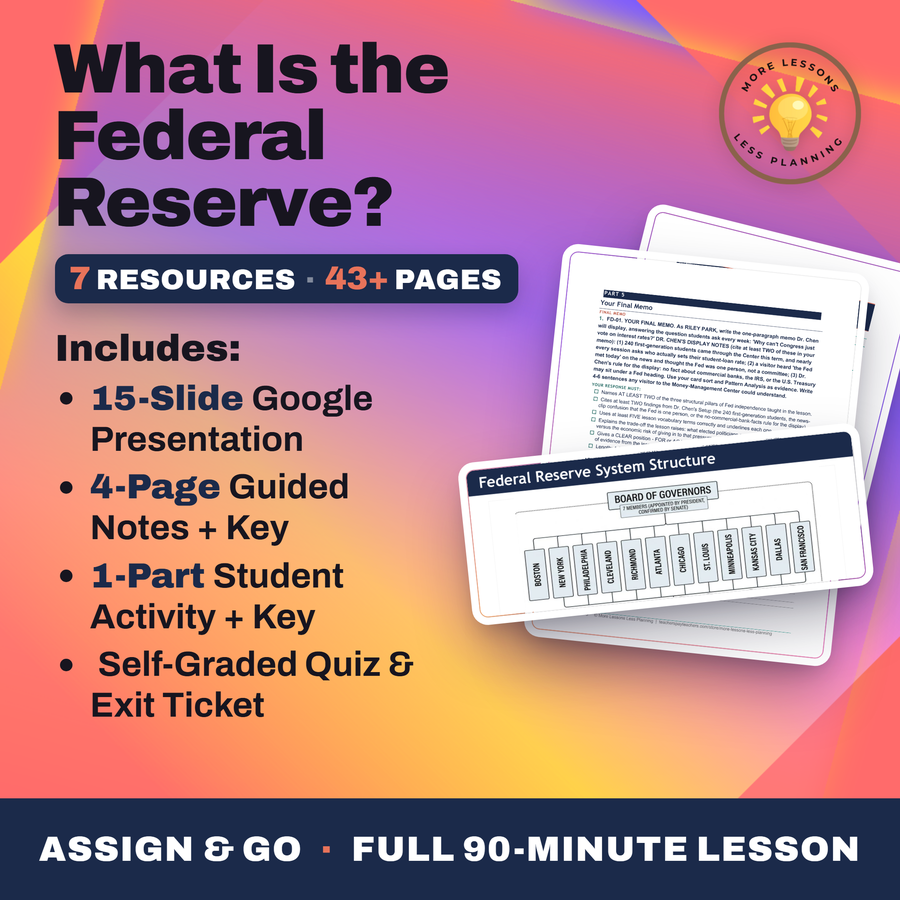
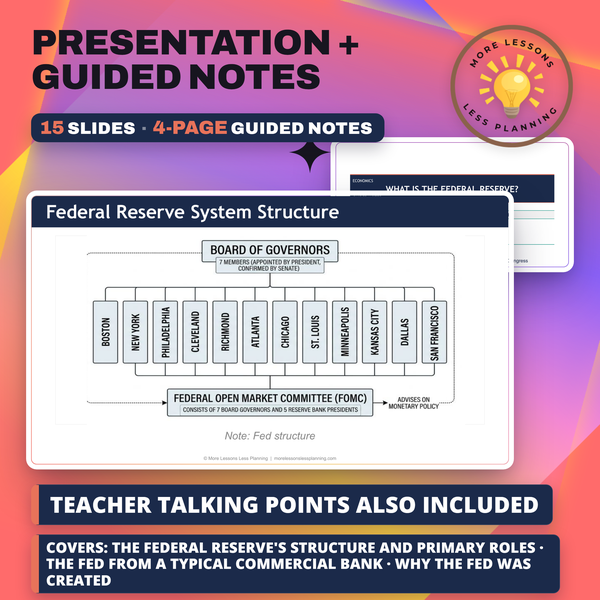
- Map the Fed's dual structure, the seven-member Board in Washington plus the twelve regional banks
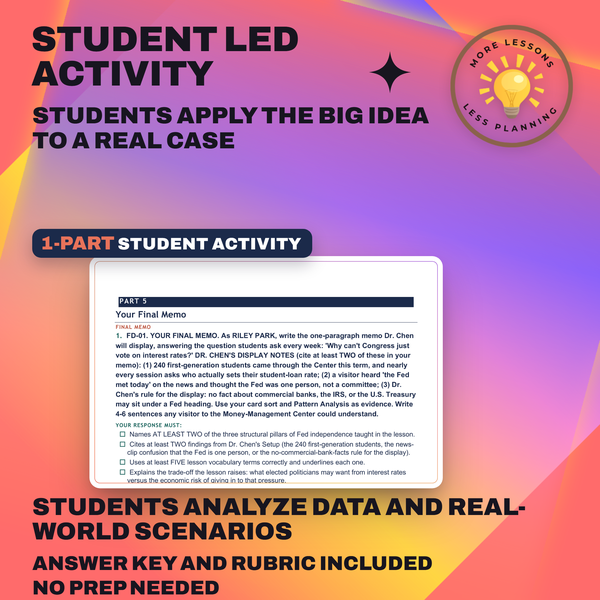
- Argue for or against Fed independence from Congress in a final memo, citing the Fed's structural protections
What it covers
- Why the Panic of 1907 pushed Congress to create the Fed in 1913
- The FOMC's twelve voting members and how the federal funds rate reaches mortgages and credit cards
- The structural protections, from fourteen-year terms to self-funding, that keep the Fed independent from Congress
- How the Fed differs from a commercial bank like Chase or Wells Fargo
Learning targets
- Describe the Federal Reserve's structure and primary roles
- Distinguish the Fed from a typical commercial bank
- Explain why the Fed was created and how it remains independent from Congress
Peek inside
What a Central Bank Does
Issues the national currency (dollars)
Sets monetary policy (interest rates)
Supervises commercial banks
Acts as banker to the government
What a Central Bank Does
A central bank issues the national .
A central bank sets policy - mainly interest rates.
The U.S. central bank is the Reserve.
A central bank is the bank for , not for individuals.
SECTION 2
1. Q1. The seven-member federal agency in Washington, D.C. that sets Fed policy - members appointed by the President and confirmed by the Senate to 14-year terms - is the .
Why this matters
A financial panic in 1907 got bad enough that private bankers had to bail out the country themselves, so Congress created the Federal Reserve in 1913. Twelve regional banks and a seven-member board in Washington now split that job, which surprises students expecting one building.
The Fed is not a bank the way Chase is one, and that is the fact students need repeating: it does not serve individual customers or compete for their business. Sorting real facts into the right bucket, Board, Regional Banks, or FOMC, makes that difference stick.
From one teacher to another
This is the lesson for the moment when a student says "the Fed just prints money," and you get to correct that in fifteen slides. The card sort makes them place real facts into the Board, Regional Banks, or FOMC bucket instead of nodding along, and three of the twelve cards are deliberate distractors describing functions the Fed does not perform. The independence debate at the end never resolves cleanly, and that's the point: I want students defending a position using the Fed's own structure as evidence.
Every file in this toolkit
-
Activity (Student)
Riley Park works through twelve real scenario cards, filing each one under the right Fed structure heading and ruling out three that describe functions the Fed does not perform. A closing memo defends independence for a college financial-literacy display.
-
Activity (Answer Key)
14-year terms outlasting three presidential terms carry the reasoning. Each of twelve sorted facts gets its correct bucket, and a six-element checklist scores the final memo on Fed independence for 240 first-generation students.
-
Exit Ticket (Student)
One question tests the two branches of the Fed's dual structure, another asks what sets it apart from an ordinary bank, and a third asks which protection keeps governors independent. Students explain why the Fed was made independent and what could go wrong without it.
-
Exit Ticket (Answer Key)
The Board of Governors plus twelve regional banks is the dual structure, serving banks and the government sets it apart from an ordinary bank, and fourteen-year terms are the named protection. The protection, the incentive, the inflation risk, and a clear argument complete the case.
-
Guided Notes (Student)
A central-bank definition opens the notes before students fill in the 1913 founding year, the Panic of 1907 trigger, and the dual structure of a seven-member Board plus twelve regional banks from Boston to San Francisco. FOMC facts and the three pillars of independence close the page.
-
Guided Notes (Teacher Key)
The seven-member Board's 14-year terms, the twelve regional districts from Boston to San Francisco, and twelve FOMC voters meeting eight times a year all stand mapped. The 1913 founding, the Panic of 1907 trigger, and the three independence pillars carry full answers.
-
Quiz (Student)
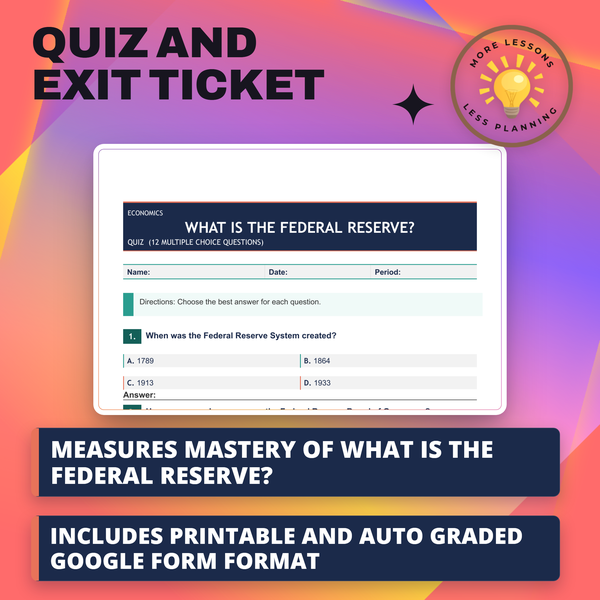
How many regional Reserve Banks exist is one structure item, another asks how the Fed's relationship to a bank like Chase actually works, and a third names the historical event tied to its creation.
-
Quiz (Answer Key)
Twelve regional Reserve Banks make up the system, the founding event dates to the Panic of 1907, Board members serve 14-year terms, and the Fed works as a banker's bank that skips retail deposits.
-
Slides
A 1907 bank run crisis forced J.P. Morgan to bail out failing banks himself, and Congress answered in 1913 with a dual structure, a seven member Board on 14 year terms next to 12 regional banks. The FOMC's 12 voting members and eight meetings a year lead into the independence debate.
-
Teacher Guide
A twelve card sort into Board, Regional Bank, and FOMC buckets structures the class period, and discussion prompts ask why the New York Fed keeps a permanent seat the other eleven districts rotate.
-
Teacher Presentation Notes
Twelve facts in the card sort include three deliberate distractors that do not belong to the Fed at all, timed right before the deck turns to how differently the Fed treats its customers compared with an ordinary commercial bank.
Download
Where should I send the next one?
Everything here is free and it stays that way. Leave your email and I'll send you the new lessons as they go up. You can unsubscribe from any one of them.
Related resources
Deflation: Why Falling Prices Are Bad
Hyperinflation: Weimar, Zimbabwe, Venezuela
Interest Rates: The Fed's Main Tool
Jerome Powell: The Most Powerful Person You've Never Heard Of
The 2022-2024 Inflation Crisis
The Dual Mandate: Jobs vs Prices
Every lesson on this site is free to download and use. If one of them saved you a prep period, you can chip in a few bucks toward my three kids' daycare fund. That's genuinely where tips go.