What is Compound Interest? The Secret to Growing Your Money
Quality reviewed September 2026
Facts verified September 24, 2026
- Subject
- Career & Life Skills
- Grades
- Grades 9-12
- Length
- 7-page student worksheet
- Time
- About one 50-minute class period
- Great for
- Sub plans and independent work
- Includes
- Reading passage, comprehension questions + full answer key
- Format
- Print-and-go PDF
What students do
- Match exponential growth and linear growth to compound interest and simple interest, and principal amount to a $5,000 initial deposit, plus the Rule of 72 and Sarah's account balance growth to their own definitions
- Fill in the blanks on the compound interest formula, what interest on both principal and past interest is called, and how to estimate an investment's doubling time
- Answer multiple choice questions on what compound interest calculates interest on, how the Rule of 72 works, and its main advantage over simple interest
- Write short answers on why compound interest suits long-term savings, how starting early changes total earnings, and how Sarah's account grew by more than her original $5,000 deposit between ages 18 and 30 without another dollar added
What it covers
- The compound interest formula and how it differs from simple interest
- The Rule of 72 for estimating how long it takes money to double
- A case study on Sarah, whose $5,000 birth deposit grew to $16,217 by age 30 without any additional contributions
Start reading this worksheet
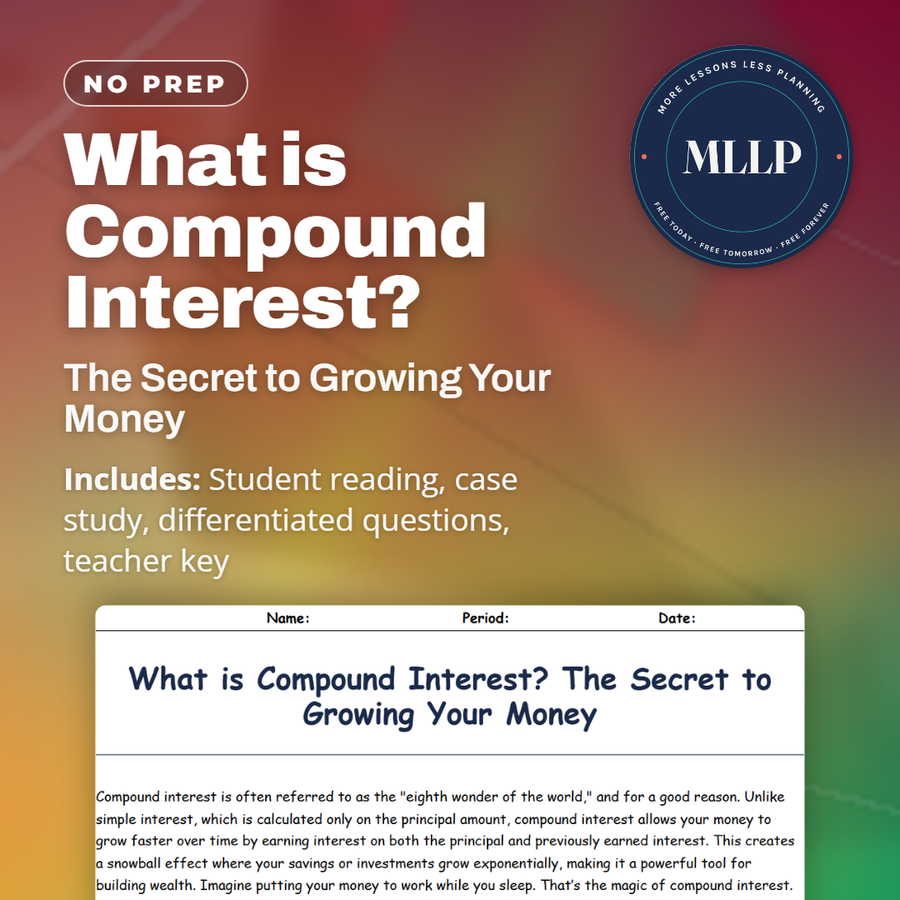
Compound interest is often referred to as the "eighth wonder of the world," and for a good reason. Unlike simple interest, which is calculated only on the principal amount, compound interest allows your money to grow faster over time by earning interest on both the principal and previously earned interest. This creates a snowball effect where your savings or investments grow exponentially, making it a powerful tool for building wealth. Imagine putting your money to work while you sleep. That’s the magic of compound interest. But how exactly does it work? Let’s look at its mechanics, benefits, and real-world applications to understand why starting early is essential for maximizing this financial tool.
The Basics of Compound Interest
Compound interest is calculated on the principal amount (the initial deposit or loan amount) and the accumulated interest from previous periods. Unlike simple interest, where only the principal earns interest, compounding adds a layer of growth. For example, if you deposit $1,000 into a savings account with a 5% annual interest rate compounded yearly, you’ll earn $50 in the first year. In the second year, you’ll earn interest on $1,050 instead of just $1,000. Over time, this compounding effect accelerates the growth of your savings.
The formula for compound interest is:
A = P × (1 + r/n)^(n × t). Where: A is the future value of the investment/loan, including interest. P is the principal amount. r is the annual interest rate (in decimal form). n is the number of times interest is compounded per year. t is the time in years. Let’s see this formula in action with a real-world example to better understand its potential.
Like what you read? The full reading, the case study, and every question set are in the free download below, along with the answer key.
Why this matters
The ten-year gap between Alex and Jamie is the clearest argument in the reading for not waiting to start saving, since the same monthly amount produces double the result depending only on when it began. Sarah's account shows the same effect working on its own, growing by more than the original deposit with nobody adding anything after it opened. The reading also flags that compound interest works against a borrower carrying a credit card balance, which matters just as much to a student who has one as the savings side does to someone who's investing.
From one teacher to another
A $1,000 deposit earning 5% interest is the reading's starting example for how compound interest lets money earn money on its own past earnings as well as the original amount. It compares Alex and Jamie, who both invest $200 a month at 6% but start ten years apart, ending up with $400,000 versus $200,000 by 60, and introduces the Rule of 72 as a quick way to estimate how long money takes to double at a given rate. A $5,000 deposit made for Sarah at birth at 4% interest carries the case study, growing to $10,129 by age 18 and $16,217 by 30 without a single additional dollar going in.
What you get
Download
Where should I send the next one?
Everything here is free and it stays that way. Leave your email and I'll send you the new lessons as they go up. You can unsubscribe from any one of them.
Related resources

Debit vs. Credit Cards: How to Choose the Right Payment Method

Financial Scams Teens Should Know: Spotting and Avoiding Fraud
How to Build a Strong Credit Score from Day One
How to Read a Paycheck: Understanding Deductions and Net Pay
How to Start Saving for Retirement as a Teen

Insurance for Beginners: What Teens Need to Know About Coverage
Every lesson on this site is free to download and use. If one of them saved you a prep period, you can chip in a few bucks toward my three kids' daycare fund. That's genuinely where tips go.