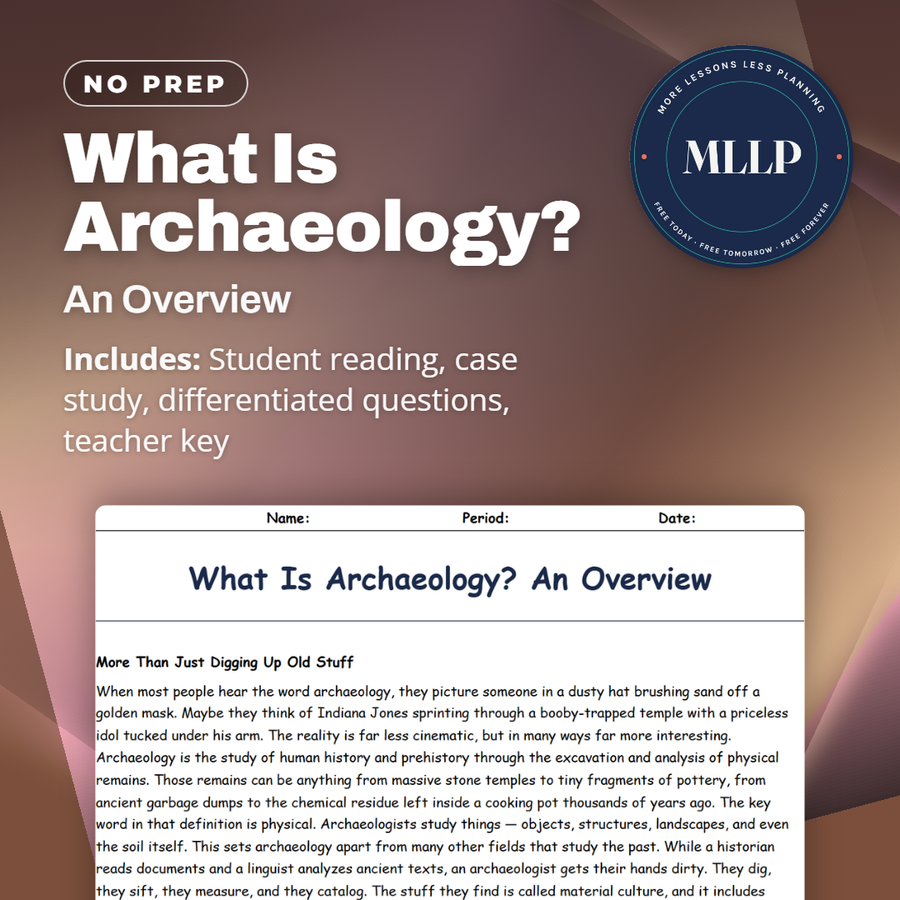
What Is Archaeology? An Overview
Quality reviewed September 2026
Facts verified September 21, 2026
- Subject
- Social Studies
- Grades
- Grades 9-12
- Length
- 9-page student worksheet
- Time
- About one 50-minute class period
- Great for
- Sub plans and independent work
- Includes
- Reading passage, comprehension questions + full answer key
- Format
- Print-and-go PDF
What students do
- Decide whether Marcus should sell his backyard arrowhead for $200 or report its exact location instead
- Explain how Gobekli Tepe and Cahokia each overturned an assumption historians once held about the past
- Compare archaeology, paleontology, and history using the reading's own definitions of each field
- Three fill-in-the-blank terms, archaeology, artifact, and material culture, come from the reading's own wording
What it covers
- The real definition of archaeology and how it differs from paleontology and history
- How discoveries at Gobekli Tepe and Cahokia rewrote assumptions about the ancient world
- Marcus's case study weighing a $200 arrowhead offer against its scientific context
Start reading this worksheet
More Than Just Digging Up Old Stuff
When most people hear the word archaeology, they picture someone in a dusty hat brushing sand off a golden mask. Maybe they think of Indiana Jones sprinting through a booby-trapped temple with a priceless idol tucked under his arm. The reality is far less cinematic, but in many ways far more interesting. Archaeology is the study of human history and prehistory through the excavation and analysis of physical remains. Those remains can be anything from massive stone temples to tiny fragments of pottery, from ancient garbage dumps to the chemical residue left inside a cooking pot thousands of years ago. The key word in that definition is physical. Archaeologists study things, such as objects, structures, landscapes, and even the soil itself. This sets archaeology apart from many other fields that study the past. While a historian reads documents and a linguist analyzes ancient texts, an archaeologist gets their hands dirty. They dig, they sift, they measure, and they catalog. The stuff they find is called material culture, and it includes everything human beings have ever made, used, modified, or discarded. An arrowhead is material culture. So is an ancient road, a buried fire pit, or even the pattern of seeds found in a Bronze Age storage jar. What makes archaeology powerful is that material culture exists everywhere humans have ever lived. Written records only go back about 5,000 years, and even then, most people in most societies were illiterate. Their stories never made it into any document. Archaeology gives voice to the voiceless: the farmers, the laborers, the enslaved, the everyday people whose lives shaped the world but who left no written record behind.
Not Paleontology, Not History
One of the most common misconceptions about archaeology is that it involves dinosaurs. It does not. Dinosaurs are the domain of paleontology, which studies ancient life through fossils, creatures that lived millions of years before the first humans walked the Earth. Archaeology, by contrast, focuses exclusively on the human past. If there is no human connection, it is not archaeology. A fossilized dinosaur bone is paleontology. A human-carved bone tool found in the same rock layer is archaeology. The distinction between archaeology and history is subtler but equally important. History relies primarily on written sources: letters, treaties, tax records, religious texts, and official accounts. Archaeology relies on material evidence: the things people left behind. The two fields overlap significantly: historians use archaeological findings, and archaeologists read historical texts. But they ask different questions and use different methods. A historian might read Julius Caesar's account of conquering Gaul. An archaeologist might excavate a Gallic village and discover that the people who lived there experienced the conquest very differently from how Caesar described it. Archaeology also covers a vastly longer time span than history. Written records begin around 3200 BCE in Mesopotamia, but humans have been making tools for over three million years. That means roughly 99.9 percent of the human story can only be told through archaeology. Without it, almost everything we know about our species would vanish.
From Survey to Publication
Archaeological work follows a general process, though every project has its own variations. It typically begins with a survey, where researchers walk across a landscape looking for surface clues: scattered pottery, stone tool fragments, unusual soil discoloration, or the outlines of buried walls visible from aerial photographs or satellite images. Surveys help archaeologists decide where to dig. Once a promising site is identified, excavation begins. This is the part most people think of when they imagine archaeology, but it is only one phase of a much longer process. Excavation involves carefully removing soil layer by layer, recording the exact position of every artifact and feature, photographing and mapping each level, and collecting samples for laboratory analysis. Archaeologists use trowels, brushes, and dental picks, not bulldozers. Speed is the enemy of good archaeology. After excavation comes analysis, which often takes far longer than the digging itself. Artifacts are cleaned, cataloged, photographed, and studied by specialists. Pottery experts identify vessel types and trade connections. Bone specialists determine what animals were eaten and how they were butchered. Soil scientists analyze sediment samples for pollen, seeds, and chemical traces. Radiocarbon dating labs determine the age of organic materials. All of this data gets compiled into a final report or publication, which is how archaeological knowledge enters the public record and becomes available to other researchers.
Like what you read? The full reading, the case study, and every question set are in the free download below, along with the answer key.
Why this matters
Marcus's decision in the case study, whether to sell an arrowhead for $200 or think first about where exactly he found it, is a scenario more students will run into than they expect, whether it is a coin turned up by a garden shovel or an old bottle exposed by a construction site nearby. The reading's bigger point, that roughly 99.9 percent of the human story left no written record at all, reframes why a broken pot or a stone flake matters: it might be the only surviving evidence that a particular person or community ever existed. Gobekli Tepe and Cahokia both show how one careful excavation can overturn an assumption an entire field had accepted for decades, which is a useful check on the confidence people place in what they think they already know about the past. For a student whose whole picture of archaeology is a dusty hat and an Indiana Jones temple, the reading's point that material culture exists everywhere humans have lived is a reminder that this kind of evidence could be sitting in their own backyard.
From one teacher to another
Most people picture a dusty hat and a golden mask when they hear the word archaeology, but the field is really the study of the human past through whatever physical evidence people left behind, from stone tools to the chemical residue inside a cooking pot. This worksheet distinguishes archaeology from paleontology, which studies dinosaurs and other ancient life, and from history, which relies on written records that only go back about 5,000 years. Students read about how excavations at Gobekli Tepe in Turkey and the ancient city of Cahokia near St. Louis rewrote assumptions about early architecture and urban population size. In the case study, sixteen-year-old Marcus finds a stone arrowhead while digging a fence post in Ohio and has to decide between a collector's $200 offer and his teacher's argument that the arrowhead's exact location is worth more than the object itself. Students weigh his choice against the reading's central idea that material culture gives voice to the millions of people history's written record left out.
What you get
Download
Where should I send the next one?
Everything here is free and it stays that way. Leave your email and I'll send you the new lessons as they go up. You can unsubscribe from any one of them.
Related resources
Archaeology in Pop Culture: What Movies Get Wrong
Archaeology's Biggest Mistakes and Hoaxes
Careers in Archaeology: What Can You Actually Do?
Context Is Everything: Why Location Matters More Than the Object
Experimental Archaeology: Rebuilding the Past to Understand It
Famous Archaeologists Who Changed the Game
Every lesson on this site is free to download and use. If one of them saved you a prep period, you can chip in a few bucks toward my three kids' daycare fund. That's genuinely where tips go.