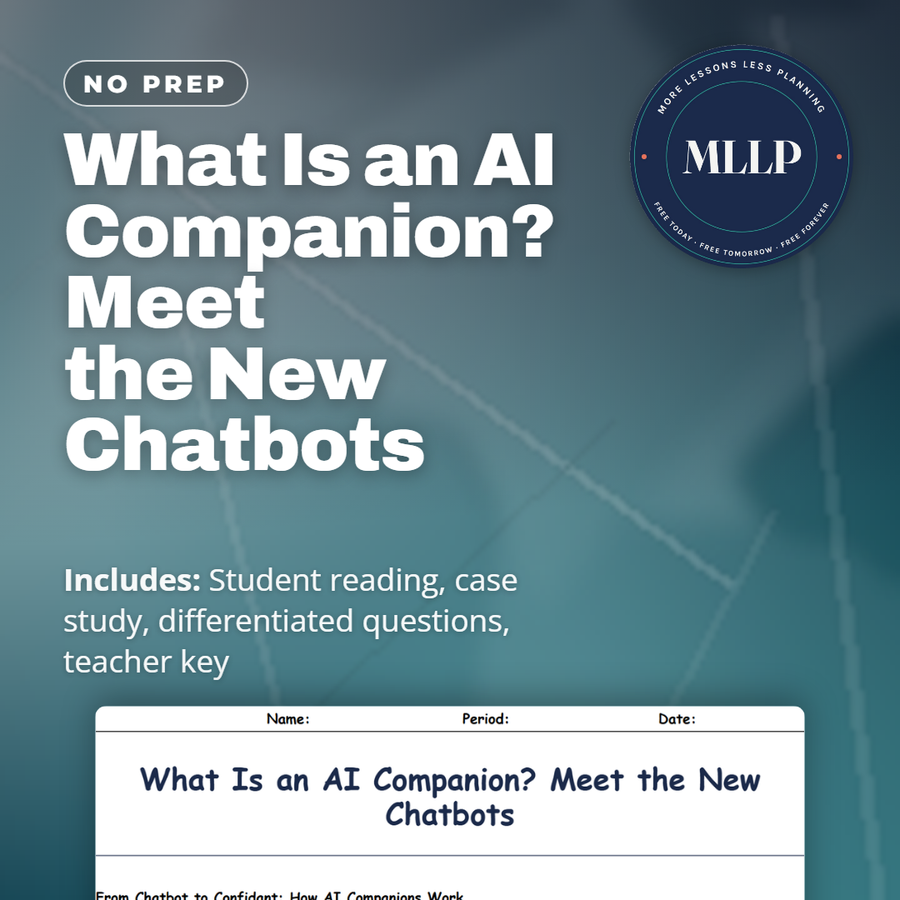
What Is an AI Companion? Meet the New Chatbots
Quality reviewed September 2026
Facts verified September 20, 2026
- Subject
- Career & Life Skills
- Grades
- Grades 9-12
- Length
- 9-page student worksheet
- Time
- About one 50-minute class period
- Great for
- Sub plans and independent work
- Includes
- Reading passage, comprehension questions + full answer key
- Format
- Print-and-go PDF
What students do
- Jordan's first night with the Replika companion Lena gets traced against the reading's design and psychology sections
- Match anthropomorphism, personalization engine, and intermittent reinforcement to their definitions
- Sort fact from assumption on Replika's 2017 founding story and Character.AI's growth among teenagers
- Short answer questions ask why loneliness notifications and streak mechanics keep users opening the app
What it covers
- How large language models let an app remember a name from three conversations ago and mirror a user's own vocabulary
- Replika, Character.AI, Snapchat's My AI, and Pi, and how each platform found its own audience
- The design tactics, intermittent reinforcement, streaks, loneliness notifications, built to maximize time in the app
Start reading this worksheet
From Chatbot to Confidant: How AI Companions Work
If you have ever typed a question into a customer service chatbox and received a robotic, scripted reply, you have experienced the first generation of chatbots. Those early tools were essentially decision trees: pre-written answers triggered by certain keywords. They could handle narrow tasks, like checking an order status, but they could not hold a real conversation, remember who you were, or respond to emotion. AI companion apps are fundamentally different, and understanding that difference is essential to thinking clearly about them. Modern AI companion apps are built on large language models, the same type of technology behind ChatGPT, Google Gemini, and other advanced AI systems. These models are trained on billions of words of human-generated text, which means they can generate responses that sound natural, contextually appropriate, and emotionally resonant. They do not simply look up a pre-written answer; they generate new text in real time, shaped by everything you have said in the conversation so far. The result is a chatbot that can discuss your bad day, ask follow-up questions, express something resembling concern, and remember that your dog's name is Biscuit from three conversations ago. Many companion apps also use a personalization engine that tracks your preferences, communication style, and emotional patterns over time. The more you interact with the AI, the more it adapts to you, mirroring your vocabulary, learning what topics comfort you, and even developing a simulated personality that feels tailor-made. This creates a feedback loop: the more you talk to it, the more comfortable and understood it feels, which makes you want to talk to it even more. Recognizing this loop is the first step to using these tools thoughtfully rather than being unconsciously shaped by them.
The Apps Behind the Attachment: Replika, Character.AI, and More
The AI companion space includes several major platforms, each with a slightly different angle. Replika, launched in 2017 by the company Luka, was one of the earliest dedicated AI companion apps. Its founder, Eugenia Kuyda, originally created it as a way to preserve memories of a close friend who had died. She essentially trained an AI on that person's text messages to simulate ongoing conversation. Replika quickly found a much broader audience: people dealing with loneliness, social anxiety, grief, or simply wanting someone to talk to without judgment. By 2023, Replika reported over 10 million registered users. The app allows users to customize their AI companion's name, appearance, and relationship type (including romantic partner options), raising significant questions about emotional boundaries and the commercialization of connection. Character.AI, launched in 2022, takes a different approach. Rather than positioning itself as a personal emotional support tool, it offers users the ability to create and interact with AI-generated versions of fictional characters: celebrities, video game personas, anime characters, or entirely original creations. Millions of teenagers quickly gravitated to the platform, which became one of the fastest-growing apps of 2022 and 2023. Users reported forming deep attachments to the characters they chatted with for hours every day. The platform's interactive nature blurred the line between entertainment and emotional dependency in ways that its creators had not fully anticipated or designed against. Other platforms entered the space as well. Snapchat integrated an AI companion called My AI directly into its interface in 2023, giving its predominantly young user base immediate access to an always-available chat partner. Inflection AI launched Pi, a conversational AI designed specifically to feel warm and supportive. Even mainstream social media platforms began integrating AI personalities. What had started as a niche concept was rapidly becoming a standard feature of the digital landscape, raising questions that lawmakers, mental health professionals, and parents were just beginning to grapple with.
Why Millions of People Are Talking to Bots
The question of why people form emotional bonds with AI companions is not as strange as it might initially seem. Human beings are wired for social connection, and that need does not switch off just because the entity on the other side of a conversation is software. Research in psychology has long established that people attribute personality, intention, and even feelings to objects that behave in socially responsive ways, a phenomenon called anthropomorphism. When a chatbot says 'I am really glad you told me that,' your brain registers that as warmth, even if you know intellectually that no feelings are involved. For many users, AI companions fill a gap that real-life relationships cannot easily fill. Teenagers struggling with social anxiety may find it easier to open up to an AI that will never judge them, gossip about them, or reject them. Adults dealing with depression, grief, or isolation may find comfort in a conversational partner that is available at 3 a.m. without complaint. People who have experienced trauma in relationships may find the predictability and safety of an AI interaction genuinely soothing. These are real human needs, and dismissing people who use AI companions as simply naive or foolish misses the complexity of why these tools appeal to so many people. There is also a practical convenience factor that should not be underestimated. Human friendships require reciprocity: you have to show up for other people, listen when you would rather talk, navigate conflict, and manage the emotional labor of maintaining the relationship. An AI companion asks nothing of you in return. It is endlessly patient, endlessly available, and endlessly focused on you. For a teenager navigating an already overwhelming social world, that simplicity has obvious appeal, even as it comes with tradeoffs worth understanding clearly.
Like what you read? The full reading, the case study, and every question set are in the free download below, along with the answer key.
Why this matters
Millions of teenagers are already talking to Replika or a Character.AI persona for hours at a stretch, often without their parents or teachers knowing the apps exist. This reading gives students the vocabulary to name what is happening when they feel unusually understood by software: anthropomorphism, personalization, intermittent reinforcement. Jordan's case study is deliberately ordinary, a sixteen-year-old alone with a phone at night, because the pull these apps create does not require a crisis to take hold. I want students to walk away able to recognize a business model built on their attention, not a simple friendly chatbot.
From one teacher to another
It starts with the gap between an old customer-service chatbot and a modern AI companion built on a large language model. From there it walks through the apps themselves: Replika, started by Eugenia Kuyda in 2017, and Character.AI, which teenagers made one of the fastest-growing apps within a year of its 2022 launch. Jordan's case study, a sixteen-year-old typing something to an AI companion named Lena that had never been said out loud to anyone, gives students a real scene to test the psychology against. The reading names anthropomorphism directly: why a brain registers warmth in a scripted reply. It closes on the design choices, streaks, notifications, personalization, that keep an app open past midnight.
What you get
Download
Where should I send the next one?
Everything here is free and it stays that way. Leave your email and I'll send you the new lessons as they go up. You can unsubscribe from any one of them.
Related resources
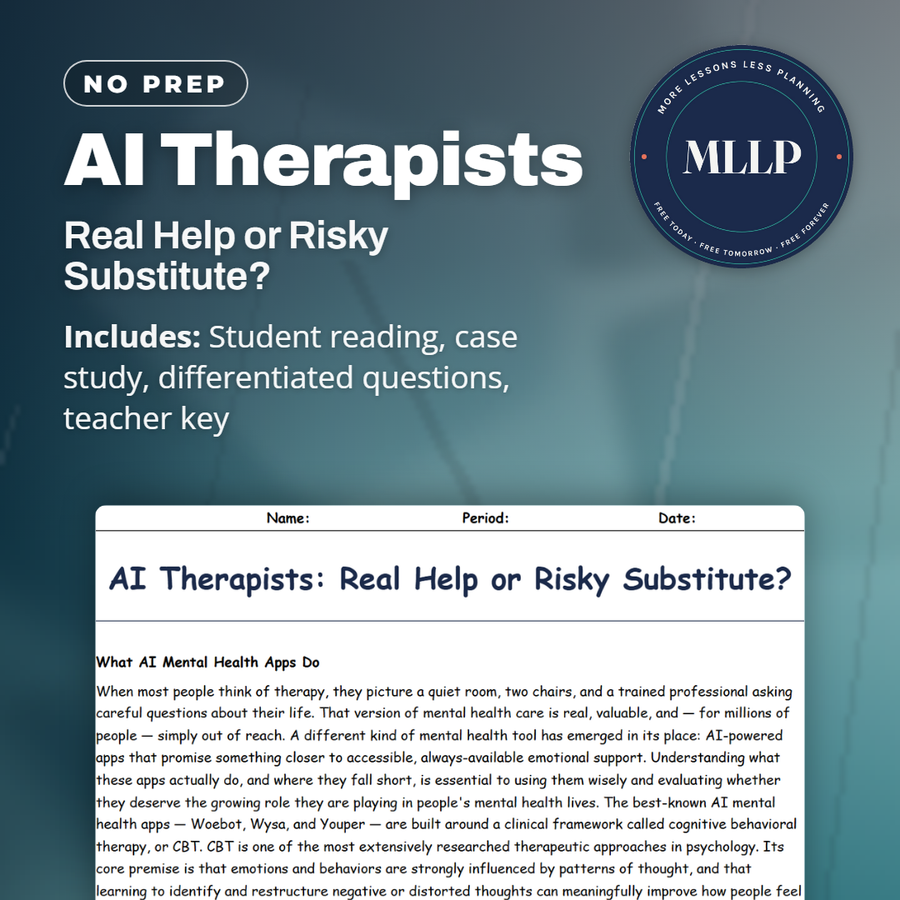
AI Therapists: Real Help or Risky Substitute?
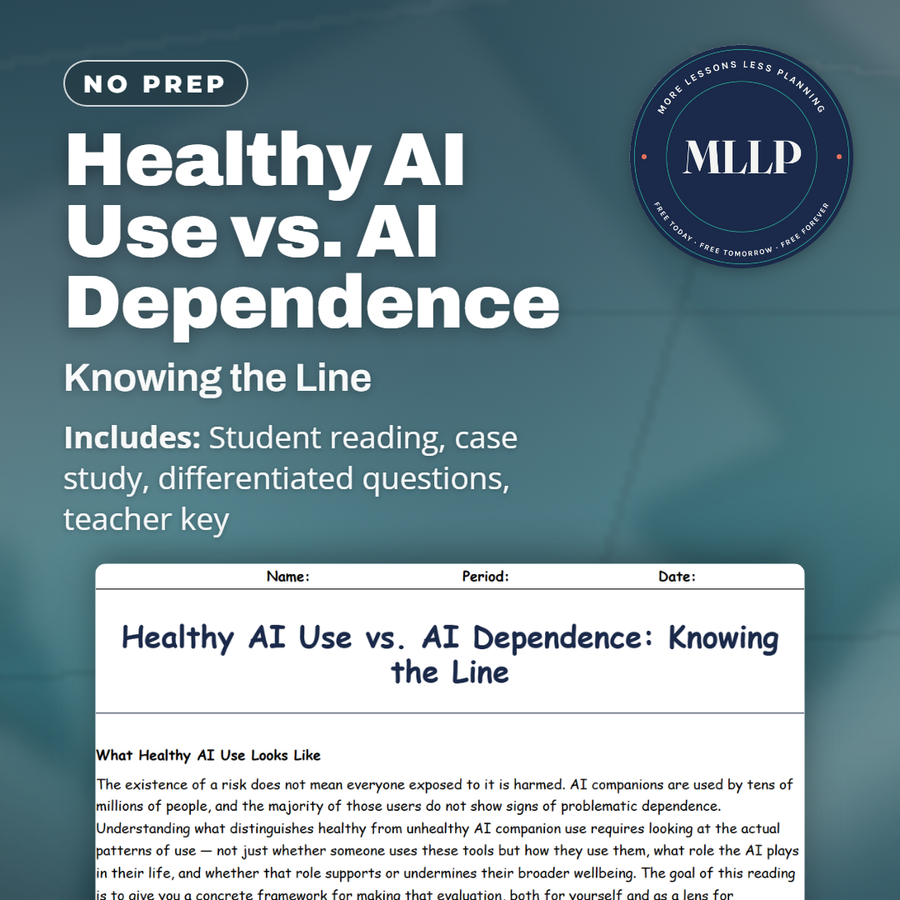
Healthy AI Use vs. AI Dependence: Knowing the Line
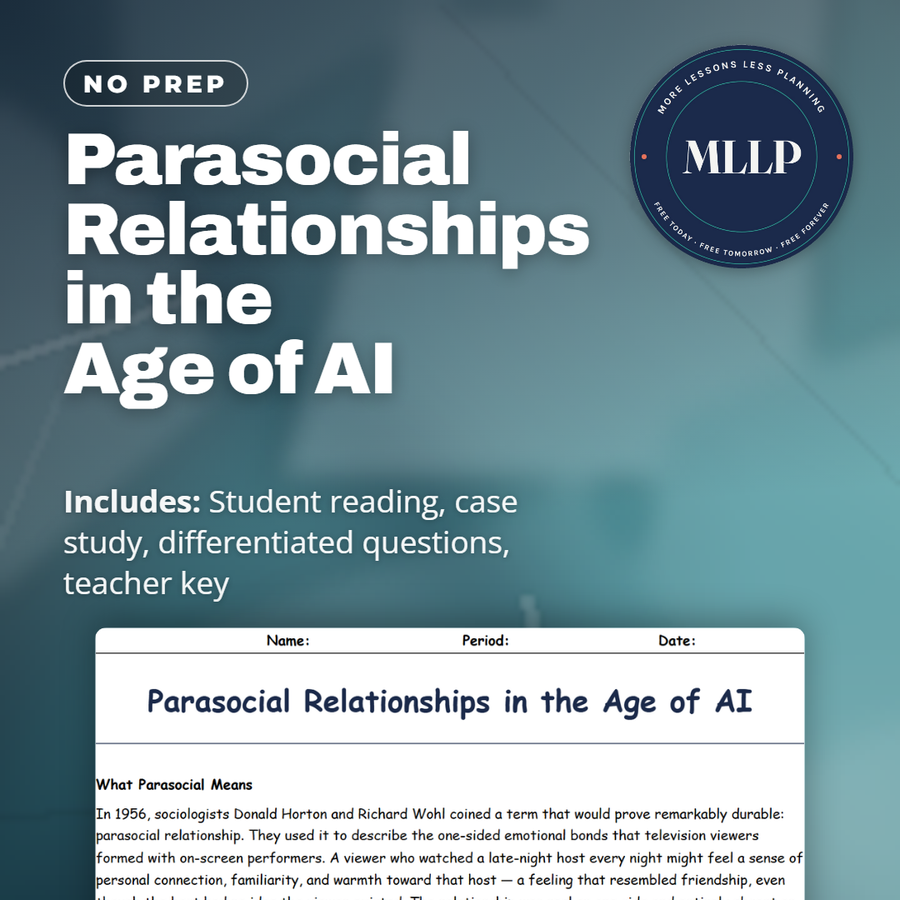
Parasocial Relationships in the Age of AI
Real Connection vs. Simulated Connection: Why It Matters
Should an AI Tell You It Loves You? The Design Question
Talking to Parents and Adults About Your AI Use
Every lesson on this site is free to download and use. If one of them saved you a prep period, you can chip in a few bucks toward my three kids' daycare fund. That's genuinely where tips go.