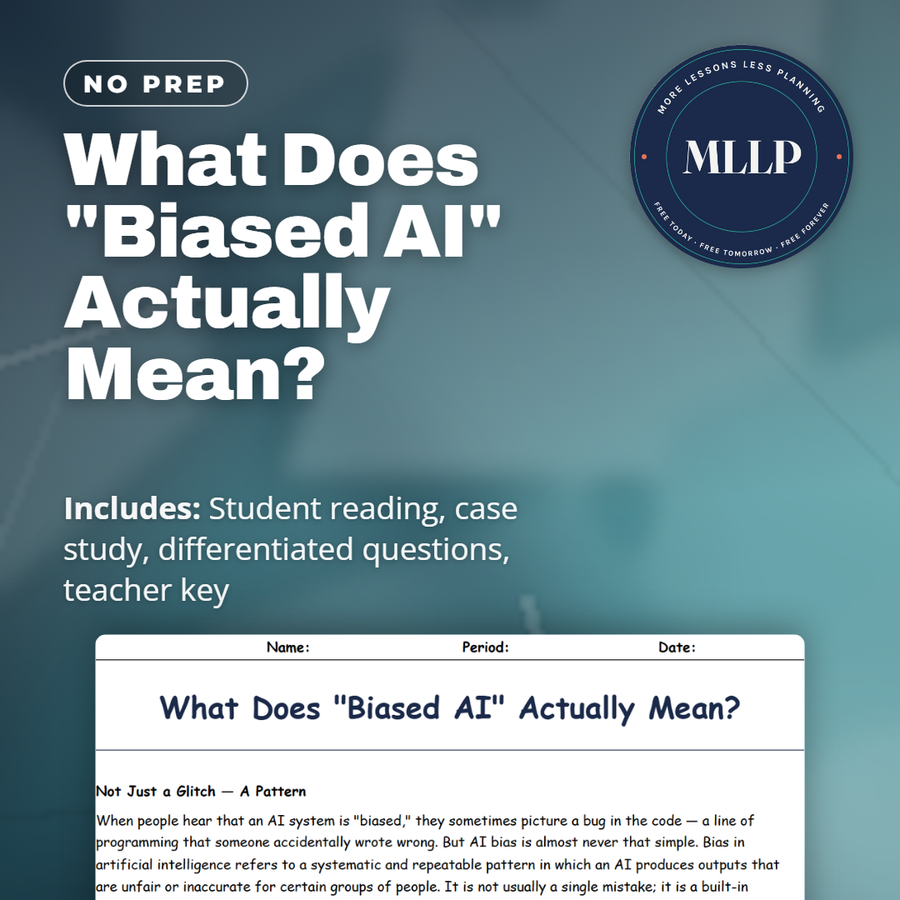
What Does "Biased AI" Actually Mean?
Quality reviewed September 2026
Facts verified September 20, 2026
- Subject
- Career & Life Skills
- Grades
- Grades 9-12
- Length
- 9-page student worksheet
- Time
- About one 50-minute class period
- Great for
- Sub plans and independent work
- Includes
- Reading passage, comprehension questions + full answer key
- Format
- Print-and-go PDF
What students do
- Maya's rejected application gets traced back to a specific type of AI bias named in the reading
- The Gender Shades study's 34.7 percent error rate gets connected to representation bias
- Match five terms, including proxy discrimination and feedback loop, to their definitions
- Explain why a credit scoring system that never mentions race can still discriminate by race
What it covers
- Historical, representation, and measurement bias, explained with real examples
- Proxy discrimination and the 2018 Gender Shades study
- A case study on a job applicant rejected by an AI screening tool
Start reading this worksheet
Not Just a Glitch: A Pattern
When people hear that an AI system is "biased," they sometimes picture a bug in the code, a line of programming that someone accidentally wrote wrong. But AI bias is almost never that simple. Bias in artificial intelligence refers to a systematic and repeatable pattern in which an AI produces outputs that are unfair or inaccurate for certain groups of people. It is not usually a single mistake; it is a built-in tendency that shows up consistently, often without anyone intending it. Understanding what causes this tendency requires looking at where AI learns in the first place: data. AI systems, particularly those based on machine learning, learn by analyzing enormous datasets: sometimes billions of examples. A language model might be trained on hundreds of millions of web pages. An image classifier might study millions of photographs. The AI detects patterns in all that information and uses those patterns to make predictions or decisions. The problem is that the data it learns from was created by human beings, who live in societies with long histories of discrimination, inequality, and prejudice. When those patterns exist in the training data, the AI absorbs them and reflects them back as if they were natural rules about the world.
Three Types of Bias You Should Know
Researchers who study AI fairness have identified several distinct types of bias. The first is historical bias. This occurs when the data accurately reflects the real world, but the real world itself contains discrimination. For example, if an AI is trained on historical hiring records from a company where women were rarely promoted to senior roles, the AI may learn to deprioritize women's applications, not because anyone programmed it to discriminate, but because discrimination was embedded in the history it studied. The second type is representation bias. This happens when certain groups are underrepresented or missing from the training data entirely. If a facial recognition system is trained mostly on photos of light-skinned individuals, it will become much less accurate when it encounters darker-skinned faces. The AI was not told to perform worse on those faces; it simply had far fewer examples to learn from. The third type is measurement bias, which occurs when the data itself is collected in a flawed way. If a predictive policing algorithm uses arrest rates as a proxy for crime rates, it is measuring police activity, not actual crime; police activity has historically been distributed unequally across communities.
The Feedback Loop Problem
One of the most troubling features of biased AI systems is that they can make bias worse over time. Imagine a hiring algorithm that learns from past hiring data. That data reflects years of discrimination against certain groups. The algorithm begins rejecting candidates from those groups at higher rates. Fewer candidates from those groups get hired. Future data now shows even lower representation. The algorithm trains again on this new data and becomes even more biased. This cycle is called a feedback loop, and it is one reason why bias in AI systems can compound and accelerate far faster than bias in purely human decision-making. Social media recommendation algorithms illustrate a similar problem. If users from certain communities are shown certain types of content more often, they click on it more. The algorithm interprets these clicks as evidence that those users want more of that content. More is shown. The cycle continues. The AI is optimizing for engagement, which sounds neutral, but the actual result can be that entire communities are systematically pushed toward certain categories of information: a form of bias that shapes what people believe and how they see the world.
Like what you read? The full reading, the case study, and every question set are in the free download below, along with the answer key.
Why this matters
Maya's story matters to my students because most of them will apply for a job through an automated portal within a few years, if they have not already. The reading pushes past the idea that math is automatically fair and shows exactly how a neutral looking variable like a ZIP code or a spending total can carry someone's race or gender along with it. Once students can name historical bias, representation bias, and measurement bias separately, they stop treating biased AI, a term the news throws around constantly, as one vague complaint.
From one teacher to another
Maya did everything right, finished a medical billing certification and worked three years at a clinic, and still got rejected by an AI screening tool before a human ever read her resume. Her case study leads into a reading that breaks bias into three specific types: historical bias, where discriminatory hiring records train an AI to keep discriminating, representation bias, where facial recognition trained mostly on light skinned faces performs worse on everyone else, and measurement bias, where arrest rates get used as a stand in for actual crime. Students also work through proxy discrimination, how a ZIP code can carry racial information without ever naming race, and the 2018 Gender Shades study, which found facial recognition error rates as high as 34.7 percent for darker skinned women compared to under 1 percent for lighter skinned men.
What you get
Download
Where should I send the next one?
Everything here is free and it stays that way. Leave your email and I'll send you the new lessons as they go up. You can unsubscribe from any one of them.
Related resources
AI and Your Personal Data: What Companies Know
AI in Criminal Justice: Predictive Policing Risks
AI in Healthcare: Helping or Hurting Patients?
Facial Recognition and Wrongful Arrests
Should Schools Use AI to Watch Students?

Stolen Voices and Stolen Art: Copyright in the AI Age
Every lesson on this site is free to download and use. If one of them saved you a prep period, you can chip in a few bucks toward my three kids' daycare fund. That's genuinely where tips go.