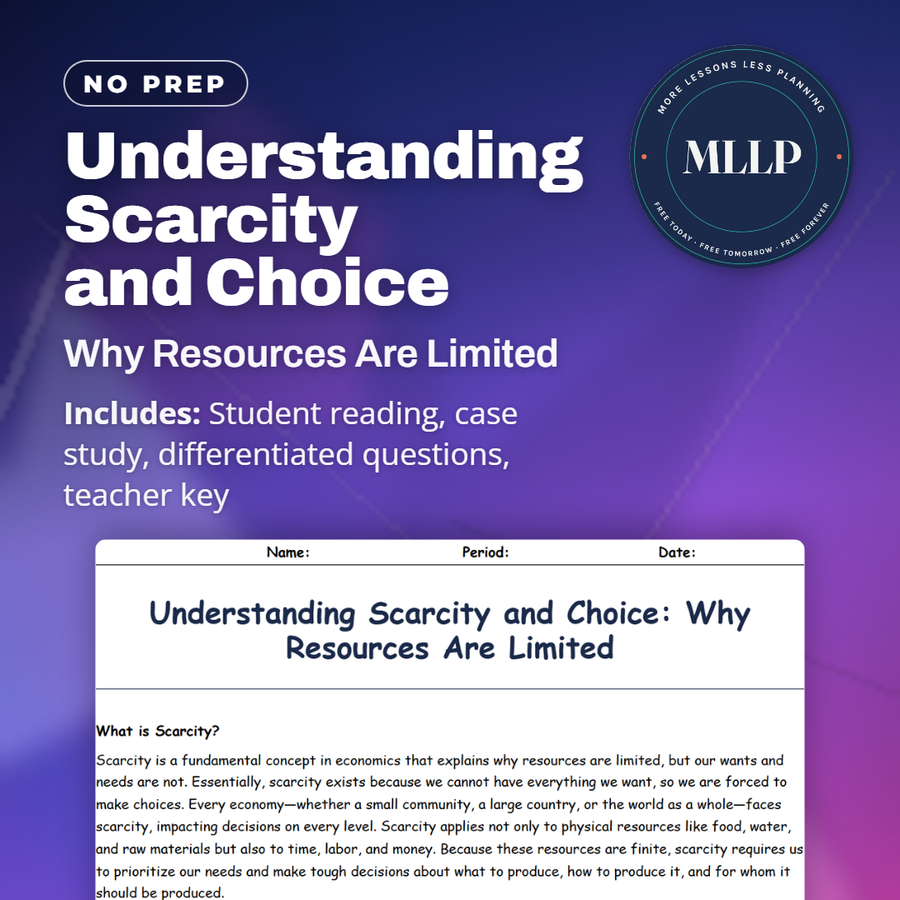
Understanding Scarcity and Choice: Why Resources Are Limited
Quality reviewed September 2026
Facts verified September 8, 2026
- Grades
- Grades 9-12
- Length
- 6-page student worksheet
- Time
- About one 50-minute class period
- Great for
- Sub plans and independent work
- Includes
- Reading passage, comprehension questions + full answer key
- Format
- Print-and-go PDF
What students do
- Analyze the 1970s oil crisis to understand how scarcity of a critical resource affected prices, consumer behavior, and government policy including rationing
- Explain how scarcity forces all economies to answer three key questions: what to produce, how to produce it, and for whom to produce
- Trace the relationship between scarcity and price using examples from droughts and agricultural products, showing why limited supply drives costs up
- Evaluate how individuals and businesses respond to scarcity through budgeting, efficiency improvements, and finding alternative materials or products
What it covers
- The fundamental economic concept that resources are limited but wants are unlimited, forcing all societies and individuals to make choices
- How scarcity affects prices, trade-offs, and the need for budgeting across individuals, businesses, and governments
- Historical case study of the 1970s oil crisis showing government rationing, public behavior changes, interest in fuel-efficient cars, and investment in alternative energy sources
Start reading this worksheet
What is Scarcity?
Scarcity is a fundamental concept in economics that explains why resources are limited, but our wants and needs are not. Essentially, scarcity exists because we cannot have everything we want, so we are forced to make choices. Every economy, whether a small community, a large country, or the world as a whole, faces scarcity, impacting decisions on every level. Scarcity applies not only to physical resources like food, water, and raw materials but also to time, labor, and money. Because these resources are finite, scarcity requires us to prioritize our needs and make tough decisions about what to produce, how to produce it, and for whom it should be produced.
Why Does Scarcity Lead to Choices?
Scarcity compels individuals, businesses, and governments to make choices about how best to use limited resources. When we decide to allocate resources to one purpose, we give up the opportunity to use them for something else. This is known as a trade-off. For example, if a city uses land to build a park, that land cannot simultaneously be used for housing or retail. The act of choosing how to use a resource means that other potential uses are sacrificed. In economics, these trade-offs are studied carefully to understand how best to meet needs within a society. Choices driven by scarcity are everywhere, from what a family buys at the grocery store to the decision of a government to invest in health care over transportation. In each scenario, scarcity is at the core of these decisions.
The Impact of Scarcity on Society
Scarcity affects more than just personal or government choices; it shapes the broader society. Countries with limited resources must be strategic, trading with others or investing in technology to make resources stretch further. For instance, many nations import resources like oil or grain, trading what they have in abundance for what they lack. Societies must balance needs and wants, often asking citizens to conserve resources or pay higher prices for scarce items. Scarcity also affects prices in an economy. When a resource is scarce, its price tends to increase. This principle is evident in situations like droughts, which lead to higher prices for water or agricultural products. When demand remains high and supply is low, scarcity leads to increased costs, making it more expensive to obtain essential goods.
Like what you read? The full reading, the case study, and every question set are in the free download below, along with the answer key.
Why this matters
Gas station lines stretching around the block, fuel rationed by the government, drivers suddenly shopping for smaller cars: the 1970s oil crisis shows what happens when a resource everyone depends on becomes scarce. Scarcity forces every economy to answer what to produce, how to produce it, and for whom, all at once.
Ask a student what scarcity means and most say something like not having much money. It actually means unlimited wants meeting finite resources. The oil crisis shows the ripple effects: higher prices, changed habits, new investment in alternative energy that outlasted the crisis itself. Every dollar spent was a dollar not spent elsewhere.
From one teacher to another
I use this worksheet when students are ready to understand that economics is fundamentally about limits. Scarcity is why every economy exists. My students learn that scarcity doesn't just mean "not much." It means unlimited wants meeting finite resources, which forces choices. The 1970s oil crisis is a powerful historical example: political tension in the Middle East restricted oil supplies, prices soared, gas stations ran out, and the government rationed fuel. Americans responded by demanding more efficient cars and thinking seriously about energy conservation. But the case study also shows the downstream effects: investments in alternative energy sources, changes in public behavior, and a lasting awareness of resource limits. My students see that scarcity isn't an emergency state, it's everyday economics. Every dollar spent is a choice not to spend it elsewhere. Every resource used for one purpose can't be used for another.
What you get
- Answer Key
-
Student Worksheet
Japan imports most of its oil because it holds almost no reserves of its own, while Saudi Arabia exports oil most countries lack, an example of scarcity working at the scale of whole nations. It also traces scarcity into prices, droughts pushing up the cost of water and crops, and returns to COVID-19, when disrupted supply chains left medical supplies and consumer electronics scarce worldwide.
Download
Where should I send the next one?
Everything here is free and it stays that way. Leave your email and I'll send you the new lessons as they go up. You can unsubscribe from any one of them.
Related resources
Comparing Economic Systems: Market, Command, and Mixed
Economic Models and Theories: Simplifying Complex Concepts
Factors of Production: Building Blocks of the Economy
Marginal Analysis: Making the Most of Every Decision
Opportunity Cost: The True Cost of Every Decision
Production Possibilities Curve: Visualizing Choices and Trade-Offs
Every lesson on this site is free to download and use. If one of them saved you a prep period, you can chip in a few bucks toward my three kids' daycare fund. That's genuinely where tips go.