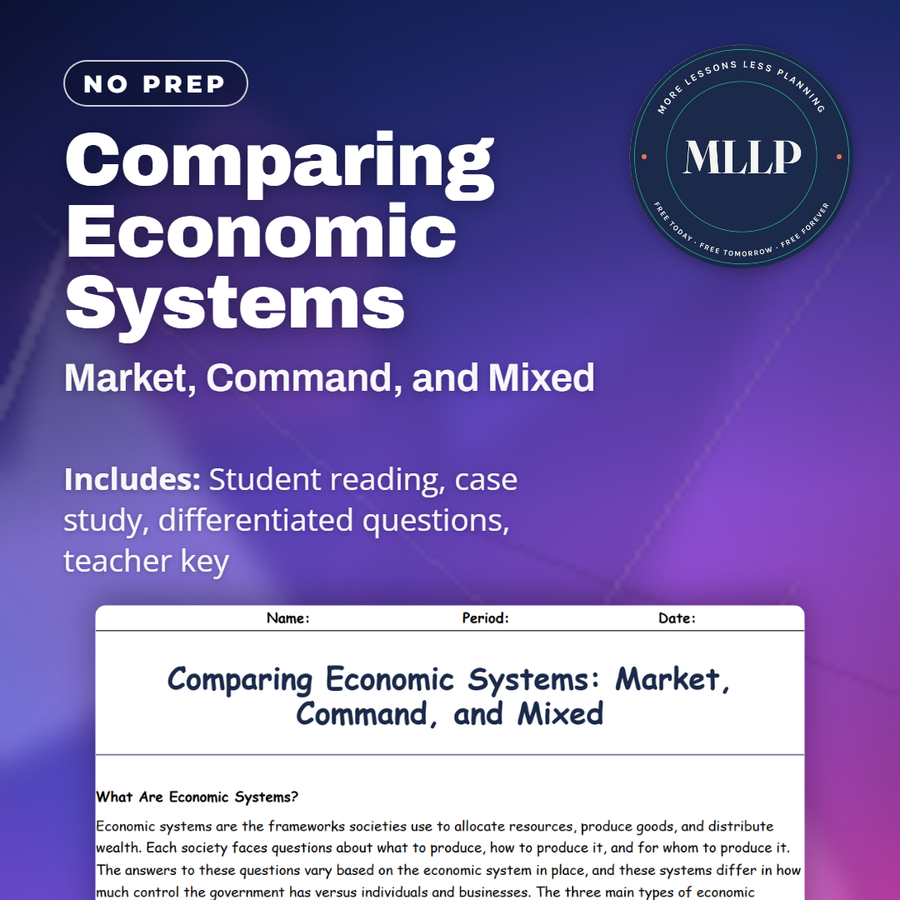
Comparing Economic Systems: Market, Command, and Mixed
Quality reviewed September 2026
Facts verified September 8, 2026
- Grades
- Grades 9-12
- Length
- 7-page student worksheet
- Time
- About one 50-minute class period
- Great for
- Sub plans and independent work
- Includes
- Reading passage, comprehension questions + full answer key
- Format
- Print-and-go PDF
What students do
- Analyze the Soviet Union case study to understand how government control affected production, goods quality, shortages, and citizen freedom of choice
- Compare the efficiency and innovation of market economies with the equity and stability of command economies
- Match key economic terms like market economy, equity, efficiency, and entrepreneurship to their definitions
- Explain how mixed economies like Canada and the United Kingdom balance government regulation with private enterprise
What it covers
- Three main economic systems, market economies, command economies, and mixed economies, showing how each answers questions about what to produce and for whom
- Advantages and disadvantages of each system in terms of efficiency, innovation, equity, stability, and access to public services
- Real-world example of the Soviet Union as a command economy, illustrating how government control provided universal healthcare and education but caused shortages and stifled innovation
Start reading this worksheet
What Are Economic Systems?
Economic systems are the frameworks societies use to allocate resources, produce goods, and distribute wealth. Each society faces questions about what to produce, how to produce it, and for whom to produce it. The answers to these questions vary based on the economic system in place, and these systems differ in how much control the government has versus individuals and businesses. The three main types of economic systems are the market economy, the command economy, and the mixed economy. Each has its unique advantages and disadvantages, and most countries in the world fall somewhere along a spectrum rather than adhering to a pure version of any single system.
Market Economy: Freedom of Choice
In a market economy, the decisions of what, how, and for whom to produce are driven primarily by the choices of individuals and businesses, not the government. This system is based on supply and demand, where prices and production are guided by consumer choices. Businesses operate to make profits, which incentivizes them to provide goods and services that meet public demand. The United States is often cited as a strong example of a market-based economy, where private ownership and free enterprise are central. However, even the U.S. government regulates certain industries to ensure public welfare and fair practices.
Advantages of a Market Economy
One of the major benefits of a market economy is efficiency. Because businesses are profit-motivated, they seek to use resources in ways that minimize costs and maximize returns. Consumers also benefit from a wider variety of goods and services, as businesses compete to meet consumer demands. Another advantage is innovation; the competition between companies drives new ideas, technologies, and products.
Like what you read? The full reading, the case study, and every question set are in the free download below, along with the answer key.
Why this matters
A country can promise every citizen free healthcare and free education and still leave its store shelves empty. That contradiction sits inside the Soviet Union case study: a command economy strong on equity but weak on quality and innovation. Every economic system decides who gets what, and each accepts different trade-offs to get there.
I assign this right after students insist one system is simply the best. Weighing the Soviet Union's guaranteed services against its shortages forces them to hold two true things at once. By the time we reach Canada and the United Kingdom, they stop expecting a pure answer and notice how much of the world runs on a blend of markets and government support.
From one teacher to another
I use this reading on economic systems when students need to see how different societies organize their economies. My students analyze the Soviet Union case study to understand why command economies provide healthcare and education to everyone but often lack innovation and quality goods. They compare the efficiency and competition of market economies with the equity and stability of command economies, then explore how mixed economies like Canada and the United Kingdom balance both approaches. The worksheet helps them grasp why most modern countries don't rely on pure market or command systems.
What you get
- Answer Key
-
Student Worksheet
The Soviet Union ran a command economy from its 1922 founding until its 1991 dissolution, directing steel, mining, and agriculture from the top. Rapid industrialization came alongside long waits for housing and cars, and by the 1980s stagnation had set in without competition to spur improvement. North Korea gets a mention too, as a modern state still running that same top-down model today.
Download
Where should I send the next one?
Everything here is free and it stays that way. Leave your email and I'll send you the new lessons as they go up. You can unsubscribe from any one of them.
Related resources
Economic Models and Theories: Simplifying Complex Concepts

Factors of Production: Building Blocks of the Economy

Marginal Analysis: Making the Most of Every Decision

Opportunity Cost: The True Cost of Every Decision
Production Possibilities Curve: Visualizing Choices and Trade-Offs
Rational Decision-Making in Economics: Balancing Benefits and Costs
Every lesson on this site is free to download and use. If one of them saved you a prep period, you can chip in a few bucks toward my three kids' daycare fund. That's genuinely where tips go.