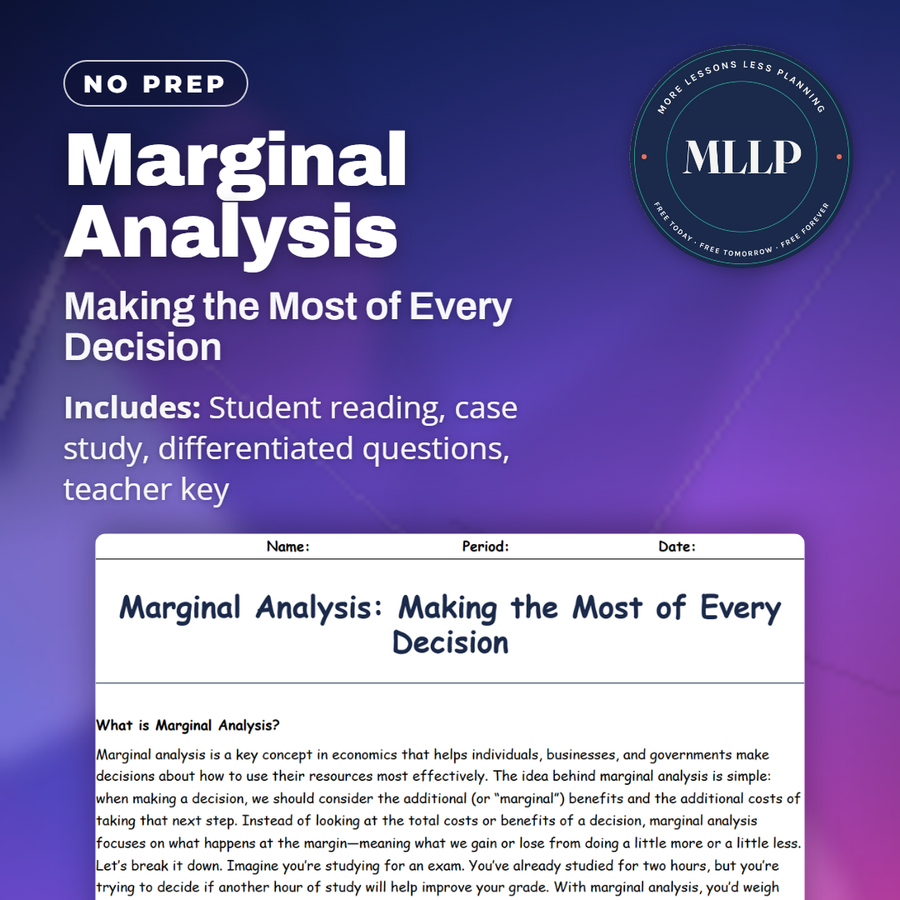
Marginal Analysis: Making the Most of Every Decision
Quality reviewed September 2026
Facts verified September 8, 2026
- Grades
- Grades 9-12
- Length
- 7-page student worksheet
- Time
- About one 50-minute class period
- Great for
- Sub plans and independent work
- Includes
- Reading passage, comprehension questions + full answer key
- Format
- Print-and-go PDF
What students do
- Apply marginal analysis to a bakery deciding how many cakes to produce each day by comparing the extra cost of each cake against what customers pay
- Analyze the diminishing returns concept using a farmer's fertilizer decisions, showing how additional fertilizer yields less benefit over time
- Graph marginal benefit versus marginal cost to identify the point where production should stop for optimal profit
- Determine when to stop an activity by finding the equilibrium point where marginal cost equals marginal benefit
What it covers
- Marginal analysis concept: weighing additional benefits and costs of one more unit to make better decisions
- Real-world applications in business (hiring, production levels, pricing), farming (fertilizer use), and everyday life (studying, exercising)
- The principle of diminishing returns, showing why additional resources eventually provide less value
Start reading this worksheet
What is Marginal Analysis?
Marginal analysis is a key concept in economics that helps individuals, businesses, and governments make decisions about how to use their resources most effectively. The idea behind marginal analysis is simple: when making a decision, we should consider the additional (or “marginal”) benefits and the additional costs of taking that next step. Instead of looking at the total costs or benefits of a decision, marginal analysis focuses on what happens at the margin—meaning what we gain or lose from doing a little more or a little less. Let’s break it down. Imagine you’re studying for an exam. You’ve already studied for two hours, but you’re trying to decide if another hour of study will help improve your grade. With marginal analysis, you’d weigh the benefit of an extra hour (a potentially higher grade) against the cost (one less hour of free time). If the benefit outweighs the cost, it makes sense to study for the additional hour.
Marginal Benefit vs. Marginal Cost
Marginal analysis centers on two concepts: marginal benefit and marginal cost. Marginal benefit refers to the additional benefit gained from consuming or producing one more unit of a good or service. Marginal cost, on the other hand, is the additional cost incurred from that extra unit. Economists believe that rational decision-making occurs when individuals, businesses, or governments continue an activity as long as the marginal benefit is greater than the marginal cost. Once the marginal cost exceeds the marginal benefit, it’s no longer worth pursuing that activity. This balance point is called the equilibrium in marginal analysis. For example, a bakery might decide how many cakes to bake each day based on the marginal benefit of selling one more cake versus the marginal cost of producing it. If it costs $5 to make a cake and customers are willing to pay $10, the bakery gains $5 in benefit for each additional cake. However, if producing another cake raises costs due to overtime pay or equipment wear, the marginal cost might rise above $10, and the bakery would choose to stop production
Table: Marginal Analysis in Cake Production
This table illustrates how a bakery might use marginal analysis to determine the optimal number of cakes to produce daily: In this example, the bakery continues producing cakes until the marginal cost of producing an additional cake ($11) exceeds the marginal benefit ($10). At that point, it’s no longer profitable to make more cakes.
Like what you read? The full reading, the case study, and every question set are in the free download below, along with the answer key.
Why this matters
Baking a cake makes sense at three to seven dollars in added cost, but not at eleven, where the extra expense outweighs what customers pay. That is marginal analysis: weighing the benefit of one more unit against its cost. The farmer's fertilizer makes the same point in reverse, useful bag after bag until the fifth, when the soil is saturated.
What surprises students is how often they already do this math: one more hour of studying, one more mile of a run, one more rep. I put the bakery and the fertilizer examples side by side so they see the same logic in a business decision and a farming decision. Once they spot where added cost catches up to added benefit, they apply it themselves.
From one teacher to another
I use this worksheet when students need to understand why people stop doing things. Marginal analysis explains everyday decisions: study one more hour or stop, hire one more worker or don't, apply one more bag of fertilizer or save the money. My students work through the bakery example where producing cakes is profitable at $3 to $7 per cake, but stops making sense at $11, because that's where the added cost exceeds the added benefit. The farmer case study shows diminishing returns in action: the first bags of fertilizer boost yield significantly, but by bag five, the soil is saturated and one more bag costs more than the extra corn is worth. Students grasp that this principle guides business decisions and how we budget our time and energy in life.
What you get
- Answer Key
-
Student Worksheet
A retail store hires seasonal staff each holiday season because the extra help meeting demand is worth more than the wages, then cuts positions once demand drops and cost outweighs benefit. The same logic applies to government, weighing a new highway's reduced traffic and improved safety against construction and environmental costs, and to pollution rules weighed against cleanup costs to businesses and taxpayers.
Download
Where should I send the next one?
Everything here is free and it stays that way. Leave your email and I'll send you the new lessons as they go up. You can unsubscribe from any one of them.
Related resources
Comparing Economic Systems: Market, Command, and Mixed
Economic Models and Theories: Simplifying Complex Concepts
Factors of Production: Building Blocks of the Economy
Opportunity Cost: The True Cost of Every Decision
Production Possibilities Curve: Visualizing Choices and Trade-Offs
Rational Decision-Making in Economics: Balancing Benefits and Costs
Every lesson on this site is free to download and use. If one of them saved you a prep period, you can chip in a few bucks toward my three kids' daycare fund. That's genuinely where tips go.