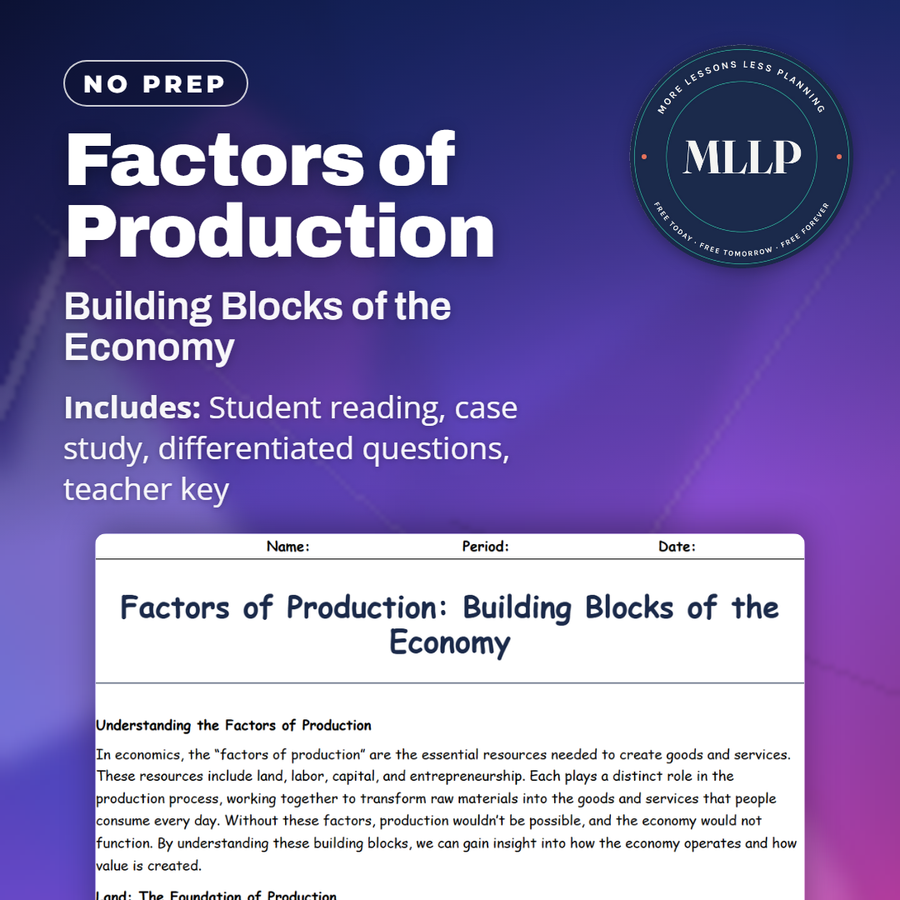
Factors of Production: Building Blocks of the Economy
Quality reviewed September 2026
Facts verified September 8, 2026
- Grades
- Grades 9-12
- Length
- 7-page student worksheet
- Time
- About one 50-minute class period
- Great for
- Sub plans and independent work
- Includes
- Reading passage, comprehension questions + full answer key
- Format
- Print-and-go PDF
What students do
- Analyze Apple's use of skilled engineers in California and high-tech machinery in factories to understand how labor and capital interact in production
- Distinguish between natural resources (land), human effort (labor), tools and machines (capital), and the risk-takers who combine them (entrepreneurs)
- Explain why capital like high-tech machinery enhances productivity, using specific examples from manufacturing and business operations
- Match economic terms including entrepreneurship, productivity, and capital to their role in creating goods and services
What it covers
- The four factors of production: land (natural resources including water, minerals, and physical space), labor (human work), capital (tools and machinery), and entrepreneurship (risk-taking and innovation)
- How these factors interact and depend on each other, demonstrated through Apple's production of iPhones with both skilled labor and sophisticated equipment
- Why capital investment and entrepreneurship drive economic growth, innovation, and competitive advantage in modern economies
Start reading this worksheet
Understanding the Factors of Production
In economics, the “factors of production” are the essential resources needed to create goods and services. These resources include land, labor, capital, and entrepreneurship. Each plays a distinct role in the production process, working together to transform raw materials into the goods and services that people consume every day. Without these factors, production wouldn’t be possible, and the economy would not function. By understanding these building blocks, we can gain insight into how the economy operates and how value is created.
Land: The Foundation of Production
Land refers to all natural resources used to produce goods and services. This includes physical space, like fields or factories, but also other natural resources like water, minerals, forests, and oil. Land is unique in that it is finite and cannot be easily increased. This scarcity makes it valuable, especially in high-demand areas. Agricultural land, for example, is critical for growing food, while mineral resources are vital for manufacturing. Land serves as the foundation for all production. Without it, there would be no place to build factories, no soil to grow crops, and no resources to mine. In the modern economy, businesses and governments make important decisions about how to use land wisely, balancing needs like agriculture, housing, and conservation.
Labor: The Human Element
Labor is the human effort involved in the production of goods and services. It includes both physical and mental work—from factory workers assembling products to engineers designing new technology. Labor can be skilled or unskilled, depending on the type of work and the qualifications needed. For example, a software developer is skilled labor, while a cashier at a retail store may be considered unskilled labor. Labor is essential because it drives production. Skilled workers can boost productivity and innovation, while unskilled labor provides essential services that keep businesses running. In addition, labor is affected by factors like education, wages, and working conditions. These factors influence the supply of labor, as people seek jobs that offer fair compensation and a good work environment.
Like what you read? The full reading, the case study, and every question set are in the free download below, along with the answer key.
Why this matters
An iPhone exists because of engineers designing it in California, machinery assembling it precisely, raw minerals mined from the ground, and someone willing to risk everything to combine all three. That is Apple's production story reduced to the four factors of production: land, labor, capital, and entrepreneurship.
Students walk in thinking land just means dirt, so I like watching them realize it covers coffee beans, minerals, and factory space itself. Tracing labor and capital through Apple shows why companies invest so heavily in both machines and people. Without entrepreneurship pulling those pieces together, nothing gets made.
From one teacher to another
I use this reading when teaching how production actually works beyond the factory. My students trace through the Apple case study to see all four factors working together: the design talent in California, the factories in Asia, the machinery that keeps production precise, and the entrepreneurs who started it all. They learn that land means more than dirt. It's every natural resource, from coffee beans to minerals to space itself. The matching and fill-in sections help them solidify that capital and labor work together, and without entrepreneurship pulling all these pieces together, nothing gets made. This worksheet makes it clear why businesses invest so heavily in both equipment and skilled people.
What you get
- Answer Key
-
Student Worksheet
A coffee shop needs its location and raw beans, baristas and a manager, espresso machines and furniture, and an owner's strategy tying it together, one small business carrying capital, labor, land, and entrepreneurship at once. The reading credits Steve Jobs, who co-founded Apple, as the entrepreneur type combining those pieces into something new, and separates skilled labor like a software developer from unskilled labor like a retail cashier.
Download
Where should I send the next one?
Everything here is free and it stays that way. Leave your email and I'll send you the new lessons as they go up. You can unsubscribe from any one of them.
Related resources
Comparing Economic Systems: Market, Command, and Mixed
Economic Models and Theories: Simplifying Complex Concepts

Marginal Analysis: Making the Most of Every Decision
Opportunity Cost: The True Cost of Every Decision
Production Possibilities Curve: Visualizing Choices and Trade-Offs
Rational Decision-Making in Economics: Balancing Benefits and Costs
Every lesson on this site is free to download and use. If one of them saved you a prep period, you can chip in a few bucks toward my three kids' daycare fund. That's genuinely where tips go.