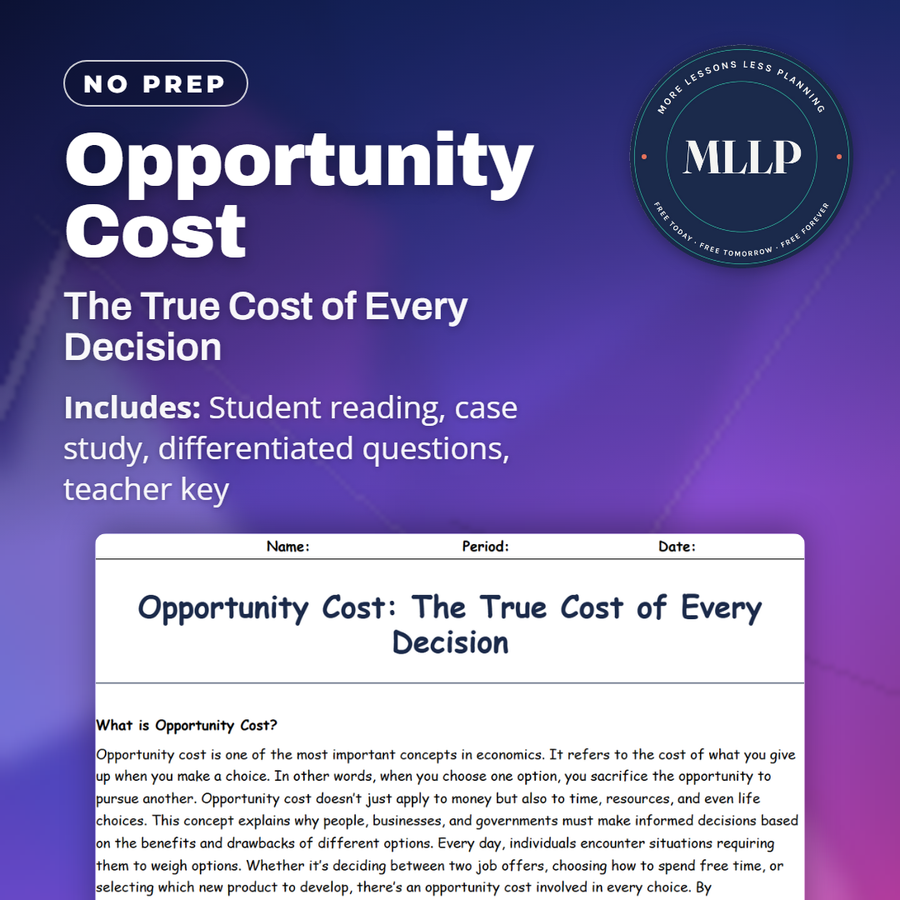
Opportunity Cost: The True Cost of Every Decision
Quality reviewed September 2026
Facts verified September 8, 2026
- Grades
- Grades 9-12
- Length
- 6-page student worksheet
- Time
- About one 50-minute class period
- Great for
- Sub plans and independent work
- Includes
- Reading passage, comprehension questions + full answer key
- Format
- Print-and-go PDF
What students do
- Compare the trade-offs of attending college, entering the workforce, or pursuing vocational training to understand opportunity cost in major life decisions
- Evaluate business scenarios where companies must choose between investing in technology or hiring more employees, calculating what they give up
- Identify opportunity costs in everyday situations like spending money on coffee daily versus saving for larger purchases, or social media time versus homework
- Explain how governments prioritize spending between healthcare and education by analyzing the opportunity cost of each funding choice
What it covers
- Definition of opportunity cost as the value of the next best alternative forgone when making a choice
- Real-world applications in personal decisions (job offers, free time), business strategy (technology versus workforce), and government policy (healthcare versus education)
- Case study on higher education showing how tuition costs and lost income present significant opportunity costs that affect long-term career potential
Start reading this worksheet
What is Opportunity Cost?
Opportunity cost is one of the most important concepts in economics. It refers to the cost of what you give up when you make a choice. In other words, when you choose one option, you sacrifice the opportunity to pursue another. Opportunity cost doesn’t just apply to money but also to time, resources, and even life choices. This concept explains why people, businesses, and governments must make informed decisions based on the benefits and drawbacks of different options. Every day, individuals encounter situations requiring them to weigh options. Whether it’s deciding between two job offers, choosing how to spend free time, or selecting which new product to develop, there’s an opportunity cost involved in every choice. By understanding opportunity cost, we gain insight into the unseen consequences of our decisions and why people often feel uncertain about big decisions.
The Role of Opportunity Cost in Decision-Making
When making decisions, the concept of opportunity cost plays a significant role in helping us prioritize what is most valuable to us. By considering what we stand to gain or lose, opportunity cost allows us to weigh each choice more carefully. For example, let’s say you’re deciding between two after-school activities: joining a sports team or volunteering at a local organization. If you choose sports, you miss out on the opportunity to gain experience in community service. Likewise, if you choose volunteering, you miss out on the chance to build athletic skills. Recognizing opportunity costs can help make these decisions clearer by highlighting what will be sacrificed for each option.
Opportunity Cost in Business Decisions
Businesses must also consider opportunity costs in nearly every decision they make. For instance, a company may need to decide between investing in new technology or expanding its workforce. If it chooses to invest in technology, the opportunity cost might be slower growth due to limited staff. On the other hand, if it hires more employees, the company may not keep up with competitors who have upgraded technology. Opportunity cost is critical in strategic planning, as it ensures that limited resources are used where they can bring the greatest benefit to the company. This consideration is especially relevant for small businesses with limited budgets, as they must carefully allocate their resources to achieve the best results.
Like what you read? The full reading, the case study, and every question set are in the free download below, along with the answer key.
Why this matters
Choosing college over an entry-level job does not just cost tuition. It costs four years of income and four years of time spent one way instead of another. That is opportunity cost: the value of whatever a person gives up by choosing something else, whether the choice is a career path, a budget line, or a daily habit.
Seniors weighing college against work feel this decision in real time, which is why it lands harder than a textbook definition. We use the healthcare-versus-education budget example to show governments face the same trade-off at a larger scale, and technology-versus-hiring to show businesses do too. Students leave realizing they already think this way.
From one teacher to another
I use this reading when students are making big decisions about their own futures. The college versus workforce case study hits home because it's about them: going to college costs money and four years, but it opens career doors that starting work immediately won't. My students see that opportunity cost is never just about money. It's about time, lifestyle, and what you give up. We analyze the healthcare versus education budget scenario to show that governments face the same trade-offs every day. A business choosing between new technology and hiring staff faces the same choice. By understanding opportunity cost, my students realize they already use this thinking in their lives. They learn to weigh what they will get against what they will lose.
What you get
- Answer Key
-
Student Worksheet
Transitioning away from fossil fuels carries steep upfront costs, but the reading treats inaction as its own cost too, one paid later in environmental damage and health harm if a country skips the switch. It makes the same point on a smaller scale with a student choosing between joining a sports team and volunteering at a local organization, since picking one closes off the specific experience the other would have built.
Download
Where should I send the next one?
Everything here is free and it stays that way. Leave your email and I'll send you the new lessons as they go up. You can unsubscribe from any one of them.
Related resources
Comparing Economic Systems: Market, Command, and Mixed
Economic Models and Theories: Simplifying Complex Concepts
Factors of Production: Building Blocks of the Economy
Marginal Analysis: Making the Most of Every Decision
Production Possibilities Curve: Visualizing Choices and Trade-Offs
Rational Decision-Making in Economics: Balancing Benefits and Costs
Every lesson on this site is free to download and use. If one of them saved you a prep period, you can chip in a few bucks toward my three kids' daycare fund. That's genuinely where tips go.