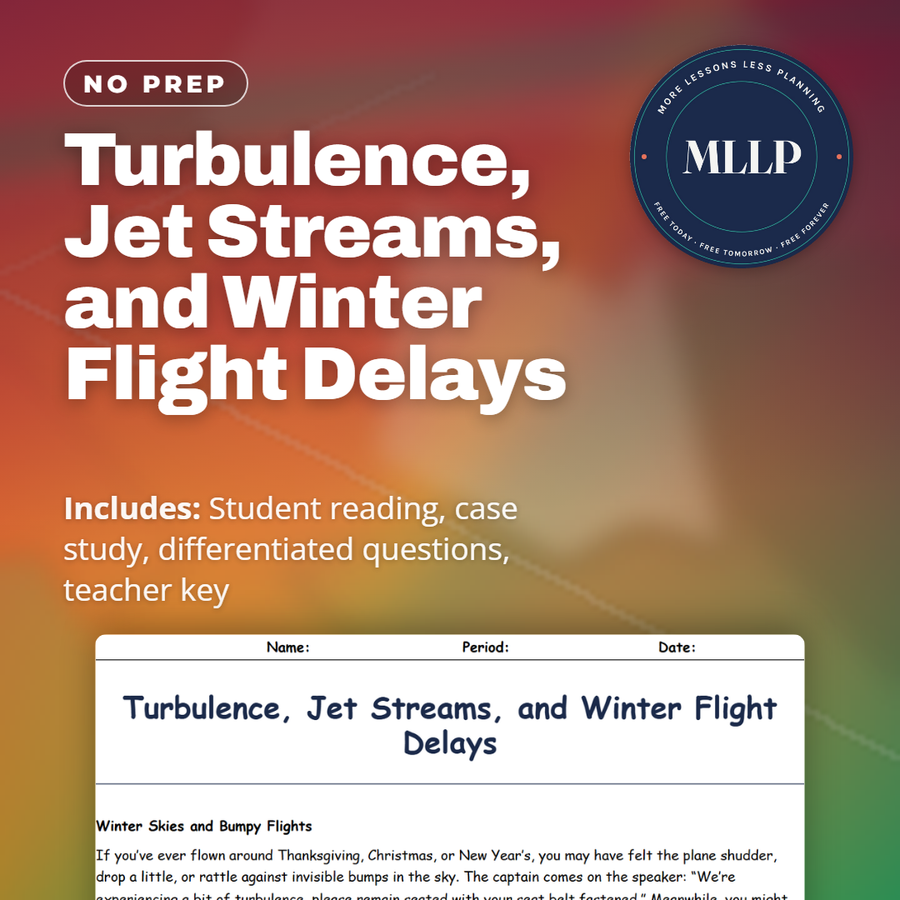
Turbulence, Jet Streams, and Winter Flight Delays
Quality reviewed September 2026
Facts verified September 9, 2026
- Subject
- Science
- Grades
- Grades 9-12
- Length
- 8-page student worksheet
- Time
- About one 50-minute class period
- Great for
- Sub plans and independent work
- Includes
- Reading passage, comprehension questions + full answer key
- Format
- Print-and-go PDF
What students do
- Explain how Earth's axial tilt and jet streams create winter weather patterns
- Distinguish between mechanical, convective, and clear-air turbulence
- Analyze why headwinds and de-icing procedures delay holiday flights
- Interpret data on jet stream effects and wind shear using a reference table
What it covers
- Jet streams and high-altitude wind patterns
- Types of atmospheric turbulence
- Winter storms and flight operations
Start reading this worksheet
Winter Skies and Bumpy Flights
If you’ve ever flown around Thanksgiving, Christmas, or New Year’s, you may have felt the plane shudder, drop a little, or rattle against invisible bumps in the sky. The captain comes on the speaker: “We’re experiencing a bit of turbulence, please remain seated with your seat belt fastened.” Meanwhile, you might be wondering: What is actually shaking this huge machine? And why does it seem so common in winter? From an Earth science point of view, a plane is simply moving through the atmosphere, a fluid made of gases. Just like water in a river can swirl, speed up, or slow down, airflows can form smooth streams or chaotic, choppy patches. Turbulence is the rough, irregular motion that happens when air currents with different speeds, temperatures, or directions collide or mix. In winter, the atmosphere often has sharper boundaries between warm and cold air masses, strong pressure gradients, and more active storm systems. All of these factors increase the chances of turbulence and weather-related flight delays. Turbulence feels scary, but pilots and planes are designed for it. Aircraft are built to withstand forces much greater than typical bumps you feel as a passenger. Pilots use weather forecasts, radar, and reports from other aircraft to avoid the worst areas when possible. Still, some types of turbulence are hard to see in advance, especially those linked to powerful high-altitude winds called jet streams. Understanding how jet streams work and how they interact with winter storms helps explain why holiday flights can be both bumpy and late.
Jet Streams: High-Altitude Rivers of Air
High above the surface, near the top of the troposphere, are narrow bands of very fast winds known as jet streams. These winds flow from west to east and can reach speeds of over 150 miles per hour (about 240 km/h). Jet streams form along boundaries between large air masses with big temperature contrasts, such as the polar front between cold polar air and warmer mid-latitude air. In winter, when those temperature differences are strongest, jet streams tend to be faster and more active. Airlines take advantage of jet streams when they can. Flights traveling with the jet stream (for example, from North America to Europe) may arrive early because the plane is riding a high-altitude “conveyor belt” of fast-moving air. Flights going against the jet stream may take longer and burn more fuel. But there’s a catch: along the edges and bends of the jet stream, strong changes in wind speed and direction can generate clear-air turbulence (CAT)—turbulence that occurs in cloud-free skies with no storms to warn you. Jet streams also help steer mid-latitude cyclones—the low-pressure systems that bring winter snowstorms, rain, and high winds. When a strong jet streak (a particularly fast segment) passes over a developing storm, it can help the storm intensify. That means the same high-altitude features that give planes helpful tailwinds can also deepen surface storms that shut down airports, create low visibility, and force airlines to cancel or delay flights for safety reasons. In other words, winter’s powerful jet streams are both a friend and a troublemaker for holiday travel. Here is a simplified snapshot of how different factors affect winter flights:
Like what you read? The full reading, the case study, and every question set are in the free download below, along with the answer key.
Why this matters
Turbulence under a cloudless sky confuses almost every passenger who has felt it. Jet streams and wind shear move air at high altitude in ways nobody on the ground can see, and a cold front that demands de-icing turns a routine flight into a stack of small delays.
I teach this right before winter break, when half the class already has a flight booked home. The case study's delayed flight, with a medical student trying to get home for the holiday, makes wind shear feel like the actual reason someone sat at a gate. The wind speed table gives the questions something real to chew on.
From one teacher to another
I teach this right before winter break, when half the class is mentally already at the airport. Everyone has felt a bumpy December flight, and this reading finally explains it with jet streams, wind shear, and clear-air turbulence. The case study follows a delayed flight with a medical student on board trying to get home, and students work out why the plane had to de-ice and why a mostly clear sky still shook the cabin. The reference table on wind speeds gives the data questions something real to chew on.
What you get
Download
Where should I send the next one?
Everything here is free and it stays that way. Leave your email and I'll send you the new lessons as they go up. You can unsubscribe from any one of them.
Related resources

Biology of Evergreen Plants: The Science Behind Christmas Trees
Body Clocks and Midnight Countdowns: Circadian Rhythms at New Year’s

Calendars, Orbits, and the Science of New Year’s Day
Christmas on the Home Front: WWII Rationing and Resilience
Colorful Chemistry: Holiday Lights, Fireworks, and the Science of Glow
Crowded Skies: Holiday Air Travel and the Environment
Every lesson on this site is free to download and use. If one of them saved you a prep period, you can chip in a few bucks toward my three kids' daycare fund. That's genuinely where tips go.