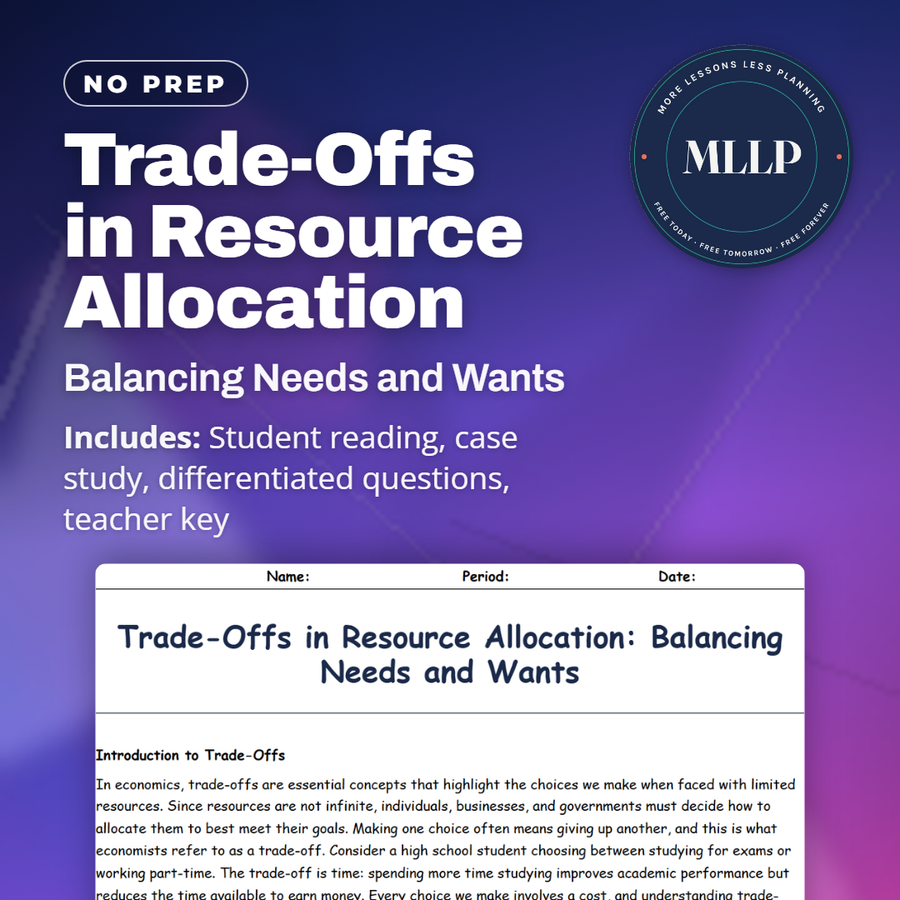
Trade-Offs in Resource Allocation: Balancing Needs and Wants
Quality reviewed September 2026
Facts verified September 8, 2026
- Grades
- Grades 9-12
- Length
- 7-page student worksheet
- Time
- About one 50-minute class period
- Great for
- Sub plans and independent work
- Includes
- Reading passage, comprehension questions + full answer key
- Format
- Print-and-go PDF
What students do
- Distinguish between needs (food, shelter, healthcare) and wants (vacation, entertainment, luxury items) to understand how scarcity forces priority choices
- Analyze a government budget scenario where increased healthcare funding means delaying infrastructure projects, demonstrating trade-off opportunity costs
- Evaluate a family budget scenario where choosing between saving for a house or spending on a vacation illustrates opportunity cost in personal finances
- Apply the Production Possibilities Curve to a national budget decision showing the trade-off between government investment in healthcare and infrastructure
What it covers
- The fundamental economic problem: limited resources force choices about what to produce, how to produce it, and who receives goods and services
- How governments, businesses, and individuals prioritize needs over wants when facing scarce resources, and the opportunity costs inherent in every choice
- Real-world example of government budget trade-offs: investing more in healthcare reduces funds available for education, infrastructure, or other priorities
Start reading this worksheet
Introduction to Trade-Offs
In economics, trade-offs are essential concepts that highlight the choices we make when faced with limited resources. Since resources are not infinite, individuals, businesses, and governments must decide how to allocate them to best meet their goals. Making one choice often means giving up another, and this is what economists refer to as a trade-off. Consider a high school student choosing between studying for exams or working part-time. The trade-off is time: spending more time studying improves academic performance but reduces the time available to earn money. Every choice we make involves a cost, and understanding trade-offs helps individuals and societies make more informed decisions.
Needs vs. Wants
A key part of understanding trade-offs is recognizing the difference between needs and wants. Needs are essentials required for survival, such as food, water, and shelter, while wants are things that make life more enjoyable but aren’t necessary, like luxury items or entertainment. When resources are limited, prioritizing needs over wants is often essential for individuals and societies. In an economy, resources like labor, capital, and land are finite, so societies must decide how to distribute them to best balance needs and wants. For instance, if a government spends more on healthcare (a need), it might have to cut back on funding for sports facilities (a want). This decision process of prioritizing resources is central to economics. This table shows how needs and wants vary for individuals, governments, and businesses, illustrating the complexity of resource allocation.
Opportunity Costs and Trade-Offs
Trade-offs always involve opportunity costs—the value of what we give up when we choose one option over another. Opportunity cost helps us see the true cost of our choices, beyond just financial expenses. For instance, if a student chooses to spend time watching TV instead of studying, the opportunity cost is the knowledge or grade improvement they sacrificed. In larger economic terms, if a government decides to invest in military spending, the opportunity cost could be reduced funds for education or healthcare. Recognizing these opportunity costs helps decision-makers weigh their choices carefully, ensuring resources are allocated effectively to serve the economy’s most pressing needs.
Like what you read? The full reading, the case study, and every question set are in the free download below, along with the answer key.
Why this matters
When a government increases healthcare funding, an infrastructure project somewhere gets delayed. That is not a budgeting failure. It is what scarcity forces on every government, business, and household: prioritizing needs like food and shelter over wants like vacations, even when both matter.
Some students want a clean rule for which resource should win, and pairing the government budget scenario with a family choosing between saving for a house and spending on a vacation is where that hope falls apart. Trade-offs are not a problem economics eventually solves. They are the ordinary condition every budget operates under.
From one teacher to another
I use this worksheet when students need to see economics in their own lives. We start with personal trade-offs: spending on daily coffee versus saving for a bigger purchase, or choosing between study time and a part-time job. Then we scale up to government budgets where the country must choose between healthcare and infrastructure funding. The case study makes it concrete: when healthcare needs surge, the government allocates more funding there, but that means delaying road and bridge projects. The Production Possibilities Curve helps visualize this trade-off. My students see that needs like food, housing, and education generally come before wants like festivals or luxury items, but in practice, every society balances both. The worksheet helps them understand that trade-offs aren't problems to solve. They're the reality of economic life.
What you get
- Answer Key
-
Student Worksheet
A student who studies for exams instead of working a part-time job is making the same trade-off the reading opens with, more knowledge gained against income given up. It scales that logic up to a government weighing military spending against school funding, and down to a company deciding whether a limited budget buys new technology or a bigger marketing push, since either choice trades one gain for another.
Download
Where should I send the next one?
Everything here is free and it stays that way. Leave your email and I'll send you the new lessons as they go up. You can unsubscribe from any one of them.
Related resources
Comparing Economic Systems: Market, Command, and Mixed
Economic Models and Theories: Simplifying Complex Concepts
Factors of Production: Building Blocks of the Economy
Marginal Analysis: Making the Most of Every Decision
Opportunity Cost: The True Cost of Every Decision
Production Possibilities Curve: Visualizing Choices and Trade-Offs
Every lesson on this site is free to download and use. If one of them saved you a prep period, you can chip in a few bucks toward my three kids' daycare fund. That's genuinely where tips go.