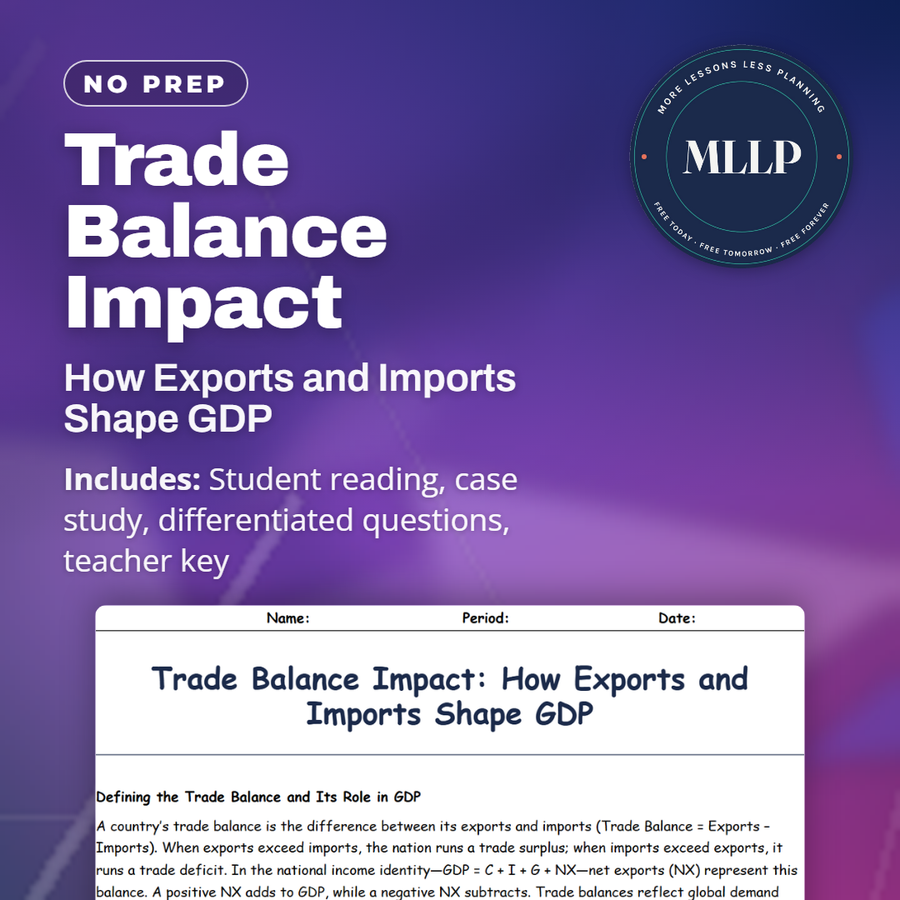
Trade Balance Impact: How Exports and Imports Shape GDP
Quality reviewed September 2026
Facts verified September 8, 2026
- Grades
- Grades 9-12
- Length
- 7-page student worksheet
- Time
- About one 50-minute class period
- Great for
- Sub plans and independent work
- Includes
- Reading passage, comprehension questions + full answer key
- Format
- Print-and-go PDF
What students do
- Calculate trade balance as exports minus imports and trace how positive net exports add to GDP in the national income formula
- Analyze the 2018-2020 U.S.-China trade war showing how $250 billion in tariffs reduced soybean exports, raised input costs, and altered supply chains
- Examine currency appreciation and depreciation effects on competitiveness (weak dollar makes U.S. exports cheaper, strong dollar makes them expensive)
- Explain why tariffs can appear to help net exports on paper but reduce consumption and investment, offsetting GDP gains
What it covers
- Trade balance definition and role in GDP through the net exports (NX) component
- Exchange rate mechanics and how currency moves affect export and import prices
- Tariffs, quotas, and trade agreements as policy tools with real trade-offs for consumers and firms
Start reading this worksheet
Defining the Trade Balance and Its Role in GDP
A country’s trade balance is the difference between its exports and imports (Trade Balance = Exports – Imports). When exports exceed imports, the nation runs a trade surplus; when imports exceed exports, it runs a trade deficit. In the national income identity (GDP = C + I + G + NX), net exports (NX) represent this balance. A positive NX adds to GDP, while a negative NX subtracts. Trade balances reflect global demand and domestic consumption patterns: a booming export sector can propel growth, whereas heavy reliance on imports can dampen overall output. Understanding trade’s contribution to GDP helps students see how international transactions feed into domestic economic performance.
Exchange Rates and Trade Flows
Exchange rates, the price of one currency in terms of another, are key to trade dynamics. When a currency appreciates, domestic goods become more expensive abroad, reducing exports and expanding imports; NX shrinks, lowering GDP. Conversely, a depreciation makes exports cheaper and imports costlier, boosting net exports and GDP. For example, if the U.S. dollar falls from 1.2 USD/EUR to 1.1 USD/EUR, American products gain a price advantage in Europe, stimulating export growth. However, currency moves can also raise domestic inflation by increasing the local‐currency cost of imported inputs, affecting firms’ cost structures and consumers’ purchasing power.
Tariffs and Trade Policies
Governments use tariffs, quotas, and trade agreements to influence the trade balance. A tariff is a tax on imported goods, raising their domestic price and discouraging imports. This improves NX and potentially GDP. But higher costs for consumers and firms relying on imported inputs can reduce consumption (C) and investment (I), offsetting some gains. Trade agreements, like NAFTA or the EU Single Market, eliminate barriers, encouraging both exports and imports; these often increase GDP by fostering specialization and efficiency. Students should weigh the short-run boost to net exports against the long-run effects on consumer prices, resource allocation, and international relations.
Like what you read? The full reading, the case study, and every question set are in the free download below, along with the answer key.
Why this matters
In 2018 the United States placed $250 billion in tariffs on Chinese goods, aiming to shrink a $419 billion trade deficit. China retaliated, soybean exports collapsed as buyers switched to Brazil, and manufacturers relying on Chinese parts paid more and passed the cost to customers. Net exports moved, but not the way anyone had promised.
Students walk in assuming tariffs are a simple lever: raise them, help exports, done. This case traces the same tariff through soybean farmers, auto parts buyers, and grocery shelves, three groups who felt it three different ways. They start asking who pays before deciding whether a policy worked.
From one teacher to another
I use this reading when teaching how international transactions feed into domestic growth. The passage breaks down the GDP formula's net exports component: when a country exports more than it imports, that positive balance adds to GDP. Students examine the 2018 trade war where the U.S. imposed $250 billion in tariffs on Chinese goods seeking to cut a $419 billion deficit. China retaliated with tariffs on U.S. products. Soybean exports plunged as Chinese buyers turned to Brazil, hurting American farmers' incomes. Meanwhile, U.S. manufacturers relying on Chinese inputs faced higher costs they passed to consumers, dampening consumption spending. The worksheet asks students to fill in blanks about deficits and appreciations, match trade surplus and current account to definitions, and write about why a global value chain means disruptions in Taiwan can slow production in Germany and affect net exports worldwide.
What you get
- Answer Key
-
Student Worksheet
A single smartphone assembled in the United States might carry chips from Taiwan, a display from South Korea, and software from India, so a slowdown in one country ripples through every other country's trade balance. By 2020 that interdependence collided with the pandemic, U.S. real GDP contracted about 3.4 percent, and multinational firms had already begun moving supply chains toward Southeast Asia to dodge the tariffs.
Download
Where should I send the next one?
Everything here is free and it stays that way. Leave your email and I'll send you the new lessons as they go up. You can unsubscribe from any one of them.
Related resources
Business Cycles Demystified: Boom, Bust, and Recovery
Economic Growth & Productivity: Drivers of Prosperity
GDP Explained: Understanding the Economy’s Core Metric
Key Economic Indicators: Signals of Market Health
Stability Factors: What Keeps the Economy Steady?
Unemployment Uncovered: Rate and Labor Force Insights
Every lesson on this site is free to download and use. If one of them saved you a prep period, you can chip in a few bucks toward my three kids' daycare fund. That's genuinely where tips go.