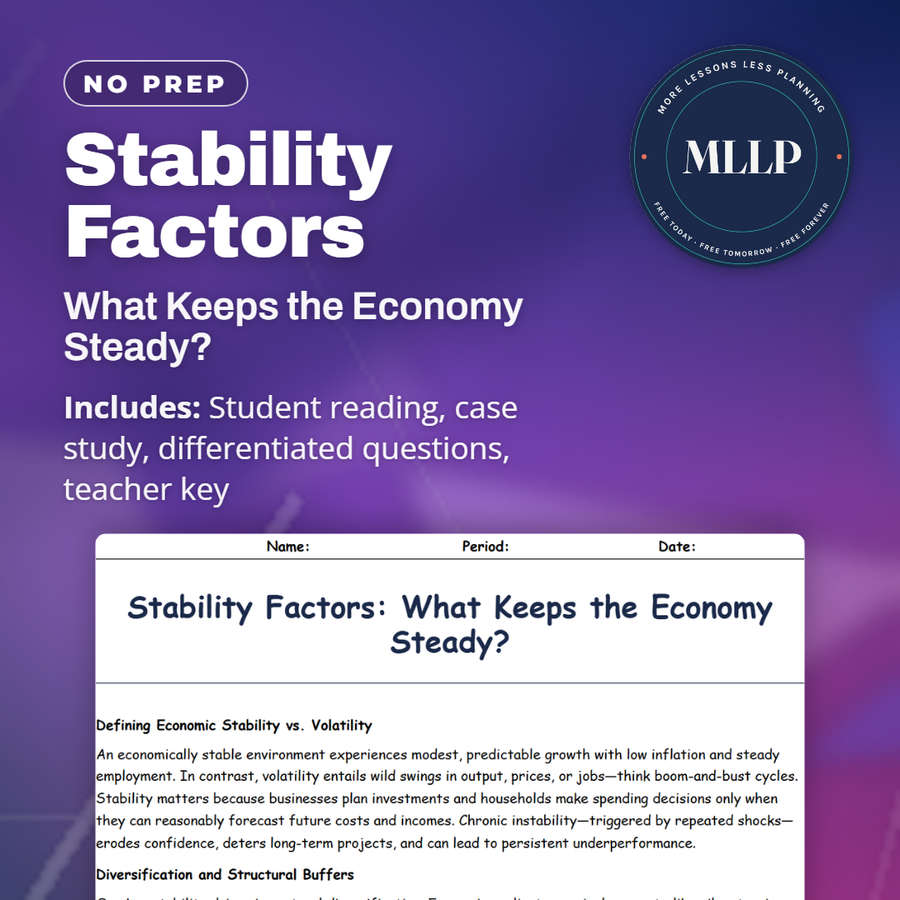
Stability Factors: What Keeps the Economy Steady?
Quality reviewed September 2026
Facts verified September 8, 2026
- Grades
- Grades 9-12
- Length
- 6-page student worksheet
- Time
- About one 50-minute class period
- Great for
- Sub plans and independent work
- Includes
- Reading passage, comprehension questions + full answer key
- Format
- Print-and-go PDF
What students do
- Identify five stability drivers: sectoral diversification, buffer stocks, automatic stabilizers, countercyclical policies, and structural reforms
- Analyze Norway's Government Pension Fund Global model that invests oil windfalls abroad and draws 3% annually to prevent domestic overheating
- Explain how progressive income taxes and unemployment benefits automatically support spending when recessions hit without new legislation
- Compare external shocks (1973 oil embargo, 2008 financial panic, COVID-19 pandemic) and how structural resilience determines recovery speed
What it covers
- Structural buffers including sectoral diversity and strategic reserves that cushion supply shocks
- Automatic stabilizers and discretionary countercyclical policies for moderating boom-bust cycles
- Long-term resilience through labor-market flexibility, regulatory clarity, and robust financial markets
Start reading this worksheet
Defining Economic Stability vs. Volatility
An economically stable environment experiences modest, predictable growth with low inflation and steady employment. In contrast, volatility entails wild swings in output, prices, or jobs: think boom-and-bust cycles. Stability matters because businesses plan investments and households make spending decisions only when they can reasonably forecast future costs and incomes. Chronic instability, triggered by repeated shocks, erodes confidence, deters long-term projects, and can lead to persistent underperformance.
Diversification and Structural Buffers
One key stability driver is sectoral diversification. Economies reliant on a single export, like oil or tourism, suffer when that market sours. A diversified base (manufacturing, services, agriculture) spreads risk and smooths aggregate demand. Another buffer is buffer stocks (e.g., strategic reserves of food or energy) that mitigate spikes in input costs. Countries often maintain petroleum reserves to cap price surges during supply disruptions. These structural features (diversified industries and buffer stocks) absorb external shocks and dampen volatility before policy action is needed.
Automatic Stabilizers and Countercyclical Policies
Built-in automatic stabilizers in fiscal systems, such as progressive income taxes and unemployment benefits, kick in without new legislation. When incomes fall, tax bills shrink and benefit payments rise, supporting household spending. This moderates downturns by preventing steep consumption drops. Countercyclical policies, in contrast, require active decisions: governments may run deficits through targeted stimulus, and central banks cut rates or buy assets. Combining automatic stabilizers with timely discretionary measures can keep output close to potential and prevent deep recessions or overheating.
Like what you read? The full reading, the case study, and every question set are in the free download below, along with the answer key.
Why this matters
Norway found oil and did the opposite of what most governments do with a windfall: instead of spending the money at home, it built a fund that invests the surplus abroad and draws down only 3 percent a year. That rule is why enormous oil wealth never overheated the economy in booms or sank it in price crashes.
Before this reading, students think stability just means nothing bad happens. Afterward they can name the machinery underneath it, like automatic stabilizers that raise benefit payments the moment incomes fall without a vote in Congress. Comparing the 1973 oil embargo, 2008, and COVID makes resilience concrete.
From one teacher to another
I use this reading to show students how economies absorb and recover from shocks. A diversified economy with manufacturing, services, and agriculture spreads risk so a shock in one sector doesn't paralyze everything. Norway's example illustrates forethought: after discovering vast oil reserves, policymakers built the GPFG to invest surplus revenues globally rather than spend them at home, which would have overheated the economy during booms and left it vulnerable during price collapses. Students examine how automatic stabilizers work: when incomes fall, tax bills shrink and benefit payments rise automatically, supporting household spending without waiting for Congress to act. The worksheet asks students to fill in blanks about the safe-draw rule, match countercyclical policy to its definition, and answer why buffer stocks and labor flexibility improve a country's ability to adapt when unexpected disruptions hit.
What you get
- Answer Key
-
Student Worksheet
By 2014, when oil prices collapsed, Norway's sovereign fund had grown past $1 trillion, letting public services continue without sudden cuts. Three global shocks line up for comparison: the 1973 oil embargo that triggered stagflation, the 2008 financial panic, and the COVID-19 pandemic that halted trade and travel outright. Flexible labor rules and deeper financial markets round out the case for resilience beyond any single windfall.
Download
Where should I send the next one?
Everything here is free and it stays that way. Leave your email and I'll send you the new lessons as they go up. You can unsubscribe from any one of them.
Related resources
Business Cycles Demystified: Boom, Bust, and Recovery
Economic Growth & Productivity: Drivers of Prosperity
GDP Explained: Understanding the Economy’s Core Metric
Key Economic Indicators: Signals of Market Health
Trade Balance Impact: How Exports and Imports Shape GDP
Unemployment Uncovered: Rate and Labor Force Insights
Every lesson on this site is free to download and use. If one of them saved you a prep period, you can chip in a few bucks toward my three kids' daycare fund. That's genuinely where tips go.