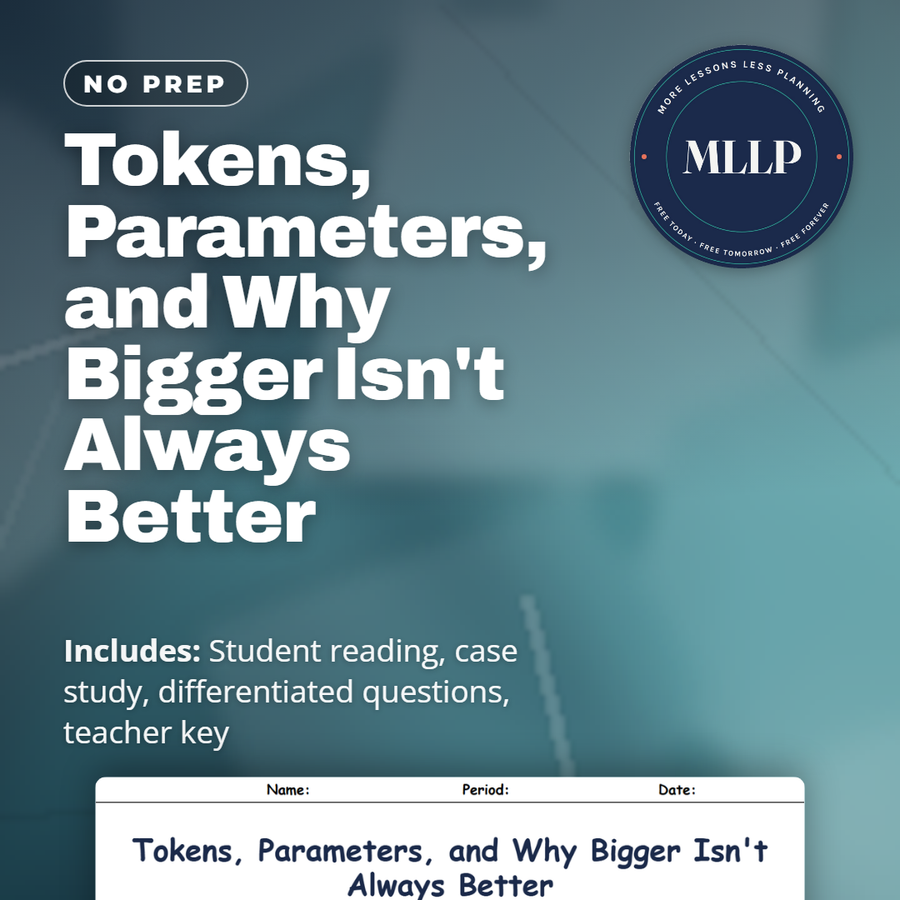
Tokens, Parameters, and Why Bigger Isn't Always Better
Quality reviewed September 2026
Facts verified September 20, 2026
- Subject
- Career & Life Skills
- Grades
- Grades 9-12
- Length
- 9-page student worksheet
- Time
- About one 50-minute class period
- Great for
- Sub plans and independent work
- Includes
- Reading passage, comprehension questions + full answer key
- Format
- Print-and-go PDF
What students do
- Token, parameter, and context window anchor a five-term matching set pulled straight from the reading
- Sofia's 400-page report and her broken context window anchor two case study questions
- A short answer question asks why a 70 billion parameter model beat one with 175 billion
- Answer three multiple choice questions on tokens, scaling laws, and model distillation
What it covers
- Six passages on tokens, parameters, scaling laws, and efficiency techniques like quantization
- A case study on Sofia's internship mistake pasting a 400-page report into the wrong AI tool
- A key info table naming GPT-3's parameter count and the 2025 DeepSeek breakthrough
Start reading this worksheet
The Vocabulary Problem: Breaking Language Into Chunks
When an AI model reads text, it does not process letters or complete words the way a human reader does. It processes units called tokens. A token is a chunk of text that the model's vocabulary system has learned to recognize as a meaningful unit. Tokens are not always whole words. Common short words like 'the,' 'is,' and 'and' are typically single tokens. Longer or rarer words might be split into multiple tokens. The word 'unbelievable,' for example, might be tokenized as 'un,' 'believ,' and 'able.' Different AI models use different tokenization systems. GPT-4 uses a system called byte-pair encoding (BPE), which starts with individual characters and merges the most common pairs into single tokens through a training process. Most large language models have vocabularies of roughly 30,000 to 100,000 unique tokens. Everything the model can understand and generate must be expressible in terms of these tokens.
Why Tokens Matter for Users
Tokens are the unit that determines how much text an LLM can process at once. Every AI model has a context window, which is the maximum number of tokens it can hold in 'working memory' during a conversation. Early GPT models had context windows of about 4,000 tokens (roughly 3,000 words). Recent models have expanded dramatically. Claude's context window can handle over 200,000 tokens. Some specialized models handle millions. Context windows matter practically. If you are asking an AI to summarize a very long document, the document has to fit within the context window, or the model has to process it in chunks and may lose track of earlier information. For conversational AI, the context window determines how far back in a conversation the model can 'remember.' When a conversation exceeds the context window, the model can no longer access the earlier parts, which is why very long AI conversations sometimes seem to forget earlier context. API pricing for AI tools is also typically based on token counts, both for the input (the text you send) and the output (the response you receive). If you are building a product using an AI API, managing token usage is a significant cost consideration.
Parameters: The Scale of What AI Knows
If tokens are the vocabulary, parameters are the memory. The number of parameters in a neural network model determines how much information it can encode and how complex its internal representations can be. A parameter is simply a number, one of billions of weights in the neural network, that gets adjusted during training. After training, the parameters are fixed, and their values encode everything the model learned. GPT-3 had 175 billion parameters. GPT-4 is estimated to have over a trillion, though OpenAI has not officially confirmed its size. Llama 3, Meta's open-source model, comes in versions ranging from 8 billion to 405 billion parameters. These numbers are staggering but also a bit abstract. What they represent practically is the model's capacity: a model with more parameters can, in theory, learn more nuanced patterns and represent more complex knowledge.
Like what you read? The full reading, the case study, and every question set are in the free download below, along with the answer key.
Why this matters
Students who understand tokens and context windows stop treating AI like a tool that can absorb anything they paste into it. When a long essay or research paper gets cut off, or the AI seems to forget the beginning of a conversation, that is a token limit, not a mood. The Chinchilla and DeepSeek material also teaches a broader lesson about efficiency: the biggest, most expensive tool is not automatically the best one for a given job, whether that is choosing an AI model, a car, or a computer, and students who grasp this trade-off make smarter choices with limited resources.
From one teacher to another
Tokens and parameters sound technical, but this worksheet grounds both in plain terms. Students first read how AI models break language into tokens rather than whole words, then learn how a context window limits how much text a model can hold at once. A passage on parameters explains that GPT-3 ran on 175 billion of them, while GPT-4 is estimated at over a trillion. The Chinchilla section is the turn: DeepMind found that a 70 billion parameter model trained on more data beat GPT-3's 175 billion, proving that size alone does not decide quality. The reading ends with quantization, distillation, and the 2025 DeepSeek release that trained a competitive model for a fraction of the usual cost. The case study follows Sofia, an intern whose AI tool rejected a 400-page report because it exceeded the context window.
What you get
Download
Where should I send the next one?
Everything here is free and it stays that way. Leave your email and I'll send you the new lessons as they go up. You can unsubscribe from any one of them.
Related resources
How AI Generates Images: From Words to Pictures
How AI Generates Voice and Video
How AI Learns: Training Data Explained
The Black Box Problem: When AI Can't Explain Itself
The Cost of AI: Energy, Water, and Data Centers
The Internet as a Textbook: Where AI Gets Its Information
Every lesson on this site is free to download and use. If one of them saved you a prep period, you can chip in a few bucks toward my three kids' daycare fund. That's genuinely where tips go.