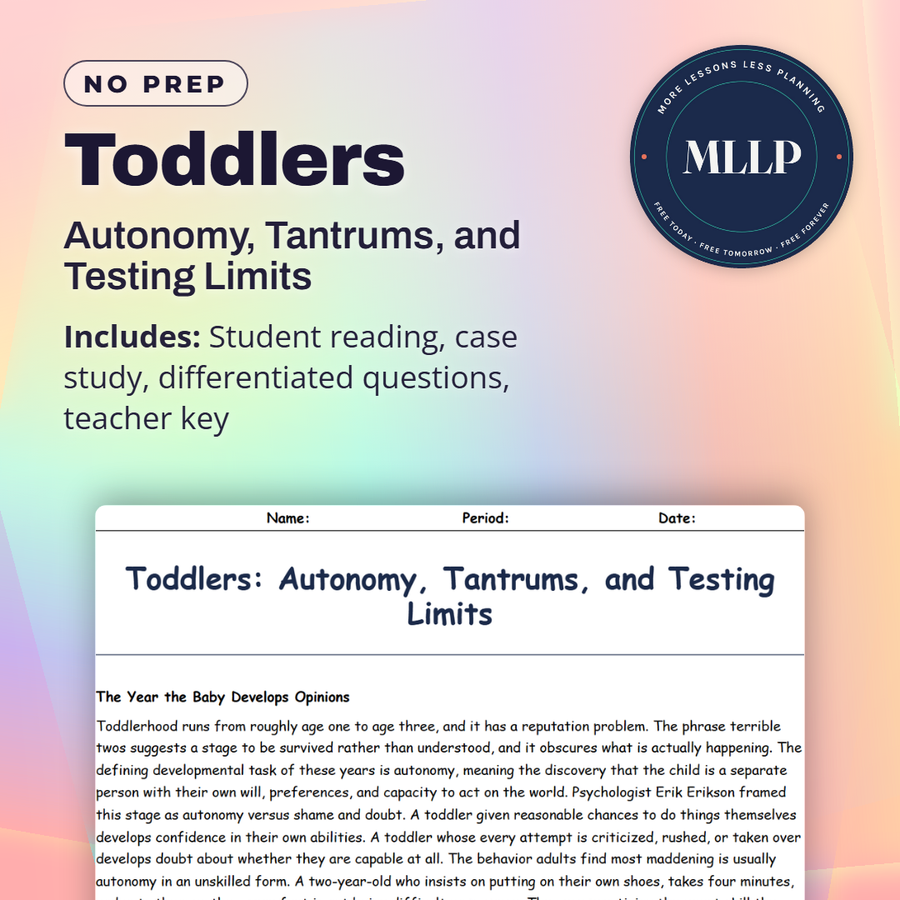
Toddlers: Autonomy, Tantrums, and Testing Limits
Quality reviewed September 2026
Facts verified September 23, 2026
- Subject
- Career & Life Skills
- Grades
- Grades 9-12
- Length
- 8-page student worksheet
- Time
- About one 50-minute class period
- Great for
- Sub plans and independent work
- Includes
- Reading passage, comprehension questions + full answer key
- Format
- Print-and-go PDF
What students do
- Ellie's meltdown over her boots traces straight back to Erikson's autonomy versus shame and doubt stage
- Inconsistent limits get explained as the reason a toddler tests more rather than less
- The gap between what a toddler understands and what they can actually say gets connected to why tantrums decline as vocabulary grows
- Decide why offering exactly two acceptable choices works better than an open-ended one
What it covers
- Why a tantrum is a regulation failure rather than manipulation, and what that means for how adults respond
- Parallel play, sharing and the early signs of empathy that show up during toddlerhood
- Why offering exactly two real choices satisfies a toddler's drive for autonomy without losing the boundary
Start reading this worksheet
The Year the Baby Develops Opinions
Toddlerhood runs from roughly age one to age three, and it has a reputation problem. The phrase terrible twos suggests a stage to be survived rather than understood, and it obscures what is actually happening. The defining developmental task of these years is autonomy, meaning the discovery that the child is a separate person with their own will, preferences, and capacity to act on the world. Psychologist Erik Erikson framed this stage as autonomy versus shame and doubt. A toddler given reasonable chances to do things themselves develops confidence in their own abilities. A toddler whose every attempt is criticized, rushed, or taken over develops doubt about whether they are capable at all. The behavior adults find most maddening is usually autonomy in an unskilled form. A two-year-old who insists on putting on their own shoes, takes four minutes, and gets them on the wrong feet is not being difficult on purpose. They are practicing the exact skill the stage is built around. The word no becomes a favorite for the same reason, since refusing is the simplest available way to test whether a separate self actually has any power. Understanding this does not make the four minutes shorter. It does change whether an adult experiences those minutes as defiance or as development, and that reframe is most of what makes the stage survivable. It also predicts which battles are worth having. A toddler insisting on doing something themselves is running the developmental program, while a toddler insisting on running into a parking lot is not, and only one of those is negotiable.
What a Tantrum Actually Is
Tantrums peak between about eighteen months and three years, and the reason is structural rather than moral. A tantrum is what happens when a child's emotional system produces a feeling far larger than the brain systems that would regulate it can handle. The prefrontal cortex, the region responsible for impulse control, planning, and emotional regulation, is one of the last areas of the brain to mature, and it is not remotely finished in a two-year-old. Meanwhile the emotional centers are fully online. The result is enormous feelings with almost no brakes. Language makes it worse. A toddler understands far more than they can say, so a child who wants something specific and lacks the words to request it experiences a frustration adults rarely have to sit with. This gap between receptive and expressive language is one of the most reliable tantrum triggers there is, which is also why tantrums tend to decline as vocabulary grows. Common triggers cluster around predictable conditions, meaning hunger, tiredness, overstimulation, transitions between activities, and being told no. What research does not support is the idea that a tantrum is manipulation. Manipulation requires the ability to model another person's mind and plan strategically around it, and a two-year-old in full meltdown has neither capacity available. The child is not running a strategy. The child is overwhelmed. The distinction has real consequences, because an adult who believes a tantrum is manipulation tends to respond with punishment, and punishing a child for a capacity they do not yet have teaches nothing except that the adult is unsafe.
Responding Without Making It Worse
Because a tantrum is a regulation failure rather than a negotiation, the responses that work look different from what instinct suggests. During the tantrum, safety comes first, meaning moving the child away from hazards or from an audience if that helps. Reasoning during the peak generally fails, since the part of the brain that processes reasoning is precisely the part currently offline. Staying calm and present matters more than any specific words, because a dysregulated child borrows regulation from a regulated adult, and an adult who escalates simply doubles the volume of the problem. Once the storm passes, the useful work begins. Naming the feeling helps a child build the vocabulary they lacked, and being told they were really frustrated when the tower fell gives them a word for next time. Consistency is the other half. Toddlers test limits because testing is how they learn where limits actually are, so a boundary that holds on Monday and collapses on Tuesday guarantees more testing rather than less. Prevention does more work than response ever will. Predictable routines, warnings before transitions, real but limited choices, and attention to hunger and sleep eliminate a substantial share of tantrums before they start. Offering a choice between two acceptable shirts satisfies the drive for autonomy while keeping the actual decision inside boundaries the adult chose. The number of options matters more than adults expect. Two is usually right, since a toddler asked to choose from a full closet is handed a decision larger than their capacity and the result is another meltdown.
Like what you read? The full reading, the case study, and every question set are in the free download below, along with the answer key.
Why this matters
Toddler behavior is the single most misread stretch of childhood covered in this unit, and the manipulation myth this reading takes apart is worth slowing down on, since it changes how a future parent or caregiver reacts to a meltdown in public. Tomas's read on Ellie, that she did not want the boots off, she wanted to be the one who put them on, is the kind of reframe that turns four screaming minutes into something a caregiver can actually work with instead of fight. The passage on real choices, exactly two, chosen by the adult, is a specific practical tool students can use the next time they are watching a toddler themselves.
From one teacher to another
Two-year-olds insist on putting their own boots on the wrong feet, and this reading uses Erikson's autonomy versus shame and doubt stage to explain why that four minutes of struggle is the actual developmental work of toddlerhood. A full passage breaks down what a tantrum really is, an immature prefrontal cortex overwhelmed by feelings it cannot yet regulate, and directly rejects the idea that tantrums are manipulation. Another passage covers what helps during and after a tantrum, staying calm, naming the feeling once it passes, and holding limits consistently. The case study follows Tomas, a home childcare provider, and Ellie, whose boot crisis turns out to have nothing to do with the boots themselves. A closing passage covers the physical and language growth of these years, along with parallel play and the early beginnings of empathy.
What you get
Download
Where should I send the next one?
Everything here is free and it stays that way. Leave your email and I'll send you the new lessons as they go up. You can unsubscribe from any one of them.
Related resources

Brain Development in Early Childhood
How Children Learn Language
Infant Development: The First Year

Prenatal Development and a Healthy Pregnancy
School-Age Development
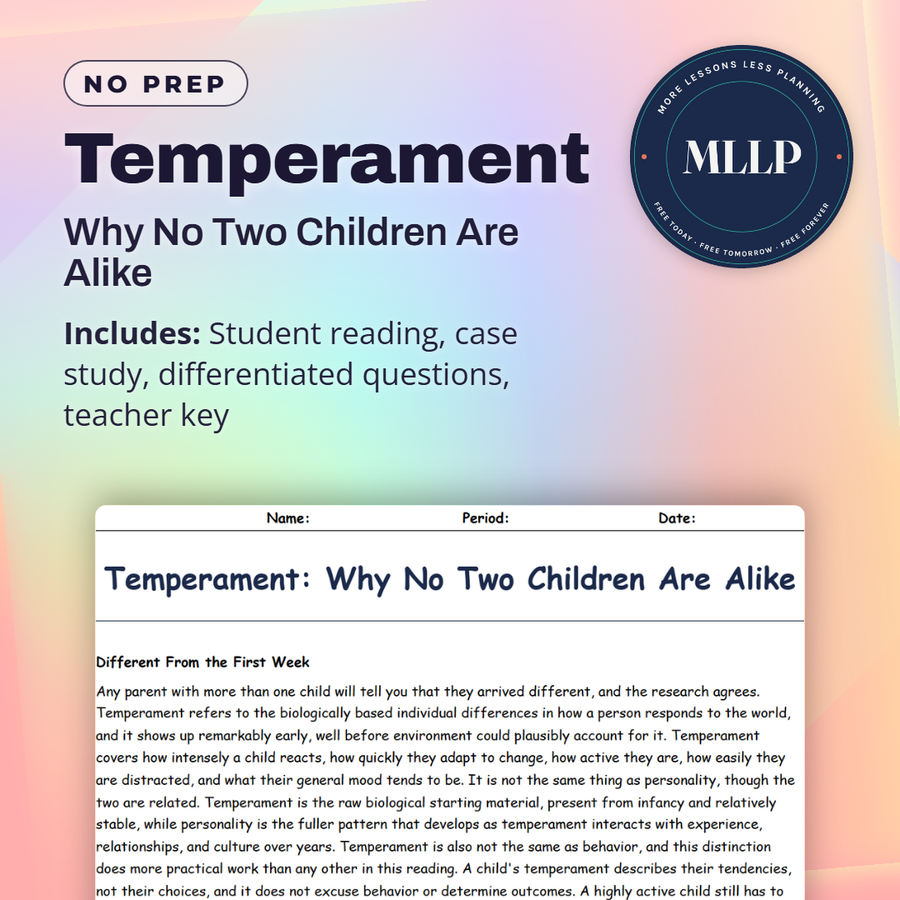
Temperament: Why No Two Children Are Alike
Every lesson on this site is free to download and use. If one of them saved you a prep period, you can chip in a few bucks toward my three kids' daycare fund. That's genuinely where tips go.