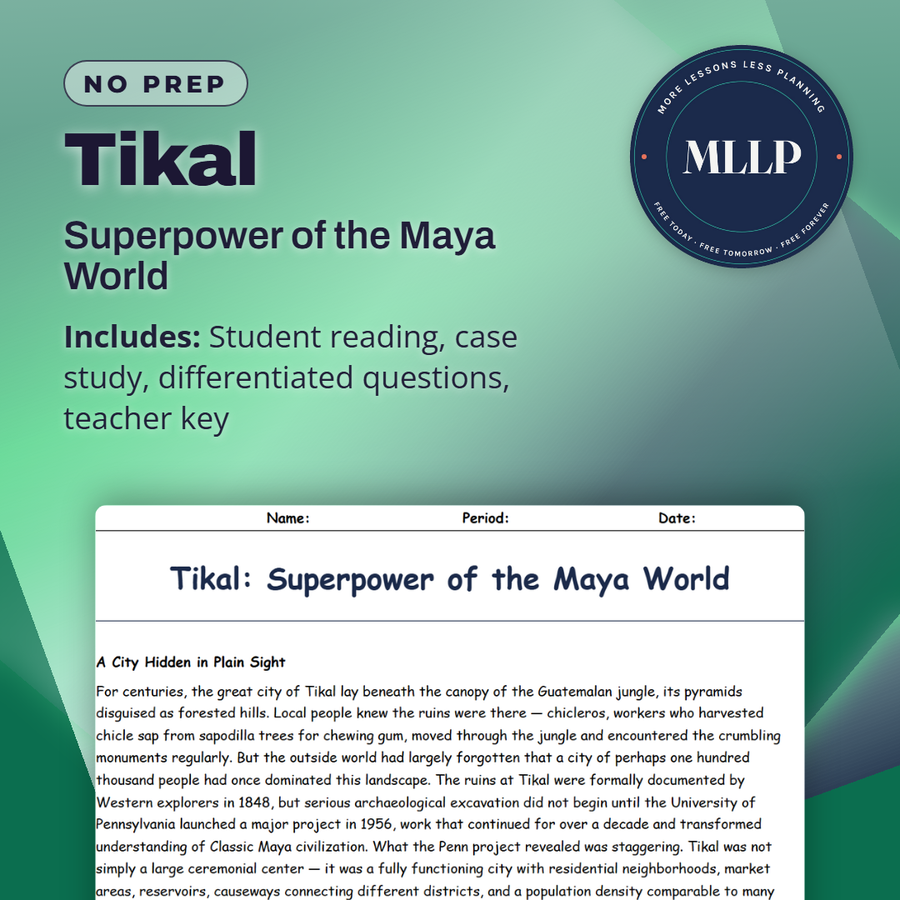
Tikal: Superpower of the Maya World
Quality reviewed September 2026
Facts verified September 21, 2026
- Subject
- Social Studies
- Grades
- Grades 9-12
- Length
- 8-page student worksheet
- Time
- About one 50-minute class period
- Great for
- Sub plans and independent work
- Includes
- Reading passage, comprehension questions + full answer key
- Format
- Print-and-go PDF
What students do
- Tikal's rise from a small settlement around 600 BCE to a regional superpower gets traced through the reading's timeline
- The 378 CE entrada and its possible tie to Teotihuacan's political reach gets worked out from the reading's account
- Compare Tikal's crushing defeat by Calakmul in 562 CE to its recovery under Jasaw Chan K'awil I in 695 CE
- Fill in blanks tracing Marcos Ajú's choice to report rather than sell the monument he found, and why it mattered to him
What it covers
- Tikal's rise to regional power and its centuries-long rivalry with the city of Calakmul
- The 378 CE "entrada" and what it reveals about Teotihuacan's political reach into the Maya world
- A 2016 LiDAR survey that more than doubled Tikal's known size, told through a chiclero's 1953 discovery
Start reading this worksheet
A City Hidden in Plain Sight
For centuries, the great city of Tikal lay beneath the canopy of the Guatemalan jungle, its pyramids disguised as forested hills. Local people knew the ruins were there. Chicleros, workers who harvested chicle sap from sapodilla trees for chewing gum, moved through the jungle and encountered the crumbling monuments regularly. But the outside world had largely forgotten that a city of perhaps one hundred thousand people had once dominated this landscape. The ruins at Tikal were formally documented by Western explorers in 1848, but serious archaeological excavation did not begin until the University of Pennsylvania launched a major project in 1956, work that continued for over a decade and transformed understanding of Classic Maya civilization. What the Penn project revealed was staggering. Tikal was not simply a large ceremonial center. It was a fully functioning city with residential neighborhoods, market areas, reservoirs, causeways connecting different districts, and a population density comparable to many modern cities. The Great Plaza at the heart of Tikal is flanked by Temple I and Temple II, two of the most recognizable pyramids in the Americas. Temple IV, the tallest structure at Tikal, rises 70 meters above the jungle floor, its top once visible for miles across the flat lowlands.
The Rise to Regional Dominance
Tikal's rise to power was not inevitable. The site began as a modest settlement around 600 BCE but grew steadily through the Preclassic period. By the Early Classic (250-600 CE), Tikal had established itself as a major political force. Key to this rise was Tikal's location: it sat astride trade routes that connected the Maya highlands to the lowlands, and controlled access to valuable obsidian, jade, and other prestige goods that fueled the political economy of Classic Maya cities. The city's rulers used warfare, diplomacy, and strategic marriage alliances to extend their influence. One of the most dramatic episodes in Tikal's history came in 378 CE when a warrior named Siyaj K'ak', possibly an agent of the distant city of Teotihuacan in central Mexico, arrived at Tikal and apparently orchestrated the death of the sitting ruler. Within days, a new dynasty aligned with Teotihuacan was installed. This event, now called the 'entrada,' left archaeological evidence in the form of Teotihuacan-style artifacts and architectural elements appearing suddenly in Tikal's material record. It demonstrates how far-reaching political networks were even in the 4th century CE.
The Great Rival: Calakmul
Tikal's most dangerous rival was Calakmul, a massive city in what is now southern Mexico. The competition between these two superpowers shaped the political landscape of the entire Classic Maya world for centuries. Smaller cities were forced to choose sides, forming alliances with either Tikal or Calakmul in a geopolitical rivalry that archaeologists have reconstructed from carved stelae and hieroglyphic inscriptions. In 562 CE, Calakmul led a coalition of cities that inflicted a decisive military defeat on Tikal, a 'Star War' victory recorded on multiple monuments. Tikal suffered a dark period of more than a century during which few monuments were erected and the city's influence contracted sharply. Tikal's recovery came under the warrior-king Jasaw Chan K'awil I, who came to power in 682 CE, launched an extraordinary building campaign, and defeated Calakmul in 695 CE in a reversal that restored Tikal to regional supremacy. Temple I was later built over his tomb. The victory stela shows Jasaw riding above a captive Calakmul ruler: one of the most powerful political images in Classic Maya art.
Like what you read? The full reading, the case study, and every question set are in the free download below, along with the answer key.
Why this matters
Marcos Ajú's decision not to sell the monument he found is worth slowing down on, because it shows that respect for cultural heritage doesn't have to come from a law or a museum, it can come from a grandfather's voice telling you not to sell family. It's also a good moment to point out that local workers like Marcos held knowledge of sites like Tikal for generations before any university team arrived, and that knowledge mattered as much as funding or equipment in getting the archaeologists to the right patch of jungle in the first place.
From one teacher to another
For over a century, chicleros harvesting chewing gum sap moved through the ruins of Tikal while the outside world had mostly forgotten a city of perhaps 100,000 people once stood there, until the University of Pennsylvania began serious excavation in 1956. The reading traces Tikal's rise from a modest settlement around 600 BCE to a regional superpower, including the strange 378 CE 'entrada,' when a warrior possibly tied to the distant city of Teotihuacan arrived and a new dynasty took the throne within days. Students follow the long rivalry between Tikal and Calakmul, including Tikal's crushing 562 CE defeat and its recovery under Jasaw Chan K'awil I, who beat Calakmul in 695 CE and built Temple I over his own tomb. A 2016 LiDAR survey then more than doubles the known size of the city, turning up thousands of buried structures nobody had mapped. The case study follows a chiclero named Marcos Ajú, who found a carved monument alone in the jungle in 1953 and had to decide whether to sell it or report it.
What you get
Download
Where should I send the next one?
Everything here is free and it stays that way. Leave your email and I'll send you the new lessons as they go up. You can unsubscribe from any one of them.
Related resources
Chichen Itza: Where Tourists Meet the Ancient World
LiDAR and the Maya: Finding Hidden Cities from the Sky
Maya Agriculture: Feeding Cities in the Jungle
Maya Mathematics and the Calendar: Zero and the End of the World
Maya Writing: Cracking the Hieroglyphic Code
Palenque and King Pakal: A Royal Tomb Inside a Pyramid
Every lesson on this site is free to download and use. If one of them saved you a prep period, you can chip in a few bucks toward my three kids' daycare fund. That's genuinely where tips go.