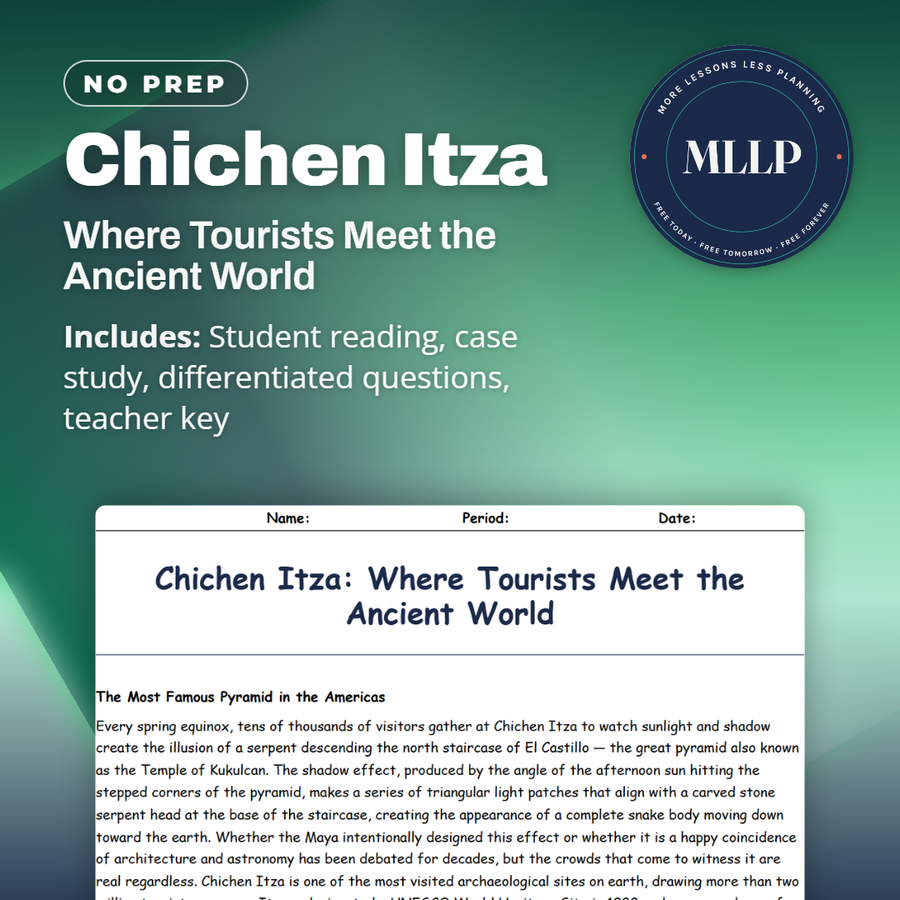
Chichen Itza: Where Tourists Meet the Ancient World
Quality reviewed September 2026
Facts verified September 21, 2026
- Subject
- Social Studies
- Grades
- Grades 9-12
- Length
- 8-page student worksheet
- Time
- About one 50-minute class period
- Great for
- Sub plans and independent work
- Includes
- Reading passage, comprehension questions + full answer key
- Format
- Print-and-go PDF
What students do
- The equinox shadow on El Castillo gets explained as an effect of sun angle and stepped stone corners, not a mystery
- Sort the competing explanations for the "Toltec influence" in Chichen Itza's architecture, from conquest theory to shared style
- The ball court carvings and what they do and don't prove about sacrificed players get weighed against the actual evidence
- Answer questions on Ricardo Canul's confrontation with tourists and what it reveals about who bears the cost of mass tourism
What it covers
- The scholarly debate over Toltec architectural influence at Chichen Itza and what current evidence actually supports
- The Sacred Cenote's dredged offerings of gold, jade, and human remains as evidence of centuries of ritual use
- A case study on a modern site guard confronting tourists, used to explore who pays the cost of heritage tourism
Start reading this worksheet
The Most Famous Pyramid in the Americas
Every spring equinox, tens of thousands of visitors gather at Chichen Itza to watch sunlight and shadow create the illusion of a serpent descending the north staircase of El Castillo, the great pyramid also known as the Temple of Kukulcan. The shadow effect, produced by the angle of the afternoon sun hitting the stepped corners of the pyramid, makes a series of triangular light patches that align with a carved stone serpent head at the base of the staircase, creating the appearance of a complete snake body moving down toward the earth. Whether the Maya intentionally designed this effect or whether it is a happy coincidence of architecture and astronomy has been debated for decades, but the crowds that come to witness it are real regardless. Chichen Itza is one of the most visited archaeological sites on earth, drawing more than two million tourists per year. It was designated a UNESCO World Heritage Site in 1988 and was named one of the New Seven Wonders of the World in 2007. But the spectacular ruins and the crowds they attract create a problem that runs through all of modern archaeology: the tension between making heritage accessible and preserving it from the very popularity that access creates.
A City of Multiple Cultures
Chichen Itza flourished primarily between approximately 600 CE and 1200 CE, making it a Late Classic and Postclassic Maya city. But its architecture is strikingly unlike the cities of the southern Maya lowlands like Tikal or Palenque. The buildings at Chichen Itza show what archaeologists have long described as Toltec influence: features common to Tula, the capital of the Toltec civilization in central Mexico, including colonnaded halls, warrior columns, and specific deity imagery. The debate over what this 'Toltec influence' means has been ongoing for generations. Early researchers believed the Toltec conquered Chichen Itza and imposed their culture. Later scholars argued that the similarities reflected shared artistic conventions across Mesoamerica rather than conquest. The current consensus is complex: there was genuine cultural exchange between Chichen Itza and central Mexico (possibly through trade, migration, or deliberate diplomatic adoption of prestigious styles), but the city remained fundamentally Maya in its organization, religion, and population.
The Ball Court and the Meaning of the Game
The Great Ball Court at Chichen Itza is the largest in Mesoamerica: 168 meters long and 70 meters wide, with vertical walls eight meters high and stone rings mounted six meters above the playing surface through which players had to pass a solid rubber ball. Playing the ball game with a ball that heavy through rings that high required extraordinary athleticism. The game had deep ritual significance across Mesoamerica and was played for at least 3,000 years before the Spanish conquest. Carvings on the walls of the ball court at Chichen Itza depict a decapitation scene, showing one player kneeling while another holds his severed head. This has led to widespread belief that losing teams (or sometimes winning teams) were sacrificed. The reality is more complicated. While sacrifice was certainly part of Mesoamerican religious practice, archaeological evidence for systematic player sacrifice is thin. The decapitation scenes may represent mythological narratives, specific elite sacrifices, or rituals that occurred rarely. The ball game was entertainment, competition, diplomacy, and ritual all at once. It is too simplistic to reduce to 'losers get beheaded.'
Like what you read? The full reading, the case study, and every question set are in the free download below, along with the answer key.
Why this matters
Chichen Itza brings up a genuine tension that shows up anywhere old and famous meets a tourist economy: the site earns the money that pays for its own upkeep, but the crowds that pay for it are also wearing it down. Ricardo Canul's line to the German tourist, that all of humanity decided not to climb the pyramid, gives students a real answer to the question of who gets to decide how a shared inheritance gets treated, and it comes from a Maya guard rather than an outside authority telling tourists what to do.
From one teacher to another
Two million tourists a year walk through Chichen Itza to see El Castillo, the pyramid where the spring equinox throws a shadow down the north staircase that looks like a snake sliding toward a carved stone head at the bottom. I like starting here because the reading doesn't let students stop at the pretty trick of light. It moves into the real argument among archaeologists over what the so-called Toltec features in the architecture actually mean, then into the Great Ball Court, the largest in Mesoamerica, where carved panels show a beheading that has fueled a lot of loose talk about losers being sacrificed. The case study follows a site guard named Ricardo Canul, whose ancestors carved the very stone a tourist is trying to chip a souvenir off of. Students come away with a much more complicated picture of what a UNESCO site actually costs the people who live next to it.
What you get
Download
Where should I send the next one?
Everything here is free and it stays that way. Leave your email and I'll send you the new lessons as they go up. You can unsubscribe from any one of them.
Related resources
LiDAR and the Maya: Finding Hidden Cities from the Sky
Maya Agriculture: Feeding Cities in the Jungle
Maya Mathematics and the Calendar: Zero and the End of the World
Maya Writing: Cracking the Hieroglyphic Code
Palenque and King Pakal: A Royal Tomb Inside a Pyramid
The Maya Collapse: What Really Happened in the 9th Century?
Every lesson on this site is free to download and use. If one of them saved you a prep period, you can chip in a few bucks toward my three kids' daycare fund. That's genuinely where tips go.