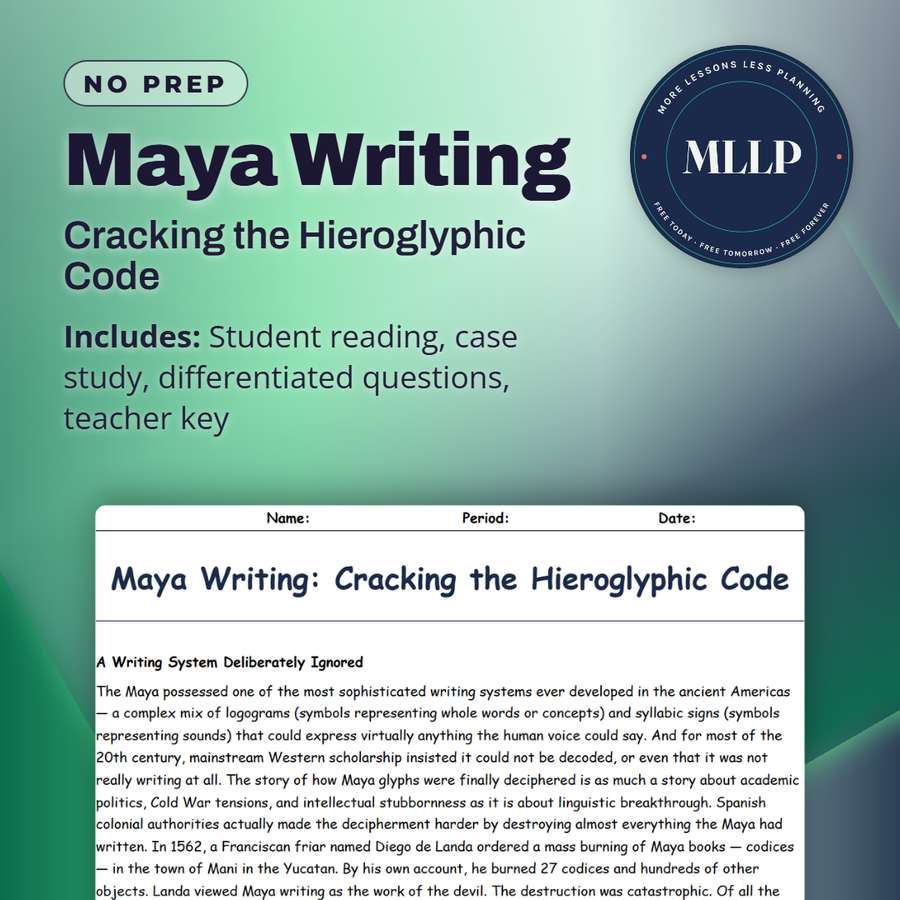
Maya Writing: Cracking the Hieroglyphic Code
Quality reviewed September 2026
Facts verified September 21, 2026
- Subject
- Social Studies
- Grades
- Grades 9-12
- Length
- 8-page student worksheet
- Time
- About one 50-minute class period
- Great for
- Sub plans and independent work
- Includes
- Reading passage, comprehension questions + full answer key
- Format
- Print-and-go PDF
What students do
- Diego de Landa's 1562 book burning and its cost to the surviving Maya written record get laid out from the reading
- Eric Thompson's logographic theory gets sorted against Yuri Knorosov's correct phonetic proposal and why one was rejected for decades
- Explain what Tatiana Proskouriakoff proved about Maya inscriptions recording real history rather than only astronomy
- Trace Knorosov's isolation as a Soviet scientist during the Cold War to how long his correct theory took to be accepted
What it covers
- Diego de Landa's 1562 burning of Maya codices and why only four books survive today
- The Cold War rejection of Yuri Knorosov's correct phonetic decipherment and Eric Thompson's competing theory
- What decoded Maya glyphs actually reveal about warrior-kings, sacrifice, and political rivalry between cities
Start reading this worksheet
A Writing System Deliberately Ignored
The Maya possessed one of the most sophisticated writing systems ever developed in the ancient Americas, a complex mix of logograms (symbols representing whole words or concepts) and syllabic signs (symbols representing sounds) that could express virtually anything the human voice could say. And for most of the 20th century, mainstream Western scholarship insisted it could not be decoded, or even that it was not really writing at all. The story of how Maya glyphs were finally deciphered is as much a story about academic politics, Cold War tensions, and intellectual stubbornness as it is about linguistic breakthrough. Spanish colonial authorities actually made the decipherment harder by destroying almost everything the Maya had written. In 1562, a Franciscan friar named Diego de Landa ordered a mass burning of Maya books (codices) in the town of Mani in the Yucatan. By his own account, he burned 27 codices and hundreds of other objects. Landa viewed Maya writing as the work of the devil. The destruction was catastrophic. Of all the books the ancient Maya produced, only four codices survive today: three are preserved in European museums and one in Mexico City. The burning of the books of Mani remains one of the great intellectual losses in human history.
The Long Road to Decipherment
After the Spanish conquest, Maya glyphs became a puzzle that linguists and archaeologists puzzled over for centuries. Early researchers correctly identified that glyphs recorded dates: the mathematical regularity of Maya calendar notations made numerical patterns relatively easy to spot. By the early 20th century, scholars like Eric Thompson, the dominant figure in Maya studies for decades, had established the view that Maya writing was largely or entirely logographic: each glyph represented a complete concept, not a sound. Thompson was a formidable scholar and a forceful personality, and his views set the agenda for Maya epigraphy (the study of inscriptions) for a generation. The problem was that Thompson was wrong. And a young Soviet linguist named Yuri Knorosov would prove it, at enormous personal and professional cost.
Knorosov's Breakthrough
Yuri Knorosov was a linguist working in Leningrad in the early 1950s. Working largely from photographs of the few surviving Maya codices and from Diego de Landa's own writings (ironically, Landa had recorded an 'alphabet' of Maya signs), Knorosov proposed that Maya writing was not purely logographic but phonetic. The glyphs represented syllables that could be combined to spell words. He published his findings in 1952. The Western scholarly community, led by Thompson, rejected Knorosov's work almost immediately, partly on linguistic grounds, but also partly because he was a Soviet scientist during the Cold War. Thompson dismissed his analysis as Marxist propaganda. Knorosov was unable to travel to see the actual Maya sites and manuscripts due to Soviet restrictions, conducting his entire analysis from photographs. Despite his isolation, he was right. Over the following decades, as more scholars tested his phonetic approach against inscriptions, evidence mounted overwhelmingly in his favor. In 1960, Tatiana Proskouriakoff proved that inscriptions recorded actual historical events and rulers rather than abstract astronomical data. By the 1970s and 1980s, a new generation of epigraphers — including Linda Schele, who helped decode royal court terminology — were reading Maya texts with increasing accuracy. The annual Palenque round table conferences, where scholars gathered to share breakthroughs, became famous for the excitement of people deciphering history in real time. Today, scholars can read roughly 90 percent of all Maya glyphs.
Like what you read? The full reading, the case study, and every question set are in the free download below, along with the answer key.
Why this matters
This reading gives students a clear, specific example of how scientific progress can get stalled by politics and personal authority rather than evidence, since Knorosov was right in 1952 and still had to wait decades for Western scholars to admit it because of Cold War hostility and one dominant academic's refusal to be wrong. It also raises an uncomfortable irony worth sitting with: the same colonial friar who destroyed almost all Maya writing left behind the alphabet that later helped scholars read what survived.
From one teacher to another
Diego de Landa burned twenty-seven Maya books in 1562, convinced their writing was the work of the devil, and that single act destroyed most of what the Maya had ever written down. Only four codices survived, which makes the eventual decipherment of Maya glyphs even more remarkable, since scholars had almost nothing to work from. The reading follows Eric Thompson, whose wrong but dominant theory that the glyphs were purely symbolic held back progress for decades, and Yuri Knorosov, a Soviet linguist who correctly proposed the writing was phonetic in 1952 and got dismissed as a propagandist for being Soviet during the Cold War. Students see how Tatiana Proskouriakoff later proved the glyphs recorded real kings and real wars rather than only astronomy, and the case study follows Knorosov himself, working from a burned library's leftover photographs decades before he was ever allowed to see an actual Maya site in person.
What you get
Download
Where should I send the next one?
Everything here is free and it stays that way. Leave your email and I'll send you the new lessons as they go up. You can unsubscribe from any one of them.
Related resources
Chichen Itza: Where Tourists Meet the Ancient World
LiDAR and the Maya: Finding Hidden Cities from the Sky

Maya Agriculture: Feeding Cities in the Jungle
Maya Mathematics and the Calendar: Zero and the End of the World
Palenque and King Pakal: A Royal Tomb Inside a Pyramid
The Maya Collapse: What Really Happened in the 9th Century?
Every lesson on this site is free to download and use. If one of them saved you a prep period, you can chip in a few bucks toward my three kids' daycare fund. That's genuinely where tips go.