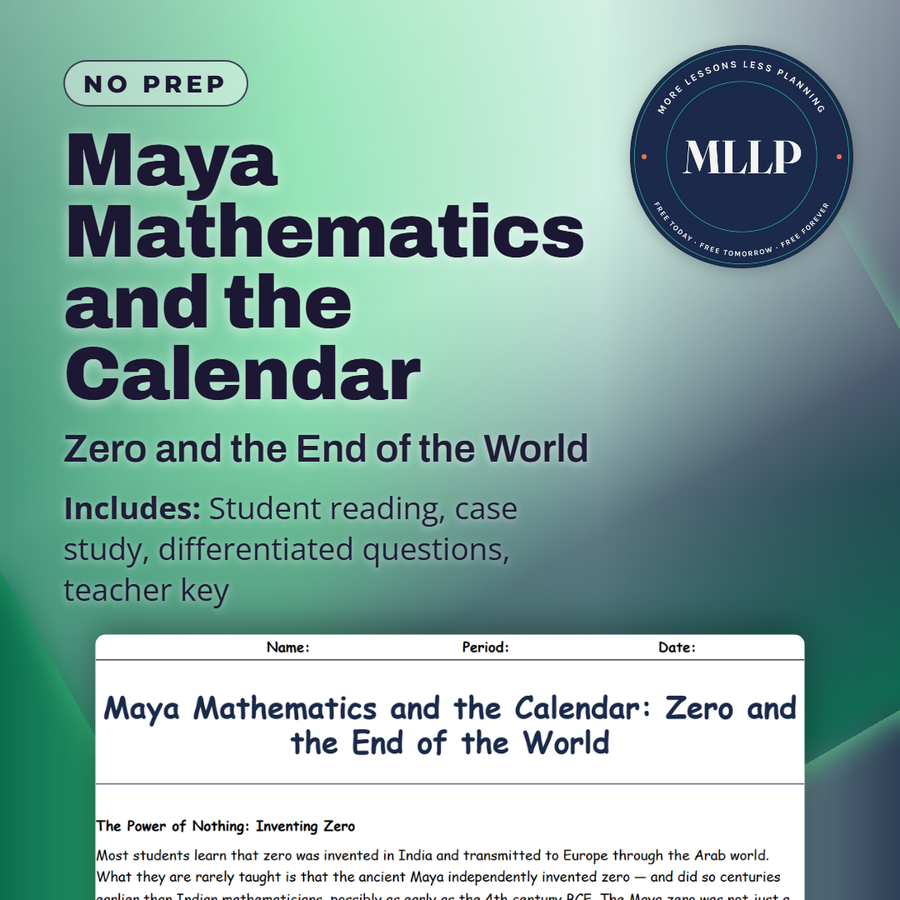
Maya Mathematics and the Calendar: Zero and the End of the World
Quality reviewed September 2026
Facts verified September 21, 2026
- Subject
- Social Studies
- Grades
- Grades 9-12
- Length
- 8-page student worksheet
- Time
- About one 50-minute class period
- Great for
- Sub plans and independent work
- Includes
- Reading passage, comprehension questions + full answer key
- Format
- Print-and-go PDF
What students do
- Maya numerals built from dots, bars, and a shell-shaped zero get worked out and compared to base-10 counting
- Explain how the Haab, Tzolkin, and Long Count operated together and what each one was actually used for
- The actual, non-apocalyptic meaning of December 21, 2012 in Long Count terms gets identified from the reading
- Write short answers connecting the Dresden Codex's Venus tables to the accuracy of naked-eye Maya astronomy
What it covers
- The Maya's independent invention of zero and how the base-20 number system used it as a true number
- How the Haab, Tzolkin, and Long Count calendars interlocked, including the 52-year Calendar Round
- The real explanation for December 21, 2012, using a case study on the Dresden Codex's eclipse and Venus tables
Start reading this worksheet
The Power of Nothing: Inventing Zero
Most students learn that zero was invented in India and transmitted to Europe through the Arab world. What they are rarely taught is that the ancient Maya independently invented zero, doing so centuries earlier than Indian mathematicians, possibly as early as the 4th century BCE. The Maya zero was not just a placeholder, as it was in Babylonian mathematics; it was a true mathematical concept, a number in its own right that could be used in calculations. This was one of the most important intellectual achievements in human history, and it happened in the jungles of Mesoamerica. The Maya number system was vigesimal (base-20) rather than the base-10 decimal system most of the world uses today. Where our number system builds in units of ten (ones, tens, hundreds, thousands), the Maya system built in units of twenty (ones, twenties, four-hundreds, eight-thousands). Numbers were written using three symbols: a dot representing one, a bar representing five, and a shell glyph representing zero. Any number could be expressed using combinations of these three symbols. The system was elegant, efficient, and capable of expressing enormous numbers. The Maya needed this because their calendar cycles stretched across millions of years.
Three Calendars Running Simultaneously
The Maya did not use just one calendar: they ran three interlocking calendar systems simultaneously, and understanding how they meshed together was central to Maya religious and political life. The three systems were the Haab (a 365-day solar calendar), the Tzolkin (a 260-day ritual calendar), and the Long Count (a linear calendar that tracked time continuously from a fixed starting point). The Haab was the agricultural and civil calendar, divided into 18 months of 20 days each, plus a final period of 5 'unlucky' days called Wayeb. The 365-day length corresponds closely to the actual solar year. The Tzolkin was a 260-day ritual calendar divided into 20 day-names and 13 numbers. Every combination of day-name and day-number was unique within the 260-day cycle, and each combination carried specific ritual significance: appropriate days for planting, marriage, warfare, or religious ceremony. Maya priests used the Tzolkin to guide virtually every important decision. When the Haab and Tzolkin ran simultaneously, the same combination of dates would not repeat for 52 years, a period Maya scholars call the Calendar Round. This 52-year cycle was immensely significant in Maya (and Mesoamerican generally) religious thought. The fear that the world might end at the completion of a Calendar Round was real, and ceremonies were performed to ensure the cycle would begin again.
The Long Count: History Carved in Stone
The Long Count calendar was unique to the Maya (and a few related cultures) and was the most powerful of the three systems. Rather than cycling, the Long Count counted continuously forward from a fixed starting point, a mythological date of creation that corresponds to August 11, 3114 BCE in the modern calendar. Every date in Maya history could be expressed precisely in Long Count notation, and every monument with a Long Count date can be placed in absolute chronological sequence. Long Count dates are written in five place-values: Baktun (144,000 days), Katun (7,200 days), Tun (360 days), Uinal (20 days), and Kin (1 day). A monument dated 9.15.10.0.0, for example, represents 9 Baktuns, 15 Katuns, 10 Tuns, 0 Uinals, and 0 Kins, placing it in approximately 741 CE. The precision of Long Count notation was central to Maya royal propaganda: linking the king's birth, accession, and military victories to astronomically significant dates demonstrated divine legitimacy.
Like what you read? The full reading, the case study, and every question set are in the free download below, along with the answer key.
Why this matters
The 2012 panic is a genuinely useful example for students of how a real, sophisticated achievement, like a calendar system precise enough to predict eclipses, gets flattened into a scary headline once it passes through popular media. It also gives a concrete way to talk about how living Maya people responded to seeing their ancestors' mathematics turned into apocalypse entertainment, which connects directly to the reading's larger point that the Maya calendar was about cycles renewing, not time running out.
From one teacher to another
Most students learn that zero came from India, but the Maya invented their own version of it centuries earlier, and it worked as a real number in a base-20 system rather than only a placeholder. The reading walks through that number system, then into the three calendars the Maya ran side by side: the 365-day Haab for agriculture, the 260-day Tzolkin for ritual timing, and the Long Count, which tracked days continuously from a fixed creation date and let every carved monument be dated precisely. Students get to the Long Count's role in royal propaganda before the reading turns to December 21, 2012, the day cable specials and bestselling books insisted the Maya calendar predicted the end of the world. The case study follows an astronomer cross-referencing the Dresden Codex's Venus tables against modern eclipse data and finding a prediction accurate to within seconds a year, made with nothing but centuries of naked-eye observation.
What you get
Download
Where should I send the next one?
Everything here is free and it stays that way. Leave your email and I'll send you the new lessons as they go up. You can unsubscribe from any one of them.
Related resources
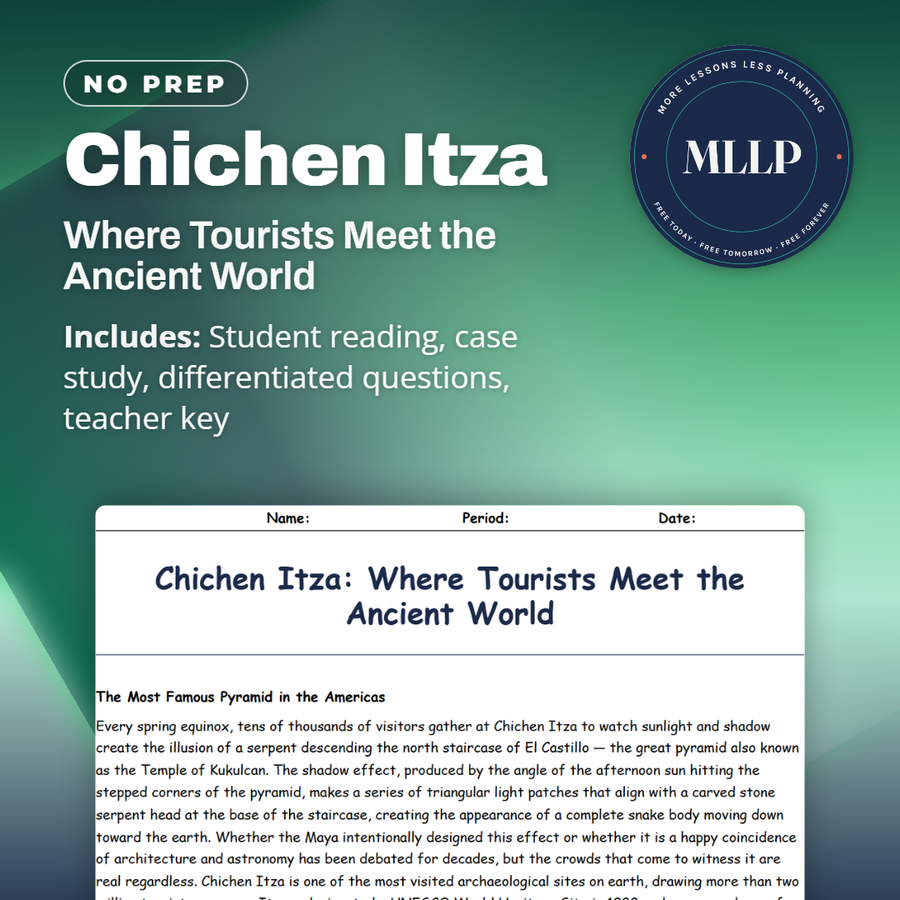
Chichen Itza: Where Tourists Meet the Ancient World
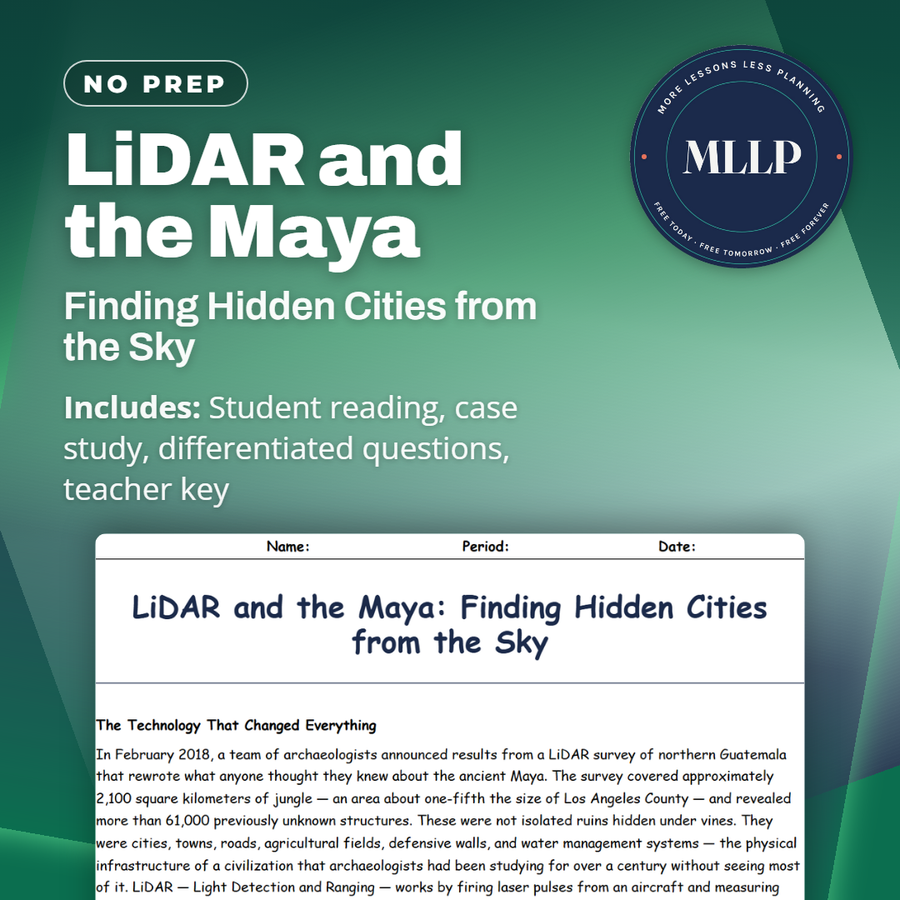
LiDAR and the Maya: Finding Hidden Cities from the Sky
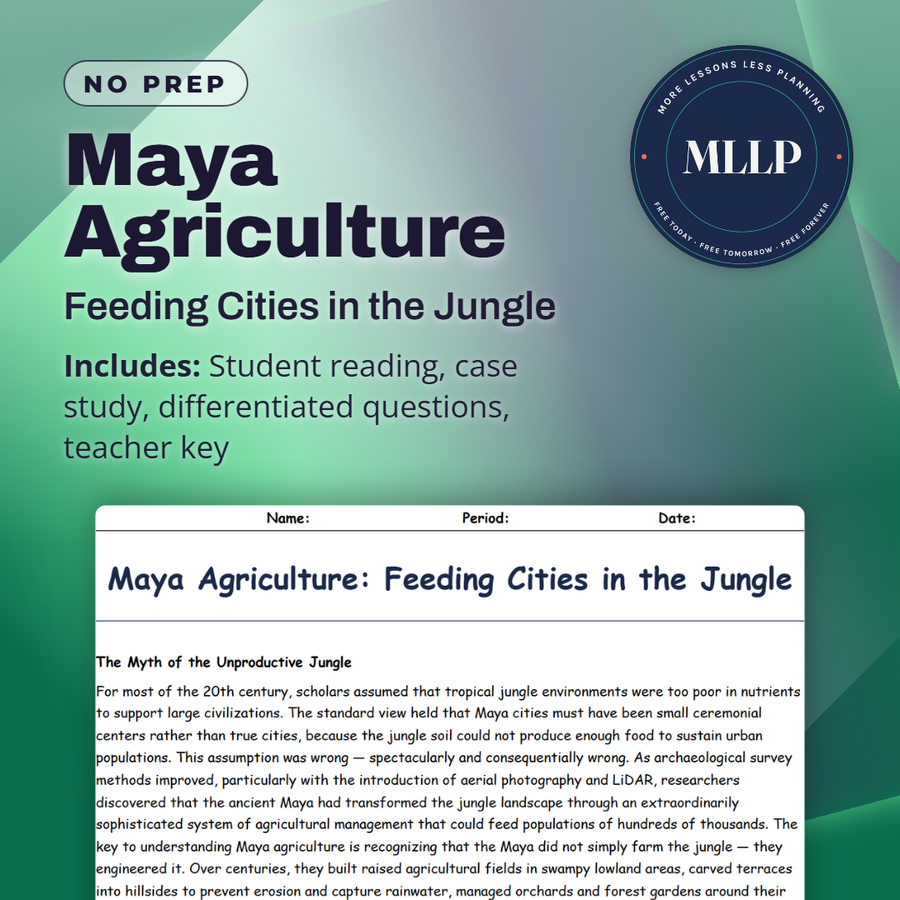
Maya Agriculture: Feeding Cities in the Jungle
Maya Writing: Cracking the Hieroglyphic Code
Palenque and King Pakal: A Royal Tomb Inside a Pyramid
The Maya Collapse: What Really Happened in the 9th Century?
Every lesson on this site is free to download and use. If one of them saved you a prep period, you can chip in a few bucks toward my three kids' daycare fund. That's genuinely where tips go.